
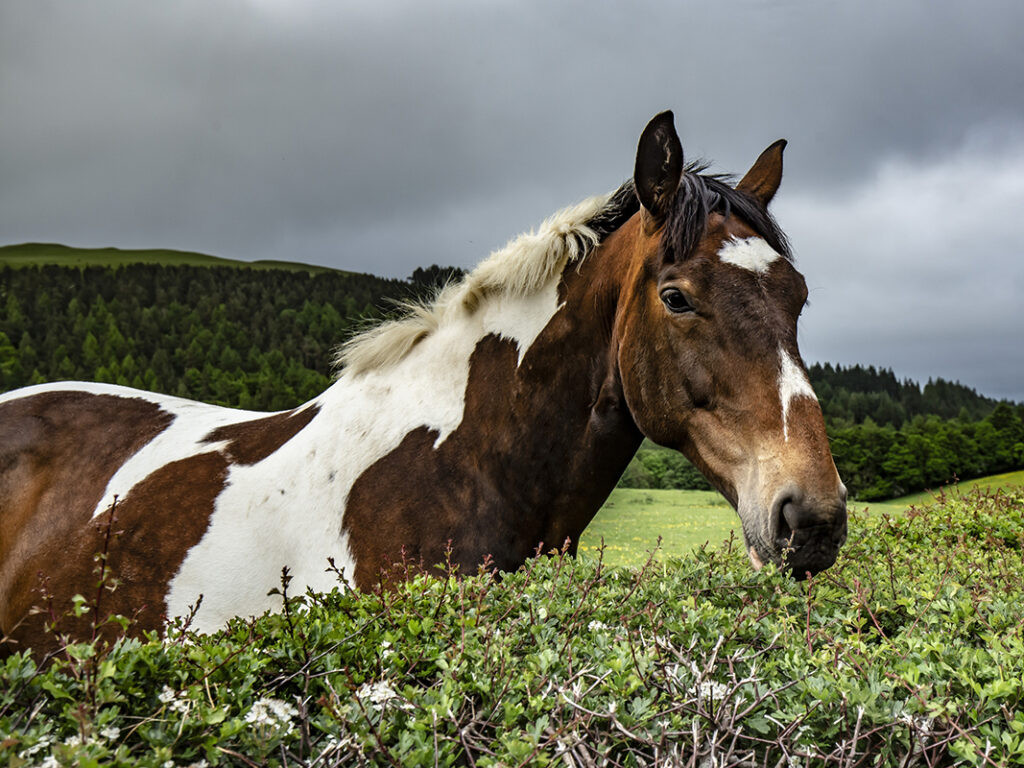
A hedge is something animals eat
Most people choose a hedge by looking at it. If you keep horses, sheep, goats or a dog that chews anything left lying about, it pays to choose by taste instead, because whatever you plant along a paddock or a garden boundary will be browsed, gnawed or swallowed sooner or later. Small children, who put berries in their mouths for much the same reasons as Labradors, belong in the same conversation.
The good news is that the safest hedging plants are also some of the best hedging plants: hawthorn, hornbeam, beech, hazel and field maple have lined British fields for centuries and do the job better than most of the glossy evergreens that cause the trouble. The plants to avoid are a short, specific list. Learn it once and you can plant with confidence.
Nothing here replaces your vet. If you think an animal has eaten something poisonous, ring them straight away and take a sample of the plant with you.
Hedging poisonous to horses and livestock
Yew is the one to fear. A mouthful of yew foliage can kill a horse within hours, and it is just as deadly to cattle, sheep and goats; there is no antidote, and animals are usually found dead rather than ill. Clippings are worse than the living hedge, because wilted yew stays toxic and is more palatable. Never plant yew where stock can reach it, and never tip yew trimmings over a fence.
The rest of the list, roughly in order of how much trouble they cause:
- Laurels (cherry laurel and Portugal laurel). The leaves release cyanide when chewed, and wilted leaves are more dangerous than fresh ones. Photinia ‘Red Robin’ belongs to the same family and carries the same risk.
- Privet. All parts are toxic to horses and livestock, causing colic and, in quantity, worse.
- Box. Bitter enough that most horses leave it alone, but toxic if eaten, and clippings change that calculation.
- Rhododendron and pieris. Particularly dangerous to sheep and goats, who will browse them; a few leaves can make a goat seriously ill.
- Laburnum. Seeds, pods and bark are all poisonous. Not a hedging plant, but often planted near one.
- Oak. Acorns and young leaves cause kidney damage in horses and cattle, worst in heavy acorn years. Oak in a field boundary is fine with fencing or an autumn sweep.
- Sycamore. The seeds and spring seedlings carry hypoglycin A, the toxin behind atypical myopathy, a muscle disease that kills most horses it affects. Around three-quarters of cases come in autumn, so October is the month to check your boundaries. Field maple and Norway maple don’t contain the toxin, and Dutch research tested hundreds of samples to prove it (Utrecht University).
- Elder. Leaves, bark and unripe berries contain cyanogenic compounds. Horses rarely bother with it, but it shouldn’t be the backbone of a paddock hedge.
The hedge bottom matters too. Ragwort, foxglove, deadly nightshade, woody nightshade and bracken all colonise neglected hedgerows, and an otherwise safe hawthorn hedge with ragwort at its foot is not a safe hedge. Walk the line twice a year.
Hedging poisonous to dogs and cats
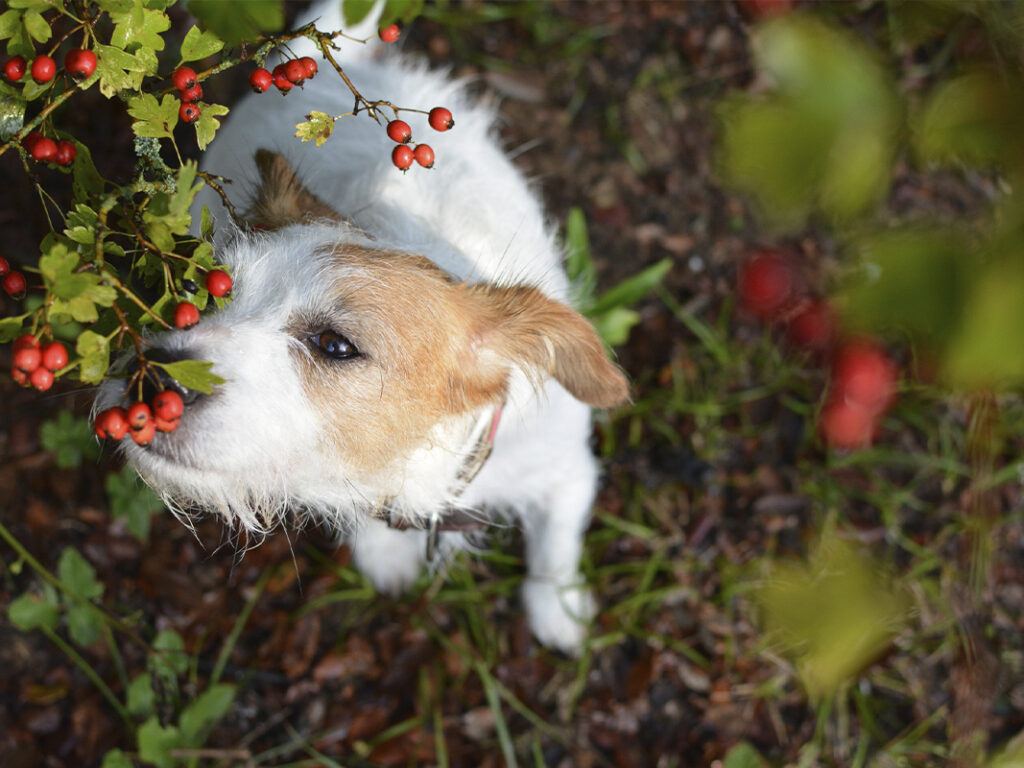
Dogs rarely eat hedges; they eat what falls off them. The risk is berries, seeds, nuts and prunings, and puppies are the ones that find them. Cats are fussier and seldom chew woody plants, so the list below is mostly about dogs.
- Yew. Toxic to dogs as to everything else; the seeds inside the red berries are the danger.
- Laurel. Leaves and seeds. A dog that chews a cherry laurel stem in boredom can be poisoned.
- Holly. The berries cause vomiting and diarrhoea rather than anything worse, but a dog that eats a lot will be miserable.
- Privet and box. Gastric upset, more serious in quantity.
- Ivy. Leaves and berries irritate the mouth and gut.
- Cotoneaster and pyracantha. Mildly toxic berries; trouble only for dogs that eat them by the handful.
- Oak and horse chestnut. Not hedges, but acorns and conkers in a hedge line are a common cause of blockages and poisoning in autumn.
If you have a dog that chews, the simplest answer is a deciduous native hedge: hornbeam, beech, field maple or hawthorn. None of them is toxic, and none drops anything a dog wants to eat.
Safe hedging for horses, ponies and livestock
A mixed native hedge is the right answer for almost every paddock. Mixing species means no single plant dominates the diet, the hedge recovers from browsing unevenly rather than all at once, and it feeds far more wildlife than a single-species line. A sound paddock mix is roughly 60% hawthorn, with the rest made up from the plants below.
- Hawthorn. The backbone of the British field hedge for good reason. Horses browse it without harm, it regrows hard after nibbling, and the thorns make it stock-proof once established.
- Hornbeam. Dense, tolerant of heavy clay and wet ground, and holds its dead leaves through winter, which gives a paddock useful shelter.
- Field maple. Safe for horses, unlike its cousin the sycamore, and quick to thicken. Lovely butter-yellow in autumn.
- Hazel. Horses enjoy it, it coppices back after damage, and it gives you pea sticks and bean poles.
- Beech. Safe in leaf and a fine windbreak. In a heavy mast year, keep greedy ponies away from piles of fallen beech nuts.
- Dog rose. Scrambles through the hedge, flowers in June and feeds birds with its hips all winter.
- Willow. Horses love browsing it, and it thrives in wet corners where little else will.
- Crab apple. Safe as part of a mix; just don’t let a pony gorge on windfalls, which brings colic.
For goats, assume they will eat all of it. A goat-proof hedge is a hedge behind a fence.
Child-friendly hedging: no poisonous berries, no thorns
A garden for small children needs a hedge that fails two tests: nothing poisonous to pick, and nothing to scratch a child who runs into it chasing a ball. Hawthorn, blackthorn, holly, pyracantha and berberis all fail the second test. The berried evergreens fail the first.
The plants that pass both:
- Hornbeam. Soft, thornless, no berries worth the name. Probably the best all-round family hedge in Britain.
- Beech. As soft as hornbeam, and the copper-brown leaves it holds through winter make a fine den wall. Prefers well-drained soil; on heavy clay, plant hornbeam instead.
- Field maple. Thornless, fast, and its winged seeds make good helicopters.
- Griselinia. A bright apple-green evergreen for mild and coastal gardens, smooth-leaved and berry-free in practice.
- Escallonia. Evergreen, thornless and flowering from June, with bees all over it. Good near the sea.
- Elaeagnus × ebbingei. Evergreen and tough, with small silvery fruits in spring that are edible, if not exciting.
Hedges children can eat
An edible hedge turns the rule around. Hazel gives cobnuts (though whole nuts are a choking risk for under-fives). Fuchsia magellanica makes a thornless hedge in milder counties, and its berries are edible. Cornelian cherry (Cornus mas) carries sharp red fruits in late summer. Blackcurrants can be grown as a low informal hedge. Teaching children which hedge fruits are safe is half the point.
Berries to keep out of a family garden
Yew, spindle (whose pink and orange fruits look made to be eaten), laburnum, privet, holly, cotoneaster, guelder rose, Lonicera nitida, daphne and Viburnum tinus. Few of these are fatal in the quantities a child is likely to eat, but none is worth the trip to A&E. Also watch for lords-and-ladies and woody nightshade turning up uninvited at the hedge bottom.
When thorns are the point
The thorns that make hawthorn wrong for a toddler’s garden make it right for a field boundary. A well-laid hawthorn hedge keeps sheep in and deer out, and does it for a century without a fence post to replace.
- Hawthorn is the first choice for a stock-proof hedge: fast, cheap, and thick enough after five or six years to turn cattle.
- Blackthorn is tougher still and suckers to fill gaps, but its punctures are notorious for going septic in people and horses alike. Keep it to the outside of a boundary, away from gateways and paths where horses are led.
- Holly and Rosa rugosa make dense, prickly barriers for keeping dogs in, or keeping other people’s dogs out. Rugosa does well on sandy soils and by the sea.
One caution for sheep owners: brambles and dog rose in a hedge can snag fleece, and a heavy ewe caught in a bramble can’t always free herself. Keep the bramble out of a sheep hedge.
Other things worth knowing
Protect a new hedge from the animals it’s for. Even safe hedging won’t survive being eaten to the ground in its first three years. Run a stock fence about 1m (3ft) out from the hedge line, or two fences for a double-sided field hedge, and use rabbit guards on bare-root whips.
Clippings are the hidden danger. Plenty of animals poisoned by yew, laurel or privet never touched the hedge; someone tipped the trimmings into the field. Wilted leaves are often more toxic and more palatable than fresh ones. Bag them or burn them.
Check what grows next door. A safe hedge on your side counts for little if a neighbour’s yew or laurel leans over the fence. Walk the boundary, and talk to them before you need to.
Shelter matters as much as safety. A thick hedge on the windward side of a field cuts wind chill for horses and lambing ewes. Beech and hornbeam, which hold their dead leaves, give the best winter shelter of any deciduous hedge.
Chickens, rabbits and guinea pigs. Hawthorn, hazel and willow leaves are all safe browse for small pets and poultry. A hazel or hawthorn hedge around a run gives hens shade in summer and cover from buzzards.
Dogs and evergreens. Dog urine scorches box, yew and conifers at the base, which is another reason to prefer a deciduous hedge along a route your dog patrols.
Mind the nesting season. Avoid cutting between March and August, when birds are nesting; disturbing an active nest is an offence under the Wildlife and Countryside Act 1981, and in England farm hedgerows have their own cutting rules. A mixed native hedge will be full of nests by May.
Plant bare-root, in winter. Bare-root hedging (dug from the field while dormant, with no pot or compost) is planted from November to March, costs a fraction of potted plants, and establishes better. If you are planning a paddock hedge, now is the time to order.
Quick reference
| Hedge plant | Horses and livestock | Dogs | Children | Thorny |
|---|---|---|---|---|
| Hornbeam | Safe | Safe | Safe | No |
| Beech | Safe (watch heavy mast years) | Safe | Safe | No |
| Field maple | Safe | Safe | Safe | No |
| Hazel | Safe | Safe | Safe (nuts a choking risk for under-fives) | No |
| Hawthorn | Safe | Safe | Safe to eat, scratchy | Yes |
| Blackthorn | Safe to browse, thorns go septic | Safe | Scratchy | Yes |
| Dog rose | Safe | Safe | Scratchy | Yes |
| Griselinia | Safe | Safe | Safe | No |
| Escallonia | Safe | Safe | Safe | No |
| Holly | Mildly toxic | Berries toxic | Berries toxic | Yes |
| Privet | Toxic | Toxic | Berries toxic | No |
| Box | Toxic | Toxic | Toxic | No |
| Laurel (cherry, Portugal) | Toxic | Toxic | Toxic | No |
| Yew | Deadly | Deadly | Deadly | No |
FAQs
Is yew poisonous to horses? Yes, and fatally so: a small amount of foliage can kill a horse within hours. Keep yew and its clippings well out of reach.
Is laurel poisonous to dogs? Yes. Cherry laurel and Portugal laurel leaves and seeds release cyanide when chewed.
Is field maple safe for horses? Yes. Unlike sycamore, field maple does not contain hypoglycin A, the toxin that causes atypical myopathy.
What is the best hedge to plant around a paddock? A mixed native hedge based on hawthorn, with hornbeam, field maple and hazel, behind a stock fence for the first few years.
What is the best thornless hedge for a family garden? Hornbeam, or beech on well-drained soil. Both are soft, safe and hold their leaves through winter.

Leave a Reply