
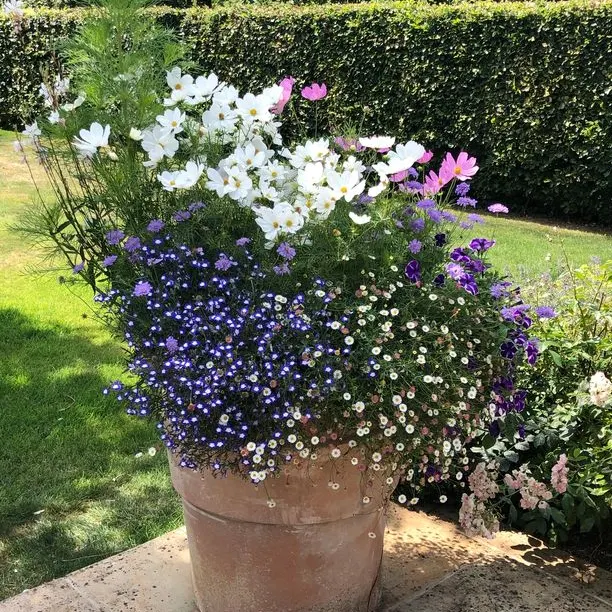
Cosmos grow exceptionally well in containers. Use a loam-based compost (John Innes No. 3 mixed with multipurpose), choose compact varieties like the Sonata series or Xanthos for the best results, and feed fortnightly with half-strength tomato fertiliser once buds appear — the one exception to the “don’t feed cosmos” rule. A 30-centimetre pot holds three to five plugs and will flower from late June until the first frost. This guide covers variety selection, pot sizes, compost, feeding, watering, and four planting schemes with companion plants.
Growing cosmos in Pots
A pot of cosmos on a sunny patio is one of the simplest and longest-running summer displays you can create. Three or four plugs in a decent container will give you flowers from June/July until the first frost; months of colour from a couple of square feet of terrace. I think they are slightly better in pots than most bedding because the things that make other plants difficult (rich compost, constant feeding, fussy watering) are exactly what cosmos don’t want. Less work, more flowers. The cosmos bargain, with provisos, applies in containers just as it does in the ground.
This guide covers everything you need to know about growing cosmos in containers: varieties, pots, compost, feeding, watering, and what to plant with them. For general cosmos advice and the “don’t feed them” rule (which applies less in containers), see our main how to grow cosmos guide. If you’re looking to branch out and choose varieties for your own schemes, browse our list of cosmos seedlings.
Which cosmos Varieties Grow Best in Pots?
Not all cosmos are equal in a container. The compact ones are genuinely good; easy, productive, and proportionate to the pot. The tall varieties can work, but they need bigger containers, support, and more vigilant watering. The very tallest are better in the ground.
The best choices: The Sonata series, Sonata Pink, Sonata White, and Sonata Carmine, stay around 50–60cm and produce flowers in proportion to their size. They don’t need staking, they don’t blow over, and they look right in a pot. Xanthos is another excellent choice; similar height, unusual butter-yellow flowers, and neat enough for a window box. Antiquity works well too; compact, early, with flowers that change from crimson to salmon-pink as they age.
Possible with caveats: Mid-height varieties like Velouette (60–100cm), the Double Click series (90–120cm), and Apricotta (80–100cm) will grow in large containers (10 litres or more) but they need staking and more attentive watering. If you have a large, sheltered patio and a big pot, they can look spectacular. They are more work than the compact types.
Not ideal in anything other than the largest freestanding pots: Candy Stripe and Dazzler can reach 150cm with soft, floppy stems. In a round pot on a balcony or exposed terrace, they catch the wind and either snap or blow the whole container over. The exceptions are a long trough or window box against a wall, where the wall provides shelter and support or in really dramatic, large terracotta pots in a sheltered area. My very clever cousin, Catherine grows huge cosmos in one-metre-tall pots with Stipa gigantea grass around her swimming pool. Candy Stripe in a south-facing trough works well (see the planting schemes below). But other than in whopper pots, grow these in the ground.
Choosing the Right Pot for cosmos
Bigger is better, but cosmos are less demanding than many container plants. They come from a dry country and therefore have deeper roots than people expect. So don’t use shallow containers, but a standard pot with 30cm of depth is fine.
Good: 30cm diameter, 30cm deep. This holds three to five compact plugs and enough compost to get through a hot week without you watering twice a day. For the Sonata series and Xanthos, this is perfectly adequate.
Better: 40cm or more across and correspondingly deeper. Room for a bigger display; eight to ten plants create that billowing, abundant look. A larger pot also holds more moisture, which means less watering on those days when you’d rather be drinking Pimm’s.
Best: For taller varieties you need a big, heavy pot, and perhaps 60cm deep. It needs enough weight at the base to stay upright when the plant is in full sail. Terracotta and stone are more stable than plastic for this reason, though they dry out faster.
Drainage holes are essential. Cosmos hate waterlogged roots. Put a layer of broken crocks, gravel, or small stones over the drainage holes before adding compost. This stops the holes blocking up and lets water escape freely. If your favourite pot doesn’t have holes, drill some. Sitting in soggy compost for even a couple of days will rot the roots.
Material matters less than you’d think. Plastic, terracotta, stone, galvanised metal, wooden troughs; they all work. Plastic holds moisture longest. Terracotta dries out fastest but is my favourite because it just looks. So. Good. Metal containers can overheat in direct sun, cooking the roots; if you use a galvanised planter, stand it where it gets some shade at the base, or line the inside walls with bubble wrap as insulation.
How Many cosmos Plants Per Pot?
More than you might think as cosmos in containers support each other. Also the display looks more impressive when the pot is full from the start. A sparse planting leaves gaps that take weeks to fill. You can get away with this because of our instructions on compost and feeding (see below).
| Pot diameter | Compact varieties | Taller varieties |
|---|---|---|
| 30cm | 3–5 plugs | 2–3 plugs |
| 40cm | 7–9 plugs | 4–5 plugs |
| 50cm+ | 10–12 plugs | 6–8 plugs |
These are starting points, not hard rules. If you want the pot to look full from day one, plant at the higher end of the range. The plants compete a little for moisture but cosmos tolerate close quarters well and the mutual support actually reduces the need for staking.
What Compost to Use for cosmos in Pots
Use a loam-based compost. We think John Innes No. 3 is ideal, mixed roughly half-and-half with the cheapest peat-free multipurpose compost. This gives you the best of both worlds: the loam holds moisture and adds ballast (important when a top-heavy cosmos is trying to blow a terracotta pot off the patio). The multipurpose keeps the mix open and moisture retentive but free-draining. Pure multipurpose is really hard to wet again if it dries out but the loam fixes that.
In the ground, you don’t feed cosmos. In pots, because the supply of nutrient is limited it is necessary. This is the other reason for the compost mix. The multi-purpose releases nutrients very early while John Innes No. 3 has very slow release fertiliser to help provide a steady stream of nourishment through the summer. Even with that, it may be necessary to provide a liquid feed after the first few weeks of growth. We suggest using tomato fertiliser at half strength, but comfrey tea will do as well. This is more similar to what you’d do for sweet peas or dahlias in pots, where you’d load the compost with richness from the start. Cosmos don’t need too much food, but they will starve without any.
Planting cosmos in Containers
Fill the pot to within 2–3cm of the rim. This gap gives you room to water without compost slopping over the edge. If you’re growing a taller variety, push your support stakes or canes into the compost now, before planting. As we keep saying in the main guide: supports go in at planting time, not after.
Water the plugs thoroughly in their tray before planting. A well-hydrated rootball settles in faster than a dry one. Make a hole just deep enough to bury the plug, firm gently, and space the plants evenly across the pot. Water the whole pot deeply once everything is planted. Not a light sprinkle; a proper soak until water runs from the drainage holes.
When to plant: After the last frost, just like open ground. However, if you have an unheated greenhouse or conservatory, you can cheat by planting and holding the cosmos indoors in a frost-free place until it’s safe to put them outside. Otherwise it is mid to late May for most of southern England; early June further north or in exposed spots. Don’t be tempted to get pots out early. A single late frost kills cosmos outright, and a pot on a patio has less thermal mass than garden soil, so it actually offers less protection, not more.
Slug protection: Young cosmos are just as vulnerable to slugs in pots as in the ground. Caviare for slugs, as we said in the main guide. Copper tape around the rim of the pot works well, or use a few organic slug pellets on the compost surface for the first three or four weeks. After that, the stems harden and slugs lose interest.
Where to Put Your cosmos Pot
Full sun. Cosmos in containers need every hour of sunlight they can get. A south-facing patio, balcony, or doorstep is ideal. West-facing works well too. East-facing is acceptable if there is some south in it and the pot gets sun from morning into early afternoon. North-facing is a waste of time and compost so don’t bother.
Shelter from strong wind matters more in pots than in the ground. A metre-tall cosmos in a 30cm pot is a sail on a stick. Wind dries out the compost, shreds open flowers, and can blow the whole thing over. A wall or fence behind the pot helps enormously: reflected warmth, wind protection, and something to lean a taller plant against if needed.
Watering pot-grown cosmos
This is another area where pot culture differs from growing in the ground. In your garden, established cosmos are genuinely drought-tolerant. You can forget about them for a week and they’ll be fine. In a pot, they are greedy drinkers once they get going, and they depend on you (or your watering system).
That said, they are less demanding in containers than sweet peas or dahlias. They tolerate a bit of drying out between waterings without immediately going to seed. The goal here is consistent moisture, not permanent sogginess.
For the first two or three weeks after planting: Check daily and water when the top couple of centimetres of compost feel dry. In cool weather, that might be every other day. In a warm spell, daily.
Once established (second half of June onwards): Check daily. In hot weather, water every morning. In a real heatwave, give them another drink in the evening too. Push a finger into the compost: if it’s dry below the surface, give them a thorough soaking.
Signs of underwatering: Wilting during the hottest part of the day is normal and the plant recovers by evening. Wilting that persists into the cool of the evening, or leaves that feel papery rather than just droopy, means the pot has dried out properly. Sit it in a tray of water for an hour to rehydrate the compost from below.
Don’t leave pots standing in water permanently. Saucers are fine to catch overflow, but empty them after an hour. Waterlogged roots rot quickly. These are Mexican plants that evolved in free-draining ground.
Feeding cosmos in Containers
This is the one situation where cosmos do need feeding. In the ground, you don’t feed them as the soil provides everything and nitrogen makes them leafy. But pots contain a limited volume of compost, and over a four-month flowering season the nutrients run out. Without a top-up, flowering tails off in August.
What to use: A high-potash liquid feed. Tomato fertiliser (Tomorite is the one most people reach for) or home-made comfrey tea if you have it. Potassium drives flower production; nitrogen drives leaf growth. Cosmos want the potassium.
When to start: When the first flower buds appear, usually early July.
How often: Every fortnight through the flowering season.
How much: Half the strength recommended on the bottle. My experience is that cosmos in pots flower better on light rations. However, they are very responsive, and you can change the strength of the feed depending on their performance.
When to stop: Late September, or when flowering slows to a trickle. There’s no point feeding a plant that’s winding down.
If you start getting lots of leaf and few flowers, stop feeding altogether for a couple of weeks. Let the plants use up the nitrogen. This is the most common container cosmos problem, and the fix is counterintuitive: do less, not more.
Supporting cosmos in Containers
Compact varieties, the Sonata series and other small cosmos such as Xanthos, and Antiquity, rarely need support in a pot, especially if you’ve planted them densely enough to hold each other up. In a sheltered spot, leave them to it.
Taller varieties in pots do need help. Push three or four short bamboo canes into the compost around the edge of the pot at planting time. Wrap twine between them at 20cm intervals as the plants grow. This creates a support cradle that the cosmos lean into rather than flop out of. Hazel twigs pushed into the compost early on work just as well and look more natural.
Whatever method you choose, get the supports in at planting time. Pushing canes into an established root system in a pot damages the plant, and by then the stems have already decided which way to grow.
Planting Partners for cosmos in Containers
A pot of cosmos on its own is lovely. A pot of cosmos with a few well-chosen companions is better; the contrast in foliage, colour, and form turns a single-species display into something that looks designed rather than just planted.
The companions need to share cosmos’s preferences: full sun, free-draining compost, and no heavy feeding. That rules out hungry bedding like petunias and fuchsias, but leaves plenty of good options. Here are four schemes we like, each for a different pot size and setting.
Four cosmos Container Schemes
1. Large pot (45–50cm). Sunny doorstep or patio focal point
Sensation Purity (white, tall) as the central plant, underplanted with Verbena rigida (low, spreading purple) as the filler, and Helichrysum petiolare (silver trailing) spilling over the edge. The white cosmos catches the light against the verbena’s intensity, and the silver helichrysum ties them together. This has a bit of a Christopher Lloyd feel; it has that contrast of cool white and hot purple he loved at Great Dixter. Needs a deep, heavy pot with good drainage.
2. Medium pot (30–35cm). Sunny table or low wall
Sonata Pink (compact, around 50cm) with Calibrachoa in a deep burgundy trailing over the rim, and a single upright dwarf Pennisetum for movement. The Sonata series is the one to use in smaller containers; the full-height varieties look leggy and top-heavy at this scale. The grass picks up any breeze and gives the whole thing life.
3. Large trough or window box. South or west-facing wall
Candy Stripe (white flushed crimson) alternating with Salvia ‘Love and Wishes’ (deep magenta-purple) as the uprights, with Nemesia ‘Wisley Vanilla’ threading through the front. The stripe in the cosmos petals echoes the salvia’s tones without matching them exactly; it’s that “bridesmaid and gatecrasher” idea Sarah Raven talks about. The nemesia keeps flowering hard and adds scent at nose height if the box is wall-mounted.
4. Small pot (20–25cm). Sunny garden table or step
A single Xanthos (the pale yellow dwarf) with nothing but a low collar of bronze-leaved Heuchera ‘Marmalade’ at its feet. Sometimes one pot, one idea, done simply, is more effective than a complicated scheme. Xanthos is unusual enough to draw people in, and the warm bronze foliage underneath gives it a base that stops it looking sparse. This works well as part of a group with the larger pots above.
What to avoid in shared pots: Anything that needs rich, moist soil (busy lizzies, hostas, hydrangeas). Large ornamental grasses such as Stipa tenuissima and gigantea may compete with cosmos and reduce their flowering, but the combination can be stunning.
Deadheading cosmos in Pots
Everything in the main guide about deadheading applies twice over in containers. A pot of cosmos that sets seed stops flowering, and in a container you will see the decline faster than in a border. Pick or snip spent flowers every couple of days. It takes two minutes and it is the single most important thing you can do for continuous flowering. You stop, they stop.
What to Do with cosmos Pots at the End of the Season
After the first frost blackens the foliage, we just empty the whole pot into the compost heap. No heap? Then tip the compost onto your borders and throw away the plants. The compost is useful as a mulch. Wash the pot, and it’s ready for autumn bulbs, wallflowers, winter pansies, or spring-flowering heucheras.
Don’t try to overwinter cosmos. They’re annuals and will die anyway. Fresh plugs next May is the way to go.
Frequently Asked Questions about cosmos in Pots
What Size Pot Do I Need for cosmos?
At least 30cm across for compact varieties like Sonata and Xanthos. A 40cm pot gives a much better display and holds more moisture, meaning less watering in hot weather. For taller varieties, you need at least 40cm and a heavy pot (terracotta or stone) that won’t blow over.
Do I Need to Feed cosmos in Pots?
Container cosmos do need feeding, which is the exception to the “don’t feed cosmos” rule. Use a half-strength high-potash liquid feed (tomato fertiliser works well) every fortnight from when buds first appear. Don’t use a general-purpose feed; the nitrogen produces leaves at the expense of flowers. In the ground, don’t feed at all. See the feeding section above for the full detail.
How Often Should I Water cosmos in Containers?
Check daily from June onwards by pushing a finger into the compost: if it’s dry below the top couple of centimetres, water thoroughly. In hot weather, water every morning; in a heatwave they may need another drink in the evening. Cosmos in pots are more forgiving than sweet peas, but consistent moisture keeps them flowering longer.
Can I Grow Tall cosmos in Pots?
Mid-height varieties like Velouette and the Double Click series work in large pots (10 litres or more) with support. Very tall varieties such as Candy Stripe and Dazzler (up to 150cm) are not ideal because they catch the wind and the soft stems snap easily in a container. Stick with the compact varieties for the best results.
What Should I Plant with cosmos in a Large Container?
Heucheras at the base for foliage contrast, trailing verbena or alyssum to soften the pot rim, and compact lavender for scent. Grasses look fab as well. All share cosmos’s preference for sun and lean compost. Avoid anything that needs rich, moist conditions; it won’t be happy sharing the pot.
What Are the Best Cosmos for Pots?
The Sonata series (Pink, White, Carmine) and Xanthos are the best choices, staying compact at 50–60 centimetres without needing support. Antiquity is another excellent option. Mid-height varieties like Velouette and Double Click work in large pots with staking. Very tall varieties like Candy Stripe and Dazzler are better in the ground.
How Many Cosmos Should I Plant Per Pot?
Three to five compact plugs in a 30-centimetre pot, seven to nine in a 40-centimetre pot, and ten to twelve in a 50-centimetre pot or larger. Plant at the higher end for a full display from day one. Cosmos tolerate close quarters well and the mutual support actually reduces the need for staking.
Do Cosmos Grow Well in Containers?
Very well indeed. Container cosmos are actually easier than many bedding plants because they need less feeding and tolerate drier conditions. The key requirements are full sun, good drainage, loam-based compost, and regular deadheading. Compact varieties in a 30-centimetre pot will flower continuously from late June until the first frost.
Browse our full range of cosmos plug plants, including the compact Sonata series and Xanthos, both ideal for containers.
And if you haven’t read it yet, our main how to grow cosmos guide covers everything else: pinching, deadheading, companion planting in borders, and the month-by-month calendar.
Remember, gardening is fun. So relax, watch your plants grow and enjoy.





Leave a Reply