
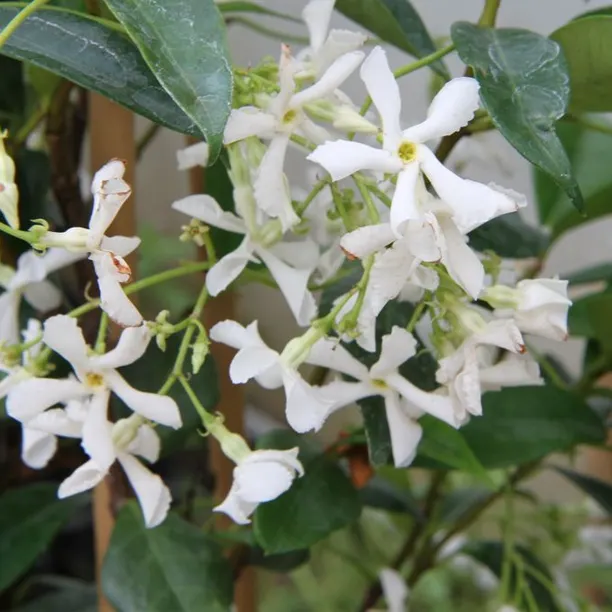
How do you grow jasmine successfully in the UK?
Growing jasmine in the UK is straightforward once you match the right species to your site and climate. Common jasmine (Jasminum officinale), star jasmine (Trachelospermum jasminoides), and winter jasmine (Jasminum nudiflorum) each have distinct needs, flowering seasons, and levels of hardiness — choosing the wrong one for your garden is the most common mistake gardeners make.
Related guides
- Best climbing plants — which climber for walls, fences, scent, shade and screening
- Clematis pruning groups explained — Groups 1, 2 and 3 with variety lists
- Clematis wilt — what it is, how to prevent it, and which varieties resist it
- Do climbing plants damage walls and fences?
- Evergreen climbing plants — year-round cover for walls, fences and screens
What are the three main types of jasmine grown in UK gardens?
The three jasmines you’ll encounter most in British gardens are common jasmine, star jasmine, and winter jasmine — and despite sharing a name, they are quite different plants with different growing requirements.
Understanding these differences saves a great deal of frustration. Star jasmine, for example, is not a true jasmine at all (it belongs to the genus Trachelospermum), yet it is widely sold as jasmine and searches for it dwarf those for the other two species combined. Here is a quick comparison:
| Feature | Common Jasmine (J. officinale) | Star Jasmine (Trachelospermum jasminoides) | Winter Jasmine (J. nudiflorum) |
|---|---|---|---|
| Flower colour | White | White | Yellow |
| Flowering season | June–September | June–August | November–March |
| Scent | Very strong | Strong, vanilla-like | Unscented |
| Evergreen? | Semi-evergreen | Evergreen | Deciduous |
| Hardiness (RHS) | H5 (down to −15°C) | H4 (down to −10°C) | H6 (down to −20°C) |
| Typical height | 4–8 m | 3–5 m | 3–4 m |
| Best aspect | South or west | South or west (sheltered) | Any, including north |
| Self-clinging? | No — needs tying in | No — needs tying in | No — needs tying in |
Browse our full range of jasmine climbing plants and star jasmine to find the right plant for your garden.
Where is the best place to plant jasmine in the UK?
The best position for common jasmine and star jasmine is a sunny, sheltered south- or west-facing wall or fence; winter jasmine is far more tolerant and will thrive even on a cold north-facing wall where little else blooms in January.
All three jasmines need a support structure — whether that is a timber trellis, horizontal wires spaced 30–40 cm apart, or an existing fence panel. None of them are self-clinging: they twine and scramble rather than producing adhesive rootlets. This makes them considerably less likely to damage brickwork than true self-clingers such as ivy, though it does mean more hands-on training in the early years.
Site selection tips by species:
- Common jasmine thrives in full sun but will tolerate partial shade, producing slightly fewer flowers. It needs reasonable shelter from cold winter winds, which can scorch the semi-evergreen foliage.
- Star jasmine (Trachelospermum jasminoides) is the most demanding of a warm, sheltered spot. In Scotland and exposed northern gardens it is best grown in a large container that can be moved under cover in a hard winter, or trained against a house wall that radiates warmth. In southern England and coastal gardens it is reliably hardy outdoors.
- Winter jasmine is unfussy. It is one of the best choices for a north- or east-facing aspect, and its arching stems will cascade attractively over a retaining wall or bank even with no formal training at all.
If you are comparing jasmine with other climbing plants for a fence or wall, our guide to best climbing plants covers a much wider range of options, and our best plants for covering fences collection groups them helpfully by situation.
What soil and planting conditions do jasmines need?
All three jasmines prefer a free-draining, moderately fertile soil; they are surprisingly tolerant of poor conditions but will languish and flower poorly in waterlogged ground.
Plant jasmine in spring or autumn when the soil is moist and workable. Container-grown plants (as supplied by Ashridge) can technically go in at any time of year, but mid-spring is ideal for star jasmine, allowing the roots to establish before their first winter. Follow these steps for any of the three species:
- Dig a hole approximately twice the width of the root ball and the same depth.
- Work in a generous amount of garden compost or well-rotted manure — particularly useful on light, sandy soils.
- Plant at the same depth as the pot, backfill, and firm gently.
- Water thoroughly, then mulch with a 5–7 cm layer of bark or compost, keeping the mulch clear of the stems to avoid rot.
- Fix initial shoots to the support immediately; even a few days of flopping can cause stems to snap in wind.
Spacing: For a continuous screen, plant common jasmine 1.5–2 m apart, star jasmine 1–1.5 m apart (it is slower growing), and winter jasmine 1.5–2 m apart.
How much should you water and feed jasmine?
In the first growing season, water all three jasmines regularly — at least once or twice a week in dry weather — to help roots establish. After that, established plants in the ground need watering only during prolonged drought.
Star jasmine is especially important to water well in its first two summers, as it establishes more slowly than the others. Container-grown star jasmine needs watering year-round, reducing significantly in winter but never allowing the compost to dry out completely.
Feeding guide:
| When | What to apply | Species |
|---|---|---|
| Early spring | General balanced granular fertiliser or well-rotted compost mulch | All three |
| May–July | High-potassium liquid feed (tomato feed works well) every 2–3 weeks to boost flowering | Common and star jasmine |
| Autumn | Mulch only — no feeding, which would push soft growth vulnerable to frost | All three |
Avoid excessive nitrogen, which produces lush leafy growth at the expense of flowers — a common reason why otherwise healthy jasmines fail to bloom freely.
How and when do you prune jasmine?
Pruning method and timing differ significantly between the three species, and getting this wrong is the most common reason gardeners fail to get flowers.
Common jasmine (Jasminum officinale) flowers on growth made in the previous year, so prune immediately after flowering (July–September). Cut back flowered shoots by about one third, removing the oldest, woodiest stems at the base each year to keep the plant open and productive. Do not prune hard in spring, or you will remove the flower buds.
Star jasmine (Trachelospermum jasminoides) also flowers on the previous season’s wood. After flowering in August or September, lightly trim to shape and remove any damaged or overcrowded stems. Star jasmine is slow to fill in and benefits from minimal pruning in its first three years; concentrate on training rather than cutting. In cold areas, resist pruning until spring, so the foliage provides some frost protection.
Winter jasmine (Jasminum nudiflorum) flowers on bare wood from November to March. Prune immediately after flowering — late February to April — cutting back flowered shoots to within two or three buds of the main framework. This is one of the easiest jasmines to maintain: a pair of shears run over the whole plant in late spring tidies it up and promotes a dense flush of next winter’s flowering stems.
| Species | Prune when? | How hard? | Flowers on… |
|---|---|---|---|
| Common jasmine | After flowering, July–Sept | One third; remove old wood from base | Previous year’s growth |
| Star jasmine | After flowering, Aug–Sept | Light trim; minimal in first 3 years | Previous year’s growth |
| Winter jasmine | After flowering, Feb–Apr | Hard — back to 2–3 buds; or shear over | Current season’s new growth |
What is star jasmine (Trachelospermum jasminoides) and how is it different?
Trachelospermum jasminoides — star jasmine — is the most searched-for jasmine in the UK by a wide margin, and its popularity is entirely justified: it is an exceptionally beautiful, fragrant, and year-round-attractive evergreen climber.
Despite the name, star jasmine belongs to the Apocynaceae family (the same family as periwinkle), not the olive family to which true jasmines belong. The confusion is understandable: the flowers are white, star-shaped, intensely fragrant, and appear in midsummer, closely resembling common jasmine in flower if not in leaf.
Key star jasmine facts:
- The glossy, dark green leaves turn bronzy-red in cold winters, providing year-round interest without the plant dropping its leaves entirely.
- The scent is heavier and more vanilla-like than common jasmine — outstanding trained around a doorway, on a pergola, or beneath a window.
- It grows more slowly than common jasmine, gaining roughly 30–60 cm per year once established (less in cool northern gardens).
- Hardy to around −10°C (RHS H4), it survives most UK winters outdoors in southern and central England, but needs protection or siting against a warm wall in colder regions.
- It produces a milky latex sap when cut — wash hands after pruning.
Star jasmine is an outstanding choice for evergreen screening and is listed in our guide to evergreen climbing plants. You can shop our full range at the star jasmine collection.
What pests and problems affect jasmine?
Jasmine is largely trouble-free, but there are a handful of issues worth knowing about so you can act quickly if they arise.
| Problem | Symptoms | Species affected | Action |
|---|---|---|---|
| Aphids | Sticky honeydew; distorted shoot tips | All, especially in spring | Blast off with water; encourage ladybirds; use insecticidal soap if severe |
| Scale insects | Brown waxy bumps on stems; sooty mould | Star jasmine most susceptible | Scrape off by hand; treat with plant oil-based spray in summer |
| Frost damage | Blackened or bleached foliage after cold spell | Star jasmine; common jasmine tips | Wait until spring, then prune out dead material — plants usually recover |
| No flowers | Lush leaves but no blooms | All | Too much nitrogen, wrong pruning time, or too much shade — reassess aspect and feeding |
| Root rot / waterlogging | Wilting despite moist soil; yellowing | All | Improve drainage; do not plant in low-lying areas prone to standing water |
Can you grow jasmine in pots and containers?
Yes — all three jasmines can be grown in containers, and it is a particularly sensible approach for star jasmine in cold or exposed gardens where winter hardiness is marginal.
Use a large container (at least 40–50 cm diameter) with drainage holes and fill with a loam-based compost mixed with horticultural grit at roughly 4:1. Provide a substantial obelisk, trellis panel, or set of bamboo canes as a support. Container-grown jasmine needs:
- Regular watering — containers dry out far faster than open ground; check daily in hot weather.
- Feeding every two weeks from April to August with a balanced liquid fertiliser, switching to a high-potassium feed in June and July to promote flowers.
- Repotting every two to three years into a container one size larger, refreshing the compost at the same time.
- Winter protection for star jasmine in pots: move to a sheltered spot, wrap the pot in fleece or bubble wrap, and if possible bring under glass during hard frosts.
Common jasmine can become quite vigorous in a large pot, so is best pruned hard in summer to keep it in check. Winter jasmine is well-suited to a large pot where its arching stems can cascade over the sides attractively.
How does jasmine compare with other scented climbers?
If you are weighing jasmine against other popular scented climbers — honeysuckle, wisteria, or fragrant clematis — the table below gives an honest comparison to help you decide.
| Climber | Scent | Season | Evergreen? | Difficulty |
|---|---|---|---|---|
| Common jasmine | ★★★★★ | June–Sept | Semi | Easy |
| Star jasmine | ★★★★★ | June–Aug | Yes | Moderate (needs shelter) |
| Winter jasmine | None | Nov–Mar | No | Very easy |
| Honeysuckle | ★★★★☆ | May–Sept | Semi–Yes | Easy |
| Wisteria | ★★★★☆ | May–June | No | Moderate (needs pruning) |
| Fragrant clematis | ★★★☆☆ | Varies | Some | Easy–Moderate |
For a fuller assessment of how these plants compare across a wider range of criteria, see our guide to best climbing plants for walls, fences, scent, shade and screening, or our article on fast-growing climbing plants if coverage speed is your priority.
How do you train jasmine up a wall, fence or pergola?
None of the three jasmine species clings to surfaces unaided, so successful training means providing the right support and directing the stems systematically from the moment of planting.
Supports: For walls, fix horizontal wires at 30–40 cm intervals using vine eyes screwed into the mortar (not the brick face). For fences, a timber trellis panel attached with a 3–5 cm gap between panel and fence improves air circulation and makes tying easier. On a pergola, stems are simply wound around uprights and horizontal beams. For concerns about potential wall damage, our article on whether climbing plants damage walls is worth reading — the short answer is that non-self-clinging plants like jasmine pose very little risk.
Training method:
- From planting, spread stems out in a fan shape rather than letting them twine up each other in a single vertical rope — this produces far better coverage.
- Tie in new growth every two to four weeks during the growing season using soft garden twine in a figure-of-eight to allow movement without chafing.
- For horizontal coverage, gently bend leading stems sideways and tie them in at a slight downward angle — this triggers more lateral, flower-bearing shoots.
- Once the plant is established, remove older, dark brown stems from the base each winter to make room for vigorous new growth from near ground level.
Star jasmine is particularly amenable to being shaped into a neat, formal covering — its slower growth rate means you have more control. Common jasmine is more exuberant and can reach 8 m in a well-chosen site; regular summer tidying is needed to prevent it becoming a tangled mass.
Frequently Asked Questions
Is star jasmine (Trachelospermum jasminoides) hardy in the UK?
Star jasmine is hardy to around −10°C (RHS H4). It survives most UK winters outdoors in southern and central England when planted against a sheltered wall, but may need fleece protection in colder or more exposed northern gardens.
Does jasmine lose its leaves in winter?
Winter jasmine is fully deciduous. Common jasmine is semi-evergreen, often retaining leaves in mild winters but losing them in cold ones. Star jasmine (Trachelospermum jasminoides) is evergreen, keeping its glossy leaves year-round, sometimes with attractive bronze winter tints.
Why is my jasmine not flowering?
The most common causes are pruning at the wrong time (removing next year’s flower buds), too much shade, over-feeding with nitrogen, or the plant being too young. Common and star jasmine need two to three years to establish before flowering freely.
How fast does star jasmine grow?
Star jasmine (Trachelospermum jasminoides) typically grows 30–60 cm per year once established — considerably slower than common jasmine. Expect it to take three to five years to cover a typical fence panel or trellis.
Can jasmine grow in shade?
Winter jasmine tolerates shade and north-facing aspects well. Common jasmine will manage partial shade but flowers less freely. Star jasmine really needs full sun and a sheltered position to perform at its best and flower reliably. See our guide to shade climbers for alternatives.
When should I plant jasmine?
Spring and autumn are ideal for planting jasmine in the ground. Mid-spring is particularly recommended for star jasmine, giving it a full growing season to establish before its first winter. Container-grown plants from Ashridge can be planted any time the ground is workable.
Does jasmine need a lot of watering?
Water regularly in the first growing season, particularly in dry spells. After establishment, in-ground plants need watering only in prolonged drought. Container-grown jasmine needs consistent watering throughout the growing season and occasional watering in winter.
What is the difference between jasmine and star jasmine?
Trachelospermum jasminoides (star jasmine) is not a true jasmine at all, but a separate genus entirely. It is evergreen, slightly slower growing, and hardy to −10°C. True jasmines (Jasminum spp.) are semi-evergreen or deciduous and generally hardier. Both have scented white flowers in summer.
Is jasmine invasive in UK gardens?
Common jasmine can become very vigorous, reaching 8 m, and will spread into surrounding plants if not pruned regularly. It is not considered invasive in a harmful ecological sense in the UK, but it does need active management in small gardens.
Can I grow jasmine on a north-facing wall?
Winter jasmine is one of the very best choices for a north-facing wall and will flower reliably even with very limited light. Common jasmine and star jasmine both need more sun and are not recommended for north-facing aspects. Browse our shade climbers guide for further options.
How do I prune star jasmine without losing flowers?
Prune star jasmine after flowering in August or September, cutting back flowered shoots to a good lateral bud. Avoid pruning in spring, which removes the buds that would otherwise develop into flowers. In cold areas, delay pruning until spring to maintain frost protection from the foliage.
Can jasmine be grown in a pot?
Yes — all three types grow well in large containers (40 cm diameter or more) with loam-based compost and good drainage. Container growing is especially useful for star jasmine in colder regions, as the pot can be moved under cover in severe winters.
Related Products
- Shop All Jasmine
- Star Jasmine (Trachelospermum jasminoides)
- Shop All Climbing Plants
- Best Plants for Covering Fences
- Honeysuckle
- Wisteria
- Clematis
- Passion Flower
Related Articles
- Best climbing plants — which climber for walls, fences, scent, shade and screening
- Evergreen climbing plants — year-round cover for walls, fences and screens
- Fast growing climbing plants — the quickest climbers for cover and screening
- Best climbing plants for shade and north-facing walls
- Do climbing plants damage walls and fences?
- How to grow honeysuckle — planting, training, pruning and scent
- How to grow wisteria — species, pruning, training and getting it to flower
Leave a Reply