
What Are the Best Sweet Pea Supports for UK Gardens?
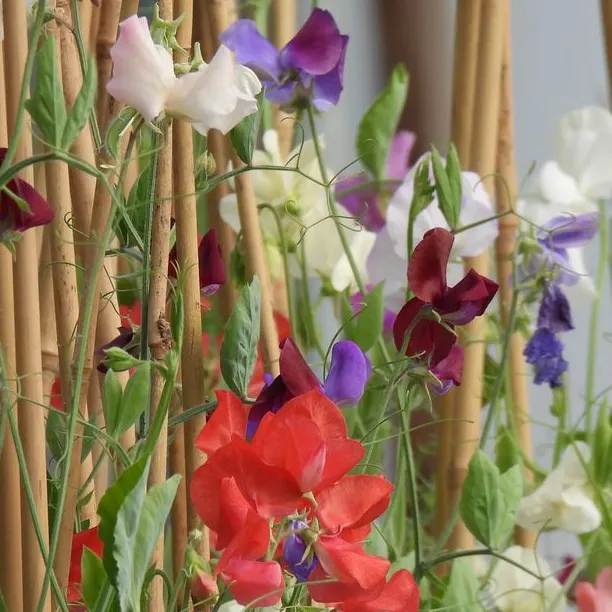
Sweet peas are vigorous climbing annuals that use tendrils to grip almost any nearby structure, but they need a support tall enough (at least 1.8 m) and textured enough for those tendrils to latch onto securely. Choosing the right sweet pea support — and training plants correctly from the outset — is the single biggest factor separating a tangled, disease-prone mess from the tall, floriferous columns of bloom that fill a vase all summer long. This guide covers every support type, how to erect and space them, how to train plants for maximum flowers, and which Ashridge varieties suit each method.
Related guides
Why Does Support Height and Structure Matter So Much for Sweet Peas?
Without adequate support, sweet pea stems flop across one another, air circulation drops sharply, and powdery mildew spreads rapidly through the planting. Good support does three jobs simultaneously: it holds plants upright so every leaf receives light; it spaces stems to allow air movement; and it gives the gardener easy access for picking, which is essential because unpicked pods signal the plant to stop flowering.
Sweet peas grow to very different ultimate heights depending on variety type. Grandiflora and Spencer types — the ones with the finest scent and the largest, most ruffled blooms — typically reach 1.8–2.4 m in a UK season. Intermediate or semi-dwarf types stop at around 90 cm–1.2 m. True dwarf or trailing types (such as those bred for hanging baskets) rarely exceed 45 cm and need only low or no support. Identifying which type you are growing before you buy or erect supports will save wasted effort and materials.
| Sweet Pea Type | Typical Height | Minimum Support Height | Best Support Style |
|---|---|---|---|
| Spencer / Grandiflora | 1.8–2.4 m | 1.8 m | Tall wigwam, single cordon canes, netting |
| Intermediate / semi-dwarf | 90 cm–1.2 m | 1.0 m | Pea sticks, shorter wigwam, trellis panel |
| Dwarf / trailing | Up to 45 cm | 30–45 cm | Short twiggy sticks, container hoops |
What Types of Sweet Pea Support Are Available?
There are five main support systems used by UK gardeners, each with different costs, aesthetics, longevity, and suitability for different garden styles. The best choice depends on whether you are growing for cutting, cottage-garden display, or exhibition.
1. Pea Sticks (Brushwood)
Pea sticks — the branching twiggy shoots of hazel, birch, or silver birch cut in late winter — are the traditional British method and arguably the most garden-friendly. Push them firmly into the ground at 20–30 cm intervals along a row or around a bed and the tendrils find the branching twigs almost immediately. Pea sticks biodegrade at season end, so there is nothing to store or clean, and their natural texture actually grips tendrils better than smooth canes. The limitation is sourcing them: you need access to suitable hedgerow material or a willing supplier. Height rarely exceeds 1.5 m with pea sticks, which is sufficient for most cottage-garden plantings but borderline for top Spencer varieties.
2. Bamboo Cane Wigwams
A wigwam of six to eight 2.1 m canes tied at the top with twine is the most popular sweet pea support for UK kitchen and cottage gardens. It is quick to erect, requires no ground anchoring beyond pushing canes 30 cm into the soil, and creates an attractive centrepiece structure. Wind string or jute twine in horizontal spirals between the canes at 20 cm intervals so tendrils can grip up the full height. Space canes evenly around a circle 60–90 cm in diameter — narrow enough that you can reach the centre for picking, wide enough to accommodate six to eight plants.
3. Single Cordon (Exhibition) Method
The cordon method is used by competitive exhibitors and serious cut-flower growers to produce the longest possible stems with the maximum number of florets per spike. Each plant is trained to a single vertical cane or string, all sideshoots and tendrils are removed as they appear, and the growing tip is directed straight up. Stems longer than 30 cm with five or more florets per stem — the show standard — are only reliably achieved this way. It is labour-intensive (daily attention in peak season) but produces spectacular results with varieties such as Anniversary and Bramdean.
4. Netting and Mesh Panels
Galvanised or plastic-coated wire mesh panels, or purpose-made sweet pea netting with 10–15 cm square apertures, can be stretched between posts to create a long, productive hedge of sweet peas. This suits a cutting garden or kitchen garden where flowers are the priority. Fix the netting between sturdy posts at least 2.1 m tall (allowing for 30 cm in the ground). Jute or coir netting is an eco-friendly option that composts at season end along with the plant stems. For a boundary-hedge effect, a double row of netting panels with plants on each side gives enormous flower volume.
5. Trellis, Obelisks, and Existing Structures
Wooden or metal obelisks, freestanding trellis panels, pergola legs, arch structures, and even established shrubs can all support sweet peas. The main requirement is that the surface provides something tendrils can grip: smooth round metal needs string woven across it, while a rustic hazel or willow obelisk works perfectly without modification. Sweet peas are annual, so there is no risk of the plant eventually overwhelming a permanent structure — they are cleared away each autumn.
How Far Apart Should Sweet Peas Be Planted Against a Support?
For general garden growing, plant one sweet pea per 20–25 cm of linear support, or one per cane on a wigwam structure. For cordon growing, give each plant its own cane spaced 30 cm apart in a row oriented north–south so both faces of the row receive even sunlight.
Planting too densely is one of the most common mistakes: overcrowded plants compete for water and nutrients, and poor air flow accelerates the onset of powdery mildew and botrytis in damp UK summers. If you are using a wigwam, restrict yourself to one plant per cane — the temptation to squeeze in extras is understandable but always regretted by midsummer.
| Support System | Plants per Linear Metre | Plants per Structure |
|---|---|---|
| Wigwam (8 canes, 75 cm dia.) | — | 6–8 |
| Pea sticks / netting row | 4–5 | — |
| Cordon row (single canes) | 3–4 | 1 per cane |
| Obelisk / freestanding trellis | — | 3–5 |
How Do You Train Sweet Peas Up Their Support?
Sweet peas will find vertical supports largely on their own once growth reaches 10–15 cm, but some initial guidance saves time and prevents plants from weaving into each other rather than upwards. Tie the main stem loosely to the first 20–30 cm of its support with soft string or jute twine in a figure-of-eight loop — this protects the stem from chafing. After that, check plants every few days and redirect any stem heading sideways back to its own cane or section of netting.
Stopping or Pinching Out
Pinching out the growing tip when plants have produced two to three pairs of leaves encourages basal sideshoots and ultimately many more flowering stems. This is one of the most important and most overlooked steps in sweet pea growing. Without pinching, a plant typically produces one or two thin main stems; with pinching, you get four to six strong stems from the base, each capable of producing multiple flower spikes over many weeks.
Cordon Training Step by Step
- Select the strongest single shoot from each pinched plant — ideally one from the base.
- Remove all side shoots and tendrils each time you visit (at least twice a week in summer).
- Tie the main stem to its cane every 20–30 cm as it grows, using soft twine or ring ties.
- When the stem reaches the top of its cane (usually mid-July in southern UK), untie the stem carefully, lower it along the ground, and re-tie it to a cane several plants along — this is called “layering” or “dropping” and keeps the productive growing tip within reach for weeks longer.
General Display Training
For wigwam or netting growing (where the goal is a beautiful display rather than exhibition stems), leave three or four sideshoots per plant after pinching. Direct tendrils gently onto the support weekly and remove spent flowers or forming pods daily. The more you pick, the longer the plant flowers — this is non-negotiable if you want continuous colour from June to September.
Which Ashridge Sweet Pea Varieties Suit Which Support Method?
Not all sweet peas behave identically on a support — scent, stem length, vigour, and flowering period all influence the best choice. The following table matches Ashridge varieties to the support method they suit best.
| Variety | Colour | Best Support Method | Notes |
|---|---|---|---|
| Anniversary | Cream / pale pink | Cordon | Long stems, excellent for cutting and showing |
| Bramdean | Deep mauve | Cordon / netting | Strong scent, vigorous climber |
| Albutt Blue | Lavender blue | Wigwam / netting | Heritage grandiflora type, outstanding scent |
| Almost Black | Deep maroon / near black | Wigwam / obelisk | Dramatic colour, cottage-garden display |
| Flora Norton | Cornflower blue | Pea sticks / wigwam | Heritage variety, naturally bushy habit |
| Black Knight | Dark maroon | Wigwam / cordon | Very long stems, superb for cutting |
| Blue Velvet | Rich violet blue | Netting / wigwam | Intense colour and scent, very free-flowering |
| Charlie’s Angel | Pale lavender | Any — very adaptable | Reliable performer on all support types |
| America | Red and white striped | Wigwam / trellis | Heritage bicolour, eye-catching display |
| Ballerina Blue | Soft blue | Cordon / netting | Consistent long-stemmed spikes |
How Do You Erect a Cane Wigwam for Sweet Peas?
A well-built wigwam takes about fifteen minutes to put up and will support six to eight plants through a full UK growing season without collapsing even in a July thunderstorm — provided the canes are long enough and pushed deep enough into the ground.
- Mark a circle 60–80 cm in diameter using a loop of string and a cane as a compass. Smaller than this and plants touch at the base; larger and the wigwam lacks stability.
- Choose canes 2.1–2.4 m long. Once pushed 25–30 cm into the ground, the usable height is 1.8–2.1 m — just right for Spencer types.
- Push canes at an inward angle (roughly 20° from vertical) so they meet near the top. Eight canes spaced evenly around the circle is the most stable configuration.
- Bind the tops together with several tight wraps of garden twine, then tie off securely. A rubber band or cable tie under the twine prevents the bundle from sliding down after rain.
- Wind horizontal twine in spirals between the canes at 20 cm intervals starting from 15 cm above ground level. This gives the tendrils something to grip at every height.
- Optionally weave pea netting between the canes rather than twine — this provides more grip surface and is particularly useful in exposed gardens.
What Are the Most Common Sweet Pea Support Mistakes?
Even experienced gardeners make avoidable errors with sweet pea supports — usually around height, density, or timing of intervention. The following table summarises the most frequent problems and their solutions.
| Mistake | What Happens | Solution |
|---|---|---|
| Canes too short (under 1.5 m) | Plants flop over the top by early July | Always use 2.1 m canes for Spencer types |
| No horizontal string between canes | Stems bunch at cane tips and topple | Add twine spirals every 20 cm before planting |
| Too many plants per cane | Mildew, reduced flowers, tangled stems | One plant per cane, one per 20–25 cm of netting |
| Support erected too late | Young stems damaged when support pushed in | Erect support before or at planting time |
| Smooth-surfaced metal without twine | Tendrils cannot grip, plants slide down | Weave jute twine across metal obelisks |
| Not removing spent flowers | Plants set seed, flowering stops by late June | Pick every 2–3 days throughout summer |
How Do You Stabilise Sweet Pea Supports in Exposed or Windy Gardens?
Sweet peas in full leaf act like a sail in strong wind, and a poorly anchored wigwam or netting row can topple under the weight of a mature, fully clothed plant in late June. In exposed sites, prevention is far easier than damage limitation.
For wigwams: push canes at least 30 cm into the ground, and consider driving a short central stake into the middle of the circle and tying the wigwam crown to it with twine — this prevents the structure from splaying outward in storms. For netting rows: use stout posts (50 mm × 50 mm timber or metal T-bar stakes) at no more than 2 m intervals, and brace the end posts with diagonal stakes driven into the ground at 45°. In coastal or very open gardens, a double row of netting — with plants growing up both faces — is inherently more stable than a single row because the plants themselves act as mutual wind-breaks as they grow dense.
What Sweet Pea Supports Work in Pots and Containers?
Container-grown sweet peas need a support that can be fixed stably into a relatively small volume of compost without tipping the pot. A central wigwam of three or five canes pushed to the base of a 30–40 cm diameter pot works well — the weight of compost and the spread of the cane base prevents toppling. For a single large specimen pot, a metal or wooden obelisk with legs inserted through the compost to the pot base is the most elegant solution.
Choose more compact varieties for containers — Cathy and Bobby’s Girl are among the best performers where space is limited. For tall Spencer varieties in large pots (40 cm or more), full-height canes are perfectly workable but the pot must be heavy (terracotta rather than plastic) and ideally positioned against a wall or fence that can provide a windbreak.
When Should You Put Up Sweet Pea Supports?
The best time to erect any sweet pea support is before planting — ideally a day or two earlier so the soil settles around cane bases and the structure is stable before plants are introduced. At the very latest, put supports up on planting day; driving canes into the ground after plants are in place risks spearing or tearing roots and young stems.
For autumn-sown sweet peas overwintered in a cold frame, erect permanent outdoor supports in late March or early April when you harden off the young plants, so they are ready the moment you plant out (typically late April after the last hard frost in most UK regions). For spring-sown plants, support should go up in April before outdoor planting in May.
Frequently Asked Questions
How tall should a sweet pea support be?
At least 1.8 m for Spencer and grandiflora varieties, which reach 2.0–2.4 m in a UK summer. Allow for 25–30 cm of cane pushed into the ground, so buy 2.1–2.4 m canes.
Can sweet peas grow up a fence?
Yes, provided the fence has something for tendrils to grip. Attach horizontal wires, netting, or trellis to the fence face at 20 cm intervals and sweet peas will climb it readily throughout the summer.
Do sweet peas need to be tied to their support?
Only the first 20–30 cm of stem needs tying. After that, tendrils grip the support independently. For cordon growing, tie every 20–30 cm throughout the season to keep the stem vertical.
What is the cordon method and is it worth the effort?
Cordon training restricts each plant to one stem, removing all sideshoots and tendrils, to maximise flower-stem length. It is labour-intensive but produces show-quality stems and is worth it for varieties like Anniversary or Bramdean.
Can I reuse canes and supports the following year?
Bamboo canes last two to three seasons if cleaned and stored dry indoors over winter. Metal obelisks and trellis panels last many years. Pea sticks and jute netting compost at the end of the season, so they cannot be reused.
What is the best sweet pea variety for a wigwam display?
Almost Black, Blue Velvet, and America all give a stunning mixed wigwam display. Plant one variety per cane and allow tendrils to intermingle naturally for a cottage-garden effect.
How do I stop my wigwam blowing over?
Push canes at least 30 cm deep, angle them inward, bind the crown tightly, and optionally tie the crown to a central stake. In exposed gardens, add horizontal twine every 15 cm for extra rigidity and wind-resistance.
Should I pinch out sweet peas when I plant them?
Yes. Pinch out the growing tip above the second or third pair of leaves at or just after planting. This stimulates multiple basal stems, each of which will produce multiple flower spikes throughout summer.
Can I grow sweet peas up a tepee of hazel poles?
Absolutely. Hazel poles — ideally with some side twigs left on — are an excellent natural support that tendrils grip without any additional twine. Height to 2.1 m suits all tall varieties, including Brook Hall and Erewhon.
My sweet peas reached the top of their support — what do I do?
For cordon growing, lower the stem along the ground and re-tie it to a cane further along the row. For wigwam or display growing, simply allow the stems to cascade back down over the top — they will continue flowering for several more weeks.
What spacing between wigwams gives the best display?
Place wigwam centres at least 90 cm apart in a border to give each structure room to be viewed and to allow air circulation between plantings. In a formal kitchen garden, 1.2 m centres give a particularly elegant rhythm.
Are there sweet peas that need no support at all?
True dwarf types grown in hanging baskets or as ground cover need only minimal support. However, Ashridge’s range focuses on classic tall Spencer and grandiflora varieties, all of which give the best performance with proper tall supports. Browse the full sweet pea collection for variety details.
Related Products
- Sweet Peas — full collection
- Albutt Blue Sweet Pea
- Almost Black Sweet Pea
- America Sweet Pea
- Anniversary Sweet Pea
- Ballerina Blue Sweet Pea
- Black Knight Sweet Pea
- Blue Velvet Sweet Pea
- Bobby’s Girl Sweet Pea
- Bramdean Sweet Pea
- Bristol Sweet Pea
- Brook Hall Sweet Pea
- Cathy Sweet Pea
- Charlie’s Angel Sweet Pea
- Erewhon Sweet Pea
- Flora Norton Sweet Pea

Leave a Reply