
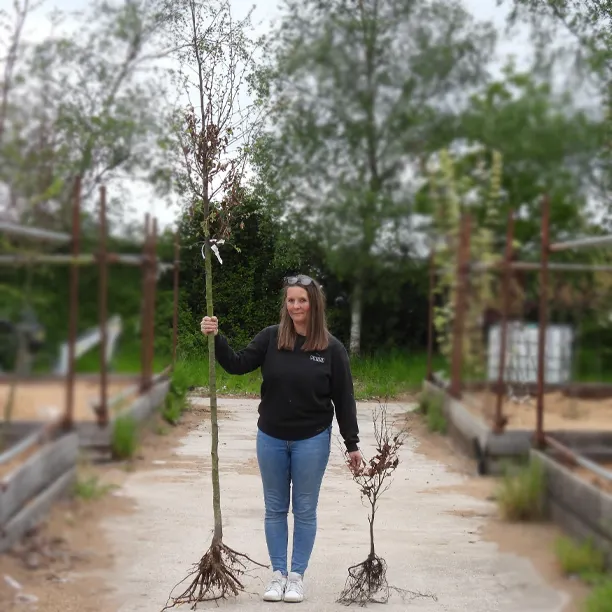
How do you plant a tree correctly so it establishes well?
Planting a tree correctly means digging the right-sized hole, setting the root collar at the correct depth, backfilling without air pockets, and watering thoroughly at the outset. Get those four steps right and almost any healthy young tree will establish quickly; get them wrong and even the finest specimen will struggle for years. This guide takes you through every stage — from choosing the right tree for your site to long-term aftercare.
Related guides
- Best Trees for Small Gardens — Buying Guide
- Best Trees for Autumn Colour
- Flowering Cherry Trees: Best Ornamental Cherries for UK Gardens
How do you choose the right tree for your garden?
Start with your site constraints — ultimate height and spread, soil type, and aspect — rather than with the tree you like the look of. A tree chosen to fit its location will outlive and outperform one forced into an unsuitable spot.
Work through the following checklist before buying:
- Space available: Measure the planting area and look up the mature spread of any candidate species. Allow at least half the mature spread as clearance from boundaries, buildings, and underground services.
- Soil: Most trees tolerate a wide pH range, but some are lime-hating (e.g. most Acer species prefer slightly acid to neutral soil). Heavy clay suits moisture-tolerant species; free-draining sandy soils suit Mediterranean and continental trees. See our guide to trees for clay soils.
- Aspect and exposure: South- and west-facing sites warm up quickly; exposed northern gardens need wind-firm, hardy species.
- Purpose: Shade, wildlife value, autumn colour, blossom, screening, or fruit all point to different species.
- Maintenance appetite: Some trees need virtually no pruning; others benefit from an annual tidy.
| Garden size / situation | Recommended category | Example species |
|---|---|---|
| Small urban garden | Small Garden Trees | Rowan, crab apple, ornamental cherry |
| Medium suburban garden | Maple Trees, Cherry Blossom Trees | Field maple, ornamental prunus |
| Large garden or paddock | Large Garden & Parkland Trees | Oak, lime, sweet chestnut |
| Wildlife garden | Native British Trees | Hawthorn, alder, silver birch |
| Pots and containers | Small Garden Trees | Japanese maple, dwarf conifers |
| Fast screening or shelter | Fastest Growing Trees | Poplar, alder, willow |
For a deep dive into compact choices, see our Best Trees for Small Gardens buying guide.
Should you buy a bare-root or pot-grown tree?
Bare-root trees are lifted from the field while dormant (November to March), despatched without soil, and are generally better value and easier to establish than pot-grown stock of the same age. Pot-grown trees can be planted year-round but need more diligent watering in their first summer.
| Feature | Bare-root | Pot-grown |
|---|---|---|
| Planting season | Nov–Mar (dormant period) | Year-round (avoid hard frost) |
| Cost | Lower | Higher |
| Root system | Unrestricted, spreads naturally | May be slightly root-bound |
| Establishment speed | Excellent when planted in season | Good with consistent watering |
| Transport weight | Light — easy to handle | Heavy — may need two people |
If you have missed the bare-root window and want to plant in spring or summer, a pot-grown or root-balled specimen from our Big Standard Trees range is the sensible choice. For an instant statement, look at the full Big Standard collection.
When is the best time to plant a tree in the UK?
The ideal planting window in the UK is mid-October to the end of March, when trees are dormant and rain is most reliable. Within that window, aim for late October to November: the soil is still warm enough to encourage a little root growth before winter, giving the tree a head start in spring.
Avoid planting into waterlogged ground or when the soil is frozen solid — roots cannot establish in either condition. If your tree arrives during a cold snap, heel it temporarily into a sheltered corner (roots covered with moist compost or soil) until conditions improve.
Pot-grown trees planted in late spring or summer need watering every five to seven days during dry spells throughout their first growing season — more often on free-draining soils.
What tools and materials do you need before planting?
Gather everything before you start: stopping mid-job to find a forgotten item risks leaving roots exposed. The list is shorter than most people expect.
- Spade and fork
- Tape measure
- Planting stake or stakes (see our guide on how to plant a tree with a stake)
- Tree tie and spacer
- Bucket of water
- Mycorrhizal fungi granules (beneficial but not essential)
- Well-rotted garden compost or composted bark to improve backfill on poor soils
- Mulch (composted bark, wood chip, or leaf mould) — at least a barrowload per tree
- Tree guard or spiral if rabbits, deer, or voles are present
Do not add fertiliser directly into the planting hole. Fresh nutrients can scorch young roots and encourage leafy top growth at the expense of root development in the first year.
How do you plant a tree step by step?
The entire process takes around 30–45 minutes for a standard transplant-sized tree. Follow each step in order — the sequence matters.
- Soak the roots. For bare-root trees, submerge the roots in a bucket of water for 30–60 minutes before planting. For pot-grown trees, water the pot thoroughly and allow it to drain.
- Mark out the hole. The hole should be two to three times the width of the root system and no deeper than the root collar (the point where the roots meet the trunk). A wide, shallow hole is always better than a narrow, deep one.
- Dig the hole. Fork the base and sides of the hole to break up compaction and allow roots to penetrate. If you hit heavy clay or hardpan, break through it.
- Check the depth. Lay a cane across the hole and hold the tree in position. The root collar should sit at or very slightly above ground level — never below it. Planting too deep is the most common cause of poor establishment and eventual death.
- Position the stake. Drive a single stake into the base of the hole at a 45° angle (pointing into the prevailing wind) before lowering the tree in — this avoids driving through the roots. For larger standards, two or three vertical stakes with cross-rail may be needed. Full guidance is in our staking guide.
- Place the tree. For bare-root trees, fan the roots out naturally; remove any circling or kinked roots with clean secateurs. Remove the pot from a container-grown tree and tease out any circling roots.
- Backfill. Replace the excavated soil in layers, firming each layer gently with your heel to eliminate air pockets. On poor soils, mix in up to 25% well-rotted compost. Do not mound soil against the stem.
- Water in. Apply 10–20 litres immediately after planting, even in winter. This settles the soil around the roots rather than relying on rainfall alone.
- Mulch. Spread a 7–10 cm layer of bark or wood-chip mulch in a circle of at least 1 metre diameter, keeping it 10 cm clear of the stem. Mulch suppresses weeds, retains moisture, and moderates soil temperature.
- Attach the tree tie. Secure the trunk to the stake with a proper rubber tree tie and buffer — never wire or nylon string directly against bark. The tie should allow slight movement; a tree that sways a little develops stronger roots and a thicker trunk.
What are the correct planting depths and spacings for common UK trees?
The root collar rule applies to every species, but spacing varies enormously with the eventual size of the tree. The figures below are for single specimen planting; for avenues or groups, seek species-specific advice.
| Species | Mature height (approx.) | Min. clearance from structures | Hole depth |
|---|---|---|---|
| Field Maple | 8–12 m | 5 m | To root collar depth |
| Rowan | 5–8 m | 3 m | To root collar depth |
| Silver Birch | 12–18 m | 6 m | To root collar depth |
| English Oak | 20–30 m | 15 m | To root collar depth |
| Ornamental Cherry | 4–9 m (varies by variety) | 4 m | To root collar depth |
| Crab Apple | 4–8 m | 4 m | To root collar depth |
How do you care for a newly planted tree in its first year?
The first growing season — roughly April to October — is the most critical. The tree’s existing roots cannot yet supply enough water to support rapid leaf growth, so supplementary irrigation and weed suppression are essential.
Watering: In dry spells (less than 20 mm of rain per week), water deeply once a week rather than a little every day. Apply 10–20 litres slowly at the base, allowing it to soak in rather than run off. A leaky watering bag placed around the trunk is the most efficient method for large standards. Continue watering through the first and second summers — a tree is not truly established until it can sustain itself through a dry summer without intervention, which typically takes two to three years for a transplant and up to five years for a large standard.
Mulch replenishment: Top up the mulch ring each spring to maintain a 7–10 cm depth. Remove any weeds that push through; grass and weeds within a metre of the stem compete intensely for water and nutrients.
Staking review: Check ties monthly — they can bite into rapidly thickening bark. Loosen or re-tie as needed. Remove stakes entirely after one to two years; a tree left staked too long develops a weak root plate.
Formative pruning: Minimal pruning in the first year is best. Remove only dead, diseased, or crossing branches in late winter. Do not remove the leader (main upright shoot) unless you want a multi-stemmed form.
Which maple trees are best for UK gardens?
Maples offer spectacular autumn colour, a range of sizes to suit every garden, and generally trouble-free establishment. Our full Maple Trees collection covers everything from compact field maples to large ornamental specimens.
| Variety | Mature height | Key feature | Best for |
|---|---|---|---|
| Field Maple | 8–12 m | Golden autumn colour, native | Wildlife, hedging, medium gardens |
| Crimson Sentry Maple | 8–10 m (narrow) | Deep purple foliage, columnar | Restricted-width sites, avenues |
| Autumn Blaze Maple | 12–15 m | Vivid scarlet autumn colour | Larger gardens, fast establishment |
| Red Maple | 15–20 m | Red flowers in late winter, red autumn | Large gardens, parkland |
| Amur Maple | 4–6 m | Compact, fragrant flowers, fiery autumn | Small gardens, pots |
| Royal Ruby Field Maple | 6–8 m | Deep ruby spring foliage | Medium gardens, colour contrast |
For the best autumn display across the whole garden, pair maples with rowans, hawthorns, and birches — see our guide to trees for autumn colour.
What are the most common tree-planting mistakes and how do you avoid them?
Most newly planted trees that fail do so because of a handful of preventable errors. Knowing them in advance saves time, money, and disappointment.
1. Planting too deep. This is the single most common cause of slow establishment and long-term decline. Burying the root collar starves roots of oxygen and invites collar rot. If in doubt, plant slightly high — the tree will settle.
2. Too small a hole. A cramped hole forces roots to circle, which can eventually girdle and kill the tree. Always excavate at least twice the root spread in diameter.
3. Neglecting watering in the first summer. Even trees planted in winter need supplementary watering through their first dry summer. A newly planted tree is always under greater moisture stress than an established one.
4. Mulch volcanos. Piling mulch up against the bark creates a warm, moist environment that encourages fungal disease and rodent damage. Keep the mulch ring flat and clear of the stem.
5. Leaving stakes on too long. Stakes should stabilise the root ball, not the trunk. Remove them after one to two growing seasons. A trunk that cannot sway slightly will never develop the taper and root anchorage it needs.
6. Choosing the wrong tree for the site. Always check ultimate size, soil preference, and drainage tolerance before purchasing. Our Native British Trees collection includes detailed growing notes for every species.
Which trees suit specific UK garden conditions?
UK gardens present a wide spectrum of conditions — from boggy river-valley soils to dry chalky hillsides and salt-laden coastal sites. Matching tree to conditions dramatically reduces aftercare.
| Condition | Recommended trees | Shop link |
|---|---|---|
| Heavy clay / wet soil | Alder, willow, hawthorn, ash | Alder Trees, Willow Trees |
| Dry, free-draining soil | Field maple, rowan, hawthorn, birch | Maple Trees, Birch Trees |
| Exposed / windy site | Hawthorn, rowan, alder, Scots pine | Hawthorn Trees, Rowan & Whitebeam |
| Chalky / alkaline soil | Beech, whitebeam, field maple, cherry | Beech Trees, Cherry Blossom Trees |
| Small / restricted space | Crab apple, Amur maple, ornamental cherry | Small Garden Trees, Crab Apple Trees |
| Year-round privacy screen | Evergreen oak, holly, yew, Leylandii | Conifers & Evergreens |
If you are gardening on heavy clay, our dedicated article on trees for clay soils gives detailed species-by-species guidance. For container planting, see 15 ideal trees for growing in pots.
Frequently Asked Questions
How deep should the hole be when planting a tree?
The hole should be no deeper than the root collar — the point where roots meet the trunk. Depth matches the root ball; width should be two to three times wider to allow roots to spread naturally.
Can you plant a tree in winter in the UK?
Yes. Winter planting (November–March) is ideal for bare-root trees. The dormant plant suffers minimal transplant shock, and winter rainfall usually provides sufficient moisture during establishment.
How often should you water a newly planted tree?
In dry spells, apply 10–20 litres once a week, slowly, at the base. Maintain this through the first two summers. Do not rely on lawn irrigation — it is rarely deep enough for tree roots.
Should you add fertiliser to the planting hole?
No. Fresh fertiliser in the hole can scorch young roots. Apply a slow-release granular feed to the soil surface in the second spring, once the tree has begun to establish and produce healthy new growth.
How long should a tree stake be left in place?
Remove stakes after one to two growing seasons. Leaving them longer prevents the trunk developing the taper and root anchorage it needs, resulting in a weaker tree long-term.
What is a root collar and why does it matter?
The root collar is the flare at the base of the trunk where stem tissue meets root tissue. Burying it starves roots of oxygen, promotes fungal rot, and is the leading cause of slow decline in newly planted trees.
Can you plant a tree near a house in the UK?
Yes, with care. As a rule, plant no closer than half the tree’s mature height from foundations. On shrinkable clay soils, increase this distance and choose less vigorous species such as Amur Maple or crab apple.
Do you need to water a tree in winter after planting?
Water in thoroughly immediately after planting, then monitor. UK winters usually provide enough rainfall. If a dry, frosty spell extends beyond three weeks, give the tree a slow, deep soak during a mild period.
What is the best mulch for a newly planted tree?
Composted bark, wood chip, or leaf mould all work well. Apply a 7–10 cm layer in at least a 1-metre circle, kept 10 cm away from the stem. Avoid fresh wood chip, which can temporarily lock up soil nitrogen.
Which trees are best for wildlife in a UK garden?
Native species support the most wildlife. Hawthorn, alder, silver birch, and oak all support hundreds of invertebrate species and provide food for birds throughout the year.
What is the fastest-growing tree for a UK garden?
Hybrid poplar, alder, and crack willow are among the fastest, gaining 1–2 metres per year in good conditions. Browse our Fastest Growing Trees collection for the full range with growth rates.
How do you plant a tree in a container?
Choose a pot at least 60 cm wide and deep, with drainage holes. Use a loam-based compost. Plant at the same depth as in the nursery pot, water thoroughly, and feed with slow-release fertiliser each spring. See our guide to trees for growing in pots.
Related Products
- Small Garden Trees
- Native British Trees
- Maple Trees
- Field Maple
- Amur Maple
- Autumn Blaze Maple
- Crimson Sentry Maple
- Red Maple
- Royal Ruby Field Maple
- Crab Apple Trees
- Cherry Blossom Trees
- Fastest Growing Trees
- Big Standard Trees

Leave a Reply