
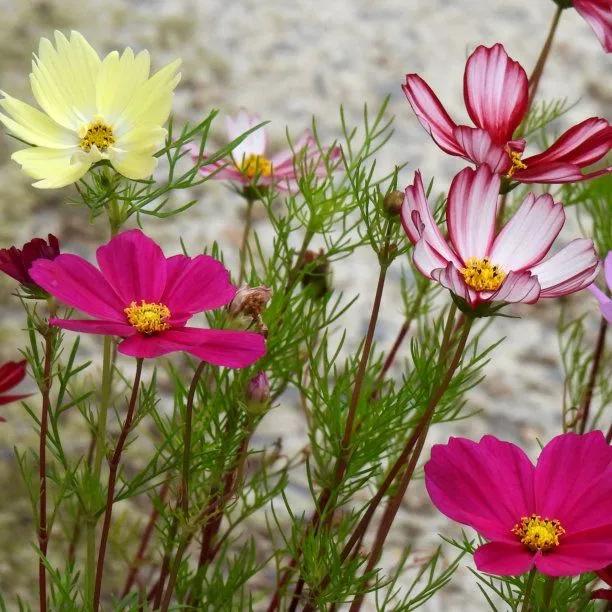
Cosmos (Cosmos bipinnatus) are half-hardy annuals that flower from June to October in UK gardens. Plant hardened-off plugs after the last frost in full sun and poor, well-drained soil. Do not feed them in the ground — lean soil produces more flowers. Pinch out growing tips at 15–20 centimetres for bushy plants with abundant blooms. This guide covers everything from planting and pinching to deadheading, staking, companion planting, and a month-by-month calendar for UK growers.
| Type | Half-hardy annual |
| Height | 50 centimetres (compact) to 150 centimetres (tall) |
| Flowering | Late June to first frost (October–November) |
| Soil | Poor, well-drained — do not improve or feed |
| Sun | Full sun, minimum six hours direct |
| Spacing | 30–45 centimetres apart |
| Container suitable | Yes — compact varieties best. See our growing cosmos in pots guide |
The Ashridge Guide to Growing Cosmos
Cosmos (Cosmos bipinnatus) were the first flowers I remember growing, with my father, when I was about six and nearly seventy years later, I still love them. They are the antidote to “everything I touch dies” being among the easiest and most rewarding flowers you can grow. Plant out our hardened-off plugs after the last frost, give them sun and poor soil (seriously, don’t feed them) and they’ll flower from the end of June into October. Pinch out the tips early for bushy plants covered in blooms, then cut for the vase as often as you like. The more you do, the more they will flower.
This guide covers planting, pinching, deadheading, staking, companion planting, and a month-by-month calendar to keep you on track all summer. And if you’re growing cosmos in pots, which they do very well indeed, you might like our separate guide to growing cosmos in containers. It covers everything specific to pot culture, compost, variety choices, feeding, watering, and which pot to use.
If you’re looking for a specific variety, browse our list of cosmos plug plants. These are hand sown and grown by us and you will get them from May onwards.
What Are the Different Types of Cosmos?
Three species are grown in UK gardens, one very widely and the other two less so. They are very different plants.
Garden Cosmos (Cosmos bipinnatus) is the one most people mean when they say “Cosmos.” Also called Cosmea or Mexican Aster, it’s a half-hardy annual, growing anywhere from 50cm (compact types like the Sonata series and Xanthos) to well over a metre for standard varieties such as Sensation Purity and Apricotta. Flowers come in whites, pinks, crimsons, apricots, and bicolours. You won’t find a blue. The range of flower types varies from simple daisy-like flowers through fully double to some with fluted, shell-shaped petals. What they have in common is they are excellent for cutting.
Sulphur Cosmos (Cosmos sulphureus) is shorter and stockier, with bolder foliage and flowers in warm yellows, oranges, and reds. It likes even more heat than garden Cosmos and is less commonly grown in the UK. For the fun of it we always have some going in a polytunnel here but even in warm(ish) Somerset they struggle outside.
Chocolate Cosmos (Cosmos atrosanguineus) is not an annual at all. This is a tender perennial grown from tubers, more closely related to a dahlia than to the garden Cosmos in this guide. It produces small, dark maroon flowers with an unmistakable chocolate scent, but it needs winter protection and completely different cultivation. We won’t cover it here.
All the Cosmos varieties we sell at Ashridge are C. bipinnatus, and this guide is specific to that species. The growing advice applies to all of them, whether you’re planting a compact Sonata White for a pot or a tall Dazzler for the back of a border.
Where Should I Plant Cosmos?
Full sun is essential. Cosmos need as much direct sunlight as possible so plant them where they can see the sun for at least six hours a day (when it is out). In anything less, they produce plenty of foliage but very few flowers. A south- or west-facing position is ideal.
A sheltered spot helps for the taller varieties. They can reach a metre or more and have soft, herbaceous stems that snap in strong wind. That said, Cosmos also benefit from decent air circulation because stagnant, humid corners encourage powdery mildew later in the season. The perfect position is open to the sun but not in a wind tunnel.
Now for the part that surprises most gardeners: please don’t improve the soil. Cosmos evolved and thrives in the poor, rocky, well-drained soils of Mexico and Central America. So, your immaculately prepared and deeply dug sweet pea or dahlia beds stuffed with compost just won’t do. You will get masses of lush green foliage and a notable absence of flowers. This is the single most common reason Cosmos disappoint.
Plant into your existing soil. Try avoid heavy clay, but if you can’t, fork in some grit or sharp sand to improve drainage. Light and sandy soil is best. We had a building project here a few years ago. There was a heap of builders sand that just sat there and it became home for the poor soil lovers. How the Cosmos got there beats me, but they were of show quality. So don’t dig in compost, don’t add manure, and don’t prepare a trench. The poorer and better-drained the soil, the more flowers you’ll get.
If you grow sweet peas as well, this is the polar opposite of what they want. Here is the practical consequence. Sweet peas fix nitrogen in the soil, enriching it for the next crop. Excellent for cabbages and runner beans; terrible for cosmos. Don’t plant cosmos where sweet peas grew the previous year. The other way around is fine.
How Do I Plant Cosmos Plug Plants?
When to plant: After the last frost. In most of southern England, that means mid-May. The Midlands and sheltered urban gardens can usually plant by late May. Further north, in exposed gardens, or at altitude, wait until early June — and check the forecast. Cosmos are half-hardy annuals and a late frost will kill them outright.
Your seedlings arrive, in plugs which are very easy to handle. We harden them off here and only send them to you when they are ready to plant. No need to acclimatise them to the cold outdoors when you get them. Just plant them straight into the ground or outdoor containers.
Planting Cosmos Seedlings in the Ground
Choose a sunny, well-drained spot. Because they like poor soil, we plant them in the same place every year. Water the plugs thoroughly before planting; it’s so much easier to get water into a rootball before it goes into the ground. Dig a hole just deep enough to let you cover the plug when it is planted. Space plants 30–45cm apart: closer for a fuller, more mutually supportive planting; wider for individual bushier plants with better airflow. Firm the soil gently around the plug and give each plant (another) thorough soaking. Quick sprinkles are for the birds.
Water every few days for the first two to three weeks while the roots establish, assuming it doesn’t rain. You are watering, not drowning. After that, Cosmos in the ground are remarkably drought-tolerant and don’t need watering in a normal UK summer.
Protect against slugs immediately. Young Cosmos are slug caviare. Use whatever method you prefer. Organic slug pellets, beer traps, copper tape, or evening patrols all work, but use your chosen method from planting day. You only need to do this for three or four weeks as the stems become woodier and less caviare-like. But one night without protection at planting time can see a patch of seedlings reduced to stumps.
How Do I Pinch Out Cosmos?
This is one of those gardening jobs that takes almost no time at all and makes an incredible difference to your plants.
Left to its own devices, a Cosmos plant will grow a single tall stem with one flower at the top. It will be lovely, but it’s one flower. So, remove the growing tip early on and the plant branches from below the cut, producing multiple stems that each carry their own flowers. Instead of one bloom, you get a bushy, productive plant covered in them. And the more you pinch, the more flowers you get.
When to pinch: When the plant reaches 15–20cm tall, or when it has developed three pairs of true leaves — whichever comes first. Our plugs arrive at 8–14cm, so let them settle for a week after planting, then pinch once they’ve put on enough growth. Don’t rush it.
How to pinch: Find the growing tip at the top of the main stem. Using your thumb and forefinger or scissors, remove the tip just above a pair of leaves. That’s it.
What happens next: Two or more side shoots develop from the leaf joints below the cut. Each of those shoots eventually carries flowers. The plant becomes bushier, stockier, and dramatically more productive over the season.
The trade-off: Pinched plants start flowering roughly seven to ten days later than unpinched ones. Worth noting, but the brief delay is nothing compared to the weeks of extra flowers you’ll get from a well-branched plant.
How Should I Water and Feed Cosmos?
Watering is straightforward. During the first two or three weeks after planting, check the soil every few days and water if it’s dry. Once established, Cosmos in the ground rarely need extra water. They’re genuinely drought-tolerant and dry conditions actually encourage flowering. If you hit a prolonged dry spell, one deep soak if they start to flag will see them through. Water at the base of the plant, not over the foliage as wet leaves encourage powdery mildew.
Container-grown Cosmos need a bit more attention. See our growing cosmos in pots guide for the full details.
Feeding is where most people go wrong with Cosmos.
In the ground: do not feed. We know this sounds counterintuitive. However nitrogen, the main ingredient in most general-purpose fertilisers, promotes leafy growth at the expense of flowers. Feed Cosmos in a border and you’ll get a magnificent dome of feathery foliage. Notmanyflowers though. The unimproved soil they’re planted in has everything they need.
In containers: different rules apply. Start with the right compost: John Innes No. 3 mixed half-and-half with a cheap peat-free multipurpose. The loam holds moisture and adds ballast; the multipurpose keeps things open and free-draining. Pure multipurpose dries out too fast and is very hard to rewet. The JI No. 3 also contains slow-release fertiliser, which gives your cosmos steady nourishment through the summer. Once that runs down and flower buds appear, switch to a fortnightly half-strength liquid feed, tomato fertiliser or comfrey tea. If you notice lots of foliage but few flowers, stop feeding and let it settle.
This is one of the few plants where doing less genuinely produces better results.
How to Support and Stake Cosmos
Cosmos stems are green and herbaceous, not woody. They snap easily in wind, and the taller varieties become top-heavy once they’re loaded with flowers. A little support, installed early, makes a real difference to the display, to the number of flowers you can cut and to the longevity of the plant.
Here is a hot tip. Put your supports in at planting time. Not when the plants are a metre tall and flopping over. By then it is too late, and pushing canes or stakes into the ground simply damages the plant. Just try to wrangle a top-heavy cosmos back upright without snapping the main stem. Get the supports in early and the plants grow through them naturally.
For individual plants or small groups: Push a bamboo cane or hazel stick into the ground next to each plant at planting time. Tie the main stem loosely with flexi-tie or soft twine at 30cm intervals as the plant grows.
For beds and rows: Horizontal netting or mesh stretched at around 30cm height works well for larger plantings. The plants grow up through it and the netting disappears behind the foliage. A second layer of twine zig-zagged at 60cm catches the upper stems as they develop. Alternatively, push twiggy pea sticks or brushwood in between the plants early in the season as the Cosmos grow through and are supported naturally. This is the method we’d recommend for a cutting garden.
For exposed or windy sites: Double up (or double down?). Use both horizontal netting at the base and individual cane ties higher up. In a really windy garden, plant compact varieties instead. The Sonata series, Xanthos, and Antiquity stay short enough (50–60cm) to be able to support themselves in most situations.
Which varieties need staking? Anything over about 60cm. The Sensation series, the Double Click series, Candy Stripe, and standalone tall varieties like Apricotta and Velouette all benefit from support. Compact types — the Sonatas, Xanthos, Antiquity — can generally manage without, especially in a sheltered spot or a container.
How to Deadhead and Cut Cosmos
Cosmos are cut-and-come-again flowers. Remove a spent bloom and the plant produces another, and another, and another from June/July until the first frost. Just like your sweet peas, if you stop deadheading, the plant sets seed. It diverts its energy towards seed production, and the display stops weeks earlier than it needs to.
How to deadhead: Cut the stem back to just above the next leaf joint or side branch. Don’t just snap off the flower head — take a decent length of stem, which encourages branching from lower down and produces more flowering shoots.
Spotting the difference between buds and spent flowers is not as obvious as you might think. New buds are round and firm. Spent flower heads, the ones you want to remove, are more elongated, slightly pointed, and softer when you squeeze them gently. If in doubt, leave it a day and look again.
Make deadheading a weekly habit but step it up to daily during the peak of flowering in August if you can manage it. Every spent flower you remove is replaced by new buds. However if you cut enough…
Cosmos as Cut Flowers
If you grow nothing else for the house, grow cosmos. They’re among the most productive and longest-lasting cut flowers any garden can produce, and the feathery foliage is a beautiful filler in mixed arrangements. Even without the blooms.
When to cut: Early in the morning or in the evening, never in the heat of the afternoon. For maximum vase life cut when the flowers are just opening; petals starting to unfurl but not fully flat. For immediate impact, cut fully open flowers, but expect a shorter display.
How to cut: Take a long stem, right back to a leaf joint. This doubles as deadheading and encourages the plant to branch. Strip the lower foliage and put the stems straight into cool water. Don’t leave them lying on a bench while you finish cutting — cosmos wilt quickly out of water and don’t always recover fully. Another tip. My mother used to put her cosmos in a plastic washing up bowl full of cold water. She then trimmed the stems with scissors, under the water and left them like that for about 10 minutes. Then she took them out and arranged them. The theory is that the freshly cut stem immediately takes up water and remains capable of doing that for longer as a result. She thought you got an extra day or two.
Vase life: Five to seven days is typical, sometimes longer in a cool room. Change the water every couple of days and recut the stems. The Double Click series, with their fuller, peony-like heads, tend to last slightly longer than singles. Candy Stripe and Velouette are particularly good cutters, both lasting well over a week in water.
The more you cut, the more you get. A cosmos plant that’s being regularly picked flowers harder and longer than one that’s left alone. If you’re growing in a cutting row, don’t feel guilty about taking armfuls. You’re doing the plant a favour.
What to Plant with Cosmos
Cosmos are generous border companions. The feathery foliage provides a soft backdrop for bolder shapes, and the flowers hover on their slender stems without crowding their neighbours. The trick is to pair them with plants that share their love of sun and free-draining soil but offer contrast in form, texture, or colour.
At the back of the border: Tall cosmos varieties — the Sensation series, Candy Stripe, Apricotta — work beautifully with dahlias. The two flower at the same time, from midsummer into autumn, and the bold, structured dahlia heads are the perfect foil for the airy cosmos. Bishop of Llandaff (dark foliage, scarlet flowers) alongside Sensation Purity is a classic combination. Café au Lait with Apricotta makes a softer, warmer pairing.
At the front: Lavender is a natural edging plant for a cosmos border. Both love sun and poor soil; lavender actually resents rich ground almost as much as cosmos does. The blue-purple spikes of Hidcote or Munstead make a gorgeous contrast with pink cosmos, and the two together are a magnet for bees. The compact Sonata Cosmos are the right height to sit just behind a lavender hedge.
For textural contrast: Ornamental grasses — Stipa tenuissima in particular — create a naturalistic, prairie-style planting when threaded through tall cosmos. The feathery cosmos foliage and the fine grass blades complement each other, and the movement of both in a breeze is something special. Verbena bonariensis does a similar job, sending up tall purple stems that weave between the cosmos flowers.
In a cutting garden: Don’t plant cosmos alongside sweet peas as sweet peas enrich the soil (and, as we all now know, cosmos hates that). But they are both great for cutting. The sweet peas start earlier and the cosmos carry on long after the sweet peas have finished, giving you cut flowers from June right through to October. Zinnias, snapdragons, and sunflowers all share cosmos’s love of sun and poor soil and make better immediate neighbours.
At the feet of climbers: Cosmos planted at the base of climbing roses cover the bare lower stems and add late-summer colour after the main rose flush. Daydream or Sonata Pink at the base of a blush-pink climber like New Dawn is a combination that looks entirely deliberate, even if you just happened to have a few spare plugs.
Growing Cosmos in Pots — A Summary
Cosmos do well in containers, and a pot of them on a sunny patio is one of the easiest summer displays you can create. Compact varieties — the Sonata series, Xanthos, Antiquity — are the natural choice, staying under 60cm without needing support. Taller varieties can work in large pots but they need staking and more vigilant watering.
The rules for container cosmos are different from growing in the ground. Use a loam-based compost (John Innes No. 3 mixed with multipurpose) rather than pure multipurpose, which dries out too fast. Feed with a half-strength high-potash liquid feed fortnightly once buds appear. Water regularly; cosmos in pots are greedy drinkers once they get going.
We’ve written a dedicated growing cosmos in pots guide that covers all of this in detail: which varieties, which pots, how many plants, compost, feeding, and four planting schemes with companion plants.
Common Cosmos Problems and How to Fix Them
Cosmos are remarkably trouble-free so this section is deliberately short.
Slugs and snails are the main threat, but only to young plants. Protect your plugs from the day you plant them. Once the stems are established and slightly woody, three or four weeks after planting, slug damage drops away sharply. If you find overnight damage on newly planted Cosmos, act immediately: slug pellets, beer traps, copper barriers, or torchlit evening patrols. Christopher Lloyd, one of the great gardeners, used his toenail clippings.
Why Are My Cosmos Not Flowering?
Almost always caused by soil that’s too rich or by feeding a border-planted Cosmos. Stop feeding and wait. The plant will eventually flower once it’s used up the excess nitrogen. Next year, plant into unimproved soil and don’t feed.
Powdery mildew. This is a white, dusty coating on the leaves that typically appears in late summer. It loves humid conditions with poor air circulation but is rarely serious enough to affect flowering significantly. Good spacing, watering at the base rather than overhead, and decent airflow all help prevent it. If it does appear, remove the worst-affected leaves. In severe cases, cut the whole plant back by a third; it will rally and produce fresh, clean growth that flowers until the frost. Mildew-affected Cosmos foliage is safe to compost at home; according to the RHS common foliar fungi break down fully during decomposition. This does not apply to foliage from plants like roses, apples, and quince, where diseases like black spot and blight overwinter happily in a compost heap.
Leggy, floppy plants usually mean too little light or too many plants crammed together. Cosmos need full sun and enough space for air to move between them. If the damage is done, stake what you can and pinch out the growing tips to encourage branching lower down. You can’t fix too little light, but if they are in a sunny spot, just remove a few plants and the rest will perk up.
Aphids occasionally appear on growing tips. Squash them by hand, spray them off with a jet of water, or use a soft soap spray. Wait for the ladybirds. They’re rarely a serious problem.
What to Do with Cosmos in Autumn
Cosmos are annuals. The first hard frost, the one that blackens the foliage, will kill them. In a mild autumn, this might not come until late October or even November, especially in the south and in sheltered urban gardens.
Saving seed is optional but simple. Allow a few flower heads to stay on the plant at the end of the season once you’ve decided the plant has given its best. Then, when the seed heads are dry, dark brown, and papery pick them on a dry day, shake the seeds out, and store them in a paper envelope somewhere cool and dry. A note of caution: named cultivars, which includes all the Cosmos we sell, may produce something different from seed. Often perfectly nice plants, but not the same variety you started with. If you want Apricotta again, you need to buy Apricotta plugs.
Clearing up: Pull up the entire plant, roots and all. Unlike sweet peas — which fix nitrogen in their roots, Cosmos roots have no special value. The whole plant goes on the compost heap.
The cleared ground is then free for autumn and winter: plant spring bulbs, sow a green manure, or simply mulch and let it rest until next year. If you plan to grow Cosmos in the same spot again, do nothing. The soil needs no preparation.
Cosmos Month-by-Month Calendar for the UK
March – April
Order your Cosmos plug plants from Ashridge. Choose your planting position: sunny, well-drained, unamended soil, weed-free. Prepare containers if you’re growing in pots: clean pots, John Innes No. 3 mixed with multipurpose compost, drainage checked. If you’re growing from seed, sow indoors on a warm windowsill in late March or April, but our plugs are easier and give you a head start.
May
Receive and unpack your plugs. Your Cosmos arrive hardened off. We keep an eye on the long-range forecast and aim to dispatch when the frost risk has passed; mid to late May for most of the UK. Southern England and sheltered urban gardens can usually plant from mid-May. The Midlands, late May. Scotland and exposed or high-altitude gardens, wait until early June. Space 30–45cm apart in the ground, or three to ten per pot depending on size. Water in thoroughly. Protect against slugs from day one.
June
Pinch out the growing tips when plants reach 15–20cm tall. Install support canes or netting for taller varieties if you forgot to do so at planting time (which is better). Water every few days if the weather is dry. Continue slug watch on younger plants.
July
First flowers appear. Begin deadheading, cutting spent blooms back to a leaf joint. Start cutting for the vase. Do not feed Cosmos planted in borders. Begin a fortnightly half-strength liquid feed (high-potash) for container plants only.
August
Peak flowering. Deadhead or cut at least once a week, daily if you can manage it. Continue the fortnightly feed for containers. Watch for powdery mildew and remove affected leaves and improve airflow.
September
Flowering continues strongly. If plants are looking tired, leggy, or mildew-ridden, cut back by a third for a fresh flush that will carry on until the frost. Continue deadheading. Ease off the container feed.
October
Flowers until the first hard frost. In mild areas, the south coast and sheltered town gardens, that frost may not come until late in the month. If you want to save seed, leave a few heads to dry on the plant now. Enjoy the last vases of the season.
November
After the first killing frost, pull up spent plants and compost them. Clean and store containers, or replant for winter with bulbs, wallflowers, or pansies.
Frequently Asked Questions about Growing Cosmos
Do Cosmos Come Back Every Year?
Garden Cosmos (Cosmos bipinnatus) are annuals so they complete their life cycle in one season and are killed by the first hard frost. You need to plant fresh each year, either from seed or from plug plants. Chocolate Cosmos (Cosmos atrosanguineus) is a tender perennial grown from tubers, but it’s an entirely different plant to the garden Cosmos in this guide. Cosmos do self-seed in mild areas, but named cultivars won’t come true; the seedlings tend to revert to plain pink or white.
How Tall Do Cosmos Grow?
It depends on the variety, smaller compact types like the Sonata series and Xanthos reach 50–60cm. Standard varieties, Sensation Purity, Apricotta, Dazzler, Daydream, grow to around a metre, sometimes more in ideal conditions. Candy Stripe can reach 150cm. All tall varieties benefit from staking; see the support section above.
Do Cosmos Need Full Sun?
Six hours of direct sunlight a day is the minimum. In less than that, you’ll get plenty of the attractive feathery foliage but far fewer flowers. A south- or west-facing border is ideal.
Do Slugs Eat Cosmos?
Freshly planted plugs are very vulnerable, particularly overnight in damp conditions. Protect them from planting day. Once the stems have hardened, after about three or four weeks, slugs lose interest. It’s a short-term problem with a simple solution: protect early, relax later.
Can I Grow Cosmos in Pots?
Cosmos grow well in containers provided the pot is at least 30cm across, they get full sun, and you water regularly. Use a loam-based compost (John Innes No. 3 mixed with multipurpose, not pure multipurpose on its own). Compact varieties like Sonata and Xanthos are the easiest choices. Feed with a half-strength high-potash liquid feed fortnightly once buds appear. See our dedicated growing cosmos in pots guide for the full details.
Are Cosmos Perennials or Annuals?
Garden cosmos (Cosmos bipinnatus) are annuals, completing their life cycle in a single season and killed by the first hard frost. You need fresh plants each year. Chocolate cosmos (Cosmos atrosanguineus) is a tender perennial grown from tubers, but it is an entirely different plant requiring different care.
When Do Cosmos Flower?
Cosmos typically begin flowering in late June or early July and continue until the first hard frost, often into late October in sheltered gardens. Pinching out growing tips delays the first blooms by a week or two but produces far more flowers overall.
What Should I Do with Cosmos in Autumn?
Allow a few seed heads to dry on the plant if you want to save seed. After the first killing frost blackens the foliage, pull up the entire plant and compost it. The cleared ground is ready for spring bulbs, green manure, or simply mulching until next year. See the autumn section above for full details.
Why Are My Cosmos Not Flowering?
The most common cause is soil that is too rich or feeding border-planted cosmos. They evolved in poor, rocky Mexican soil and respond to nitrogen by producing lush foliage at the expense of flowers. Stop feeding, plant into unamended ground next year, and avoid spots where nitrogen-fixing sweet peas grew previously.
When Should I Plant Cosmos Outside in the UK?
After the last frost: mid-May in southern England, late May in the Midlands, early June further north or in exposed gardens. Check the forecast. Cosmos are killed outright by frost, so err on the side of caution rather than planting too early.
Browse our full range of Cosmos plug plants, hand sown and grown at our nursery in Somerset.
And remember, gardening is fun, so relax, watch your plants grow, and enjoy.





Leave a Reply