
What are the fastest growing climbing plants for quick cover and screening?
The fastest growing climbing plants — including Clematis montana, Russian vine, golden hop, akebia and vigorous honeysuckles — can add 3–6 metres of new growth in a single season. Choosing the right one depends on how permanent you want the cover, whether you need flowers or scent, and how much ongoing management you are willing to give it.
Related guides
- Best climbing plants — which climber for walls, fences, scent, shade and screening
- Clematis pruning groups explained — Groups 1, 2 and 3 with variety lists
- Clematis wilt — what it is, how to prevent it, and which varieties resist it
- Do climbing plants damage walls and fences?
- Evergreen climbing plants — year-round cover for walls, fences and screens
How fast do climbing plants actually grow?
Growth rates vary enormously between genera and even between varieties within the same genus. As a practical guide, “fast” means at least 1.5–2 metres per year once established; “very fast” means 3 metres or more.
The figures below are for established plants in decent soil with adequate water. In their first year, most climbers put energy into root development and may grow considerably less — do not judge a climber by its first summer. By year two or three, the vigorous species listed here will begin delivering the rapid cover they are known for.
| Climber | Annual growth (established) | Ultimate spread | Deciduous / Evergreen |
|---|---|---|---|
| Russian vine (Fallopia baldschuanica) | Up to 6 m | 12–15 m | Deciduous |
| Golden hop (Humulus lupulus ‘Aureus’) | 4–6 m | 6–8 m | Herbaceous perennial |
| Clematis montana | 3–5 m | 8–12 m | Deciduous |
| Vigorous honeysuckle (Lonicera spp.) | 2–4 m | 6–9 m | Semi-evergreen to deciduous |
| Akebia (Akebia quinata) | 2–4 m | 8–10 m | Semi-evergreen |
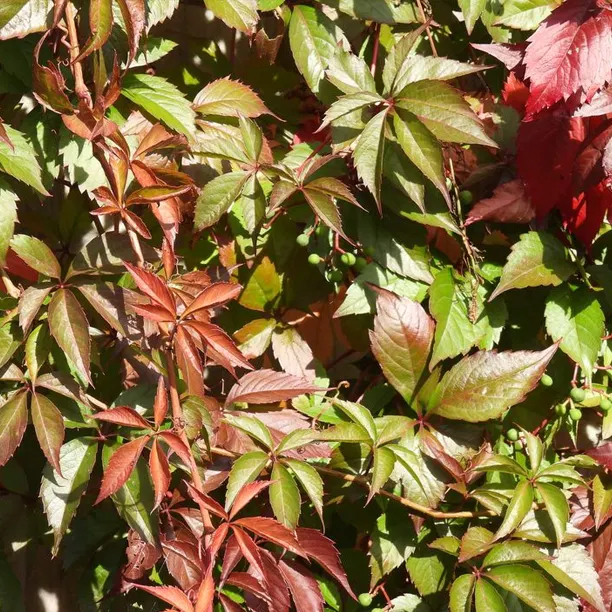
| Virginia creeper (Parthenocissus spp.) | 2–3 m | 10–15 m | Deciduous |
| Wisteria (Wisteria spp.) | 1.5–3 m | 10–30 m | Deciduous |
| Ivy (Hedera spp.) | 0.5–1.5 m | 10–30 m | Evergreen |
Is Clematis montana really the best fast-growing clematis?
Yes — among ornamental climbers, Clematis montana combines exceptional speed, spectacular spring flowers and reliable hardiness in a way very few plants can match. It belongs to Pruning Group 1 (no regular pruning needed), which makes it particularly low-maintenance once established.
A healthy montana will cover a large fence panel or an entire garden shed within three or four years. In ideal conditions — a sunny or lightly shaded aspect, reasonable soil, and something sturdy to climb — established plants are regularly recorded putting on 4–5 metres in a season. The flowers (usually white or pink, vanilla-scented in many cultivars) appear in May and June on the previous year’s wood, so the rule is simple: if you must prune, do it immediately after flowering.
Key montana varieties for fast cover:
- Elizabeth — soft pink, strongly vanilla-scented, one of the most popular montas in UK gardens. Very vigorous to 8 m.
- Fragrant Spring — pale pink, delicious scent, fresh green foliage. Reliable and quick.
- Broughton Star — semi-double, deep dusky-pink flowers, bronze-tinted young foliage. Slightly less rampant than Elizabeth, so more suitable for restricted spaces.
- Apple Blossom — pale blush-white flowers, bronze-flushed leaves; one of the earliest montas to flower.
One important caveat: montana is not suitable for a small garden wall where it will need constant cutting back. Planted against a large north- or south-facing boundary, a pergola, or allowed to scramble into a big tree, it is near-perfect.
Browse the full Clematis collection for all available varieties.
Should I plant Russian vine — is it really that fast, and how do I control it?
Russian vine (Fallopia baldschuanica, sometimes called mile-a-minute) is genuinely the fastest deciduous climber commonly available in the UK, capable of 6 metres of growth in a single season. It earns that speed with a caveat: it is extremely difficult to remove once established and will overwhelm structures, trees and neighbouring plants if left unchecked.
That said, Russian vine has its place. It will cover an ugly concrete wall, a derelict outbuilding or a chain-link fence faster than almost anything else, and its frothy white flowers in late summer are genuinely attractive. The key is honest assessment of whether you are willing to do the annual structural pruning (cut hard back in late winter) to prevent it becoming an architectural problem.
When Russian vine is a good choice: large, robust structures; very exposed or difficult sites where more ornamental plants struggle; temporary screening where the plant may eventually be removed.
When to choose something else: near trees or hedges (it will smother them), on lightweight trellises (it is very heavy), or in a small garden where control would require weekly attention.
How good is the golden hop as a fast-growing climber?
The golden hop (Humulus lupulus ‘Aureus’) is arguably the most underused fast-growing climber in British gardens. It produces brilliant lime-gold foliage that lights up a shaded corner, grows 4–6 metres each season, and then conveniently dies back to the ground in autumn — meaning it is never out of control and requires no pruning beyond cutting the dead stems to the ground in late winter.
The herbaceous nature is worth emphasising: unlike Russian vine, which accumulates woody bulk year after year, the golden hop starts completely fresh each spring. This makes it ideal for temporary summer screening (over an unsightly but necessary object, for instance) or for growing over a pergola where winter air movement and light are welcome.
It does best in full sun to partial shade in moist, fertile soil, and it needs something to twine around — wires, trellis or a sturdy shrub. The papery hop cones that develop in late summer add further ornamental interest and are attractive in dried arrangements.
Is akebia a fast enough climber for quick screening?
Akebia (Akebia quinata) is a semi-evergreen twining climber that grows 2–4 metres per year and can ultimately cover a very large area, making it a genuinely useful screening plant that is far less commonly planted than it deserves to be. Its unusual spiced-chocolate-scented purple flowers in spring and, in a warm year, sausage-shaped fruit in autumn give it multi-season interest that faster but coarser plants cannot match.
In mild UK winters it holds most of its attractive blue-green lobed leaves; in cold winters it is fully deciduous. It is happiest in a sheltered, sunny to partially shaded position and tolerates a range of soil types. Because it twines rather than self-clinging, it needs wires or trellis to attach to.
The main practical consideration: for good fruiting (which requires cross-pollination), plant two different clones near each other. For purely ornamental screening, a single plant is perfectly adequate.
Which honeysuckles grow fastest?
The most vigorous British garden honeysuckles grow 2–4 metres per year once established and combine rapid coverage with outstanding fragrance. The key species to know are Lonicera japonica (Japanese honeysuckle, semi-evergreen, very vigorous) and the large-flowered varieties of Lonicera periclymenum (native woodbine types).
| Honeysuckle variety | Vigour | Flower colour / scent | Season | Evergreen? |
|---|---|---|---|---|
| L. japonica ‘Halliana’ | Very high | White to yellow / very fragrant | June–Oct | Semi-evergreen |
| L. periclymenum ‘Serotina’ | High | Purple-red / fragrant | July–Oct | Deciduous |
| L. periclymenum ‘Belgica’ | High | Pink-white / fragrant | May–June, then Aug | Deciduous |
| L. henryi | High | Red-yellow / mild scent | June–July | Evergreen |
Honeysuckles perform best in sun to partial shade with their roots kept cool and moist — a mulch of bark chippings over the root zone makes a significant difference. They twine naturally and need support; left to scramble through a large shrub or informal hedge they can need very little intervention.
Explore the full Honeysuckle collection.
Which fast-growing climbers are best specifically for covering a fence?
For fence coverage, the most practical fast climbers are those that are dense enough to create a visual screen, manageable enough not to pull the fence apart, and suited to the fence’s aspect. The table below summarises the main options.
| Climber | Best aspect | Screen density | Weight on fence | Maintenance level |
|---|---|---|---|---|
| Clematis montana | Any except deep shade | Very good (summer) | Moderate–heavy | Low (post-flower tidy) |
| Golden hop | Sun to part shade | Excellent (summer) | Light (dies back) | Very low |
| Vigorous honeysuckle | Sun to part shade | Good | Moderate | Low–medium |
| Virginia creeper | Any aspect | Very good (summer) | Low–moderate | Low |
| Russian vine | Any aspect | Excellent | Very heavy | High |
| Ivy (Hedera) | Any aspect | Excellent (year-round) | Low–moderate | Low |
For a standard garden panel fence, the golden hop and a vigorous honeysuckle are probably the most fence-friendly fast options. Montana clematis is also excellent but can become very heavy — ensure your fence posts are well-anchored. Russian vine is best reserved for freestanding post-and-wire structures or large masonry walls rather than lightweight panel fencing.
See our full collection of best plants for covering fences or shop all climbing plants.
Are there fast-growing climbers that work in shade?
Yes — several vigorous climbers cope well with shade, though none of them grow quite as rapidly in deep shade as they would in sun. Virginia creeper, ivy and Lonicera henryi (evergreen honeysuckle) are the most reliable for north-facing and heavily shaded positions.
Clematis montana also performs surprisingly well in partial shade — it will still flower freely and grow at reasonable speed on an east- or north-facing fence, though not quite matching the performance of a south-facing plant. Akebia quinata handles part shade well and is a good choice for a sheltered but shadier spot.
For a more detailed guide, see our article on best climbing plants for shade and north-facing walls.
Which fast-growing climbing plants are also fragrant?
Speed and scent are not mutually exclusive — some of the most fragrant climbers are also genuinely vigorous. Clematis montana ‘Elizabeth’ and ‘Fragrant Spring’ produce a strong vanilla scent in May and June. Vigorous honeysuckles, particularly Lonicera japonica ‘Halliana’ and L. periclymenum ‘Serotina’, carry heavy, sweet fragrance throughout summer.
Akebia offers something more unusual — a light, spicy-chocolatey scent from its spring flowers that is unlike anything else in the garden. Wisteria, while slower to cover large areas, produces arguably the most dramatic fragrance of any climber and grows with considerable vigour once properly established.
If scent is your primary motivation, honeysuckle and montana clematis give you both speed and fragrance reliably and consistently. Browse the Honeysuckle collection or Clematis collection to find the right variety.
How do I get fast-growing climbers established quickly?
The single most important factor for rapid establishment is good planting preparation. A climber planted into impoverished, compacted soil will struggle for two or three years; the same plant in well-prepared ground will be away and growing strongly by midsummer of its first year.
Key steps for fast establishment:
- Dig a generous planting hole — at least twice the width and depth of the root ball. Loosen the sides and base of the hole.
- Improve the soil — incorporate a good quantity of garden compost or well-rotted manure. For clematis, plant the crown 5–8 cm deeper than it was in the pot to protect against clematis wilt.
- Water thoroughly at planting and keep the root zone consistently moist throughout the first season. A 5–8 cm mulch of bark chippings over the root zone dramatically reduces moisture loss.
- Feed in spring — a balanced slow-release fertiliser in March or April gives fast-growing climbers the nutrients they need to produce maximum growth.
- Provide immediate support — attach new shoots to wires or trellis early. Shoots left to flap around in wind are slowed; shoots trained flat against their support grow faster and more densely.
- Patience in year one — the phrase “sleep, creep, leap” accurately describes most climbers. Year one: root establishment. Year two: modest top growth. Year three onwards: the rapid cover you planted them for.
For clematis specifically, see our guides on how deep to plant a clematis and how to grow clematis.
How do the top five fast-growing climbers compare overall?
If you are deciding between the headline candidates, this summary table covers the most practical considerations side by side.
| Feature | Clematis montana | Russian vine | Golden hop | Akebia | Honeysuckle |
|---|---|---|---|---|---|
| Annual growth | 3–5 m | Up to 6 m | 4–6 m | 2–4 m | 2–4 m |
| Flowers | Excellent (spring) | Good (late summer) | Ornamental foliage | Unusual (spring) | Excellent (summer) |
| Fragrance | Strong (many cvs) | None | None | Subtle, spiced | Very strong |
| Winter cover | No (deciduous) | No (deciduous) | No (dies back) | Partial | Partial–none |
| Ease of control | Medium | Difficult | Very easy | Medium | Easy–medium |
| Wildlife value | Good | Good | Very good | Good | Excellent |
| Suitable for small garden | Marginal | No | Yes | Yes | Yes |
Frequently Asked Questions
What is the single fastest growing climbing plant available in the UK?
Russian vine (Fallopia baldschuanica) grows up to 6 metres per year once established and is generally accepted as the fastest-growing climbing plant commonly available to UK gardeners. It requires very robust support structures.
How quickly does Clematis montana cover a fence?
A Clematis montana ‘Elizabeth’ will typically begin to cover a standard 6-foot fence panel within two to three years of planting, achieving full coverage by years three to four in good conditions.
Is the golden hop evergreen?
No — the golden hop is a herbaceous perennial that dies back completely to the ground each autumn and regrows fresh each spring. It provides no winter cover but is extremely easy to manage as a result.
Can I grow a fast climber on a lightweight trellis?
The lightest options — golden hop, honeysuckle or a less vigorous clematis — work well on lightweight trellis. Avoid Russian vine and heavy montana on flimsy structures; they accumulate substantial woody bulk over time.
Do fast-growing climbers damage fences?
Twining climbers such as honeysuckle and hop do not physically damage fences but can put structural weight on them. Self-clinging types like ivy use adhesive pads rather than penetrating roots. Read more in our article on whether climbing plants damage walls and fences.
Is Virginia creeper a fast-growing climber?
Virginia creeper grows 2–3 metres per year once established and is self-clinging, so requires no wires or trellis. Its autumn colour is exceptional. It is not quite as fast as montana or Russian vine.
Which fast climber is best for wildlife?
Honeysuckles are outstanding for wildlife — the flowers feed long-tongued moths and bees, and the berries attract birds. Ivy, though slower-growing, is equally valuable as a nesting and roosting habitat and late-season food source. Browse our Honeysuckle collection.
How do I prune a fast-growing Clematis montana?
Montana belongs to Pruning Group 1 and needs no routine pruning. If it outgrows its space, cut it back immediately after flowering in late May or June — never in autumn or winter, as you would remove next year’s flower buds. See our guide to clematis pruning groups.
Can fast-growing climbers be grown in pots?
The most vigorous climbers — montana, Russian vine, golden hop — are not suited to containers as their root systems need unrestricted soil. Moderately vigorous clematis varieties and jasmine in large pots are more appropriate choices.
Does akebia grow in the UK climate?
Yes — akebia is fully hardy in most of the UK (to around -15°C) and performs well in a sheltered, reasonably sunny position. It is semi-evergreen in mild winters and fully deciduous in harder ones, growing reliably at 2–4 metres per year.
Which fast-growing climber gives year-round evergreen cover?
For fast and evergreen cover, ivy and Lonicera henryi are the most reliable options. Star jasmine is evergreen but slower. See our guide to evergreen climbing plants.
When is the best time to plant fast-growing climbers?
Autumn and early spring are ideal, giving roots time to establish before summer growth demands. Container-grown climbers from a mail-order nursery can be planted at any time soil is workable, provided you water well and mulch generously.
Related Products
- Shop All Climbing Plants
- Best Plants for Covering Fences
- Clematis
- Honeysuckle
- Ivy
- Virginia Creeper
- Elizabeth Clematis Montana
- Fragrant Spring Clematis Montana
- Broughton Star Clematis Montana
- Apple Blossom Clematis
Related Articles
- Best climbing plants — which climber for walls, fences, scent, shade and screening
- Evergreen climbing plants — year-round cover for walls, fences and screens
- Best climbing plants for shade and north-facing walls
- Clematis pruning groups explained — Groups 1, 2 and 3 with variety lists
- How to grow clematis — planting, feeding, watering and first-year care
- How deep do I plant a clematis?
- How to grow honeysuckle — planting, training, pruning and scent
- Do climbing plants damage walls and fences?
- Evergreen Clematis — Year-Round Cover
- Which Clematis Should I Grow?
Leave a Reply