
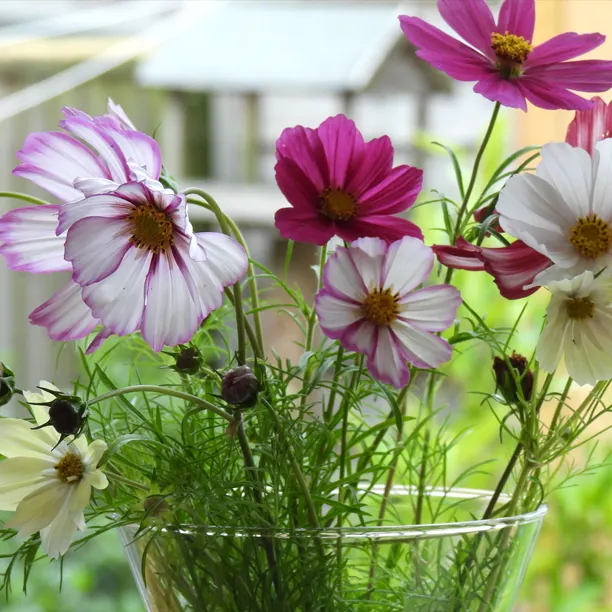
Are Cosmos Good Cut Flowers?
Cosmos are outstanding cut flowers — long-stemmed, prolific, and available in a colour range that spans pure white through every shade of pink to deep crimson and warm apricot. Cut correctly and conditioned well, individual blooms last five to seven days in the vase, and because the plants flower continuously from July until the first frosts, a single planting keeps your house supplied with fresh flowers for three to four months.
Related guides
Which Cosmos Varieties Are Best for Cutting?
Varieties with long, strong stems and high bud counts give you the most useful cut flower material; very compact patio types are less suited because their stems are too short for a vase.
For cutting, prioritise varieties that reach at least 60 cm and branch freely. The table below covers the Ashridge range, rated for cut-flower suitability:
| Variety | Colour | Stem length | Cut-flower rating |
|---|---|---|---|
| Purity | Pure white | 80–100 cm | ★★★★★ — a florist’s staple |
| Rubenza | Deep ruby-red | 75–90 cm | ★★★★★ — exceptional colour depth |
| Antiquity | Dusty rose aging to bronze | 70–90 cm | ★★★★★ — unique antique tones |
| Apricotta | Soft apricot-pink | 70–85 cm | ★★★★★ — rare warm tone |
| Daydream | Blush-white with pink flush | 75–90 cm | ★★★★★ — superb for bridal work |
| Double Click Cranberries | Deep cranberry, double | 80–100 cm | ★★★★★ — showpiece blooms |
| Double Click Snow Puff | White, fully double | 80–100 cm | ★★★★★ — pom-pom texture |
| Sensation Picotee | White with crimson edge | 80–100 cm | ★★★★☆ — striking but variable |
| Candystripe | White with pink/red streaks | 75–90 cm | ★★★★☆ — playful, eye-catching |
| Fizzy Rose Picotee | Pink with darker edge, semi-double | 60–75 cm | ★★★★☆ — shorter but distinctive |
| Fizzy White | White, anemone-centred | 60–75 cm | ★★★★☆ — unusual centre detail |
| Dazzler | Magenta-crimson | 70–90 cm | ★★★★☆ — bold border colour |
| Carmine & White | Carmine with white zone | 70–90 cm | ★★★★☆ — bicolour interest |
| Rose Bon Bon | Rose-pink, semi-double | 65–80 cm | ★★★★☆ — cottage garden feel |
| Mixed Cottage Garden | Full colour mix | 70–100 cm | ★★★★☆ — best value for mixed bunches |
Top recommendation for cutting: if you grow only one cosmos for the vase, make it Purity or Rubenza. Purity’s clean white works with everything; Rubenza brings a depth of colour rarely seen in any annual.
When Should You Harvest Cosmos Blooms?
Cut cosmos at the marshmallow stage — when the bud is fully coloured and softly rounded but the petals have not yet unfurled. This single piece of timing makes the difference between blooms that last two days and blooms that last a week.
The most common mistake is cutting fully open flowers. By the time a cosmos is wide open in the garden it has already used a significant portion of its vase life. Instead, watch for buds that feel slightly soft when gently squeezed and show full colour but with petals still folded inwards at the tips.
| Stage | Description | Cut? | Expected vase life |
|---|---|---|---|
| Tight bud, no colour | Green, pencil-thin | No — won’t open | — |
| Coloured bud, still closed | Petals showing but folded tight | Marginal — may not open reliably | 5–7 days if it opens |
| Marshmallow bud ✓ | Full colour, soft, petals beginning to separate | Yes — ideal | 5–7 days |
| Half-open | Petals spreading, centre visible | Acceptable | 3–5 days |
| Fully open | Wide flat face, pollen shedding | Last resort only | 1–3 days |
Best time of day: cut in the early morning, before heat builds. The stems are fully hydrated overnight and will harden off beautifully if conditioned straight away. If mornings are impossible, cut in the evening — avoid the middle of the day when stems are under moisture stress.
How Do You Cut Cosmos Stems Properly?
Use clean, sharp scissors or florist’s snips and cut stems as long as you can — typically 40–60 cm — taking the cut just above a leaf node or lateral bud so the plant can rebranch and flower again quickly.
The moment you cut a stem, bring it into shade and plunge it immediately into a bucket of cool water. Cosmos stems can airlock if left dry for even a few minutes, which prevents water uptake and causes rapid wilting. Some growers carry a jug of water into the garden and dip each stem as it’s cut; this is particularly worthwhile on warm days.
Strip any foliage that would sit below the waterline in the vase — submerged leaves rot quickly and cloud the water with bacteria that shorten vase life.
How Do You Condition Cosmos After Cutting?
Conditioning — allowing freshly cut stems to drink deeply in a cool, dark place before arranging — is the single most effective step for extending cosmos vase life, and it takes nothing more than a bucket of cool water and a few hours of patience.
Follow this routine for best results:
- Recut under water. When you bring stems indoors, recut each one at a sharp angle while holding the bottom centimetre under water. This removes any air bubble that has formed and ensures the stem is drawing water immediately.
- Remove lower leaves. Strip all foliage from the lower half of each stem.
- Deep water, cool location. Stand stems in at least 15 cm of cool, clean water. Place in a cool, dark room — a cool utility room or garage is ideal — for a minimum of four hours, preferably overnight.
- Change the water daily. Once arranged in a vase, change the water every day or every other day. Each time, recut 1–2 cm from the stem base.
Flower food: commercial cut-flower food (the small sachet supplied with shop-bought flowers) does genuinely extend vase life by providing sugars and an antibacterial agent. Use it in the conditioning bucket and in the display vase. As an alternative, a small pinch of sugar and a few drops of bleach in the water achieves a similar effect.
How Do You Arrange Cosmos in a Vase?
Cosmos have an airy, naturalistic character that suits loose, meadow-style arrangements far better than tight, formal ones; their slender stems and daisy-like faces work best when allowed to move and breathe rather than being packed in.
Simple hand-tied bunch
Gather five to nine stems, turning the bunch in your hand as you add each one so the heads splay outwards evenly. Tie with twine 10 cm below the lowest bloom, trim all stems to the same length, and stand in a narrow-mouthed vase that holds the bunch upright without squashing it. A mix of Purity and Rubenza in this format is striking without being fussy.
Mixed cutting-garden arrangement
Cosmos pair beautifully with:
- Ammi majus (white umbels that echo the daisy shape)
- Scabiosa (similar scale and weight)
- Grasses (add movement and texture)
- Sweet peas (complementary delicacy and fragrance)
- Zinnia (bold colour contrast)
Avoid pairing with very heavy, structural flowers such as sunflowers — cosmos tend to get visually lost. If you want to mix them with sunflowers, use double-flowered cosmos such as Double Click Cranberries or Double Click Snow Puff, which have enough visual weight to hold their own.
Single-variety statement vase
A tall glass vase filled with fifteen to twenty stems of Antiquity — its blooms shifting from warm rose to faded bronze as they age — is one of the most quietly beautiful things you can put on a dining table. Single-variety arrangements let the texture of the flower type speak for itself, and cosmos are interesting enough to carry it.
How Should You Plan Your Cosmos Colour Palette for Cutting?
Planning a cohesive cutting-garden palette before you plant saves a great deal of creative frustration in July; the table below groups Ashridge cosmos varieties by colour family to help you build harmonious combinations.
| Palette | Varieties to combine | Mood |
|---|---|---|
| White & blush | Purity, Daydream, Double Click Snow Puff, Fizzy White | Bridal, minimal, elegant |
| Warm sunset | Apricotta, Antiquity, Rose Bon Bon | Romantic, autumnal, cottage |
| Deep jewel | Rubenza, Double Click Cranberries, Dazzler | Dramatic, moody, rich |
| Bicolour & stripe | Candystripe, Sensation Picotee, Carmine & White, Fizzy Rose Picotee | Playful, garden-party, fresh |
| Full mix | Mixed Cottage Garden | Relaxed, abundant, meadow |
How Do You Maximise Your Cosmos Yield for Cutting?
The more you cut, the more cosmos flower — but only if you manage the plants actively from the start. Three techniques make the biggest difference to how many stems you can harvest across the season.
Pinching out
When young plants reach 30–40 cm, pinch out the growing tip above the third or fourth set of leaves. This delays first flowering by about two weeks but results in a plant with four to six main stems instead of one, dramatically increasing total yield. For cut-flower production this is non-negotiable; plants grown unpinched produce fewer, sappier stems that are more prone to wilting after cutting.
Deadheading and cutting
The act of cutting for a vase is itself a form of deadheading. Regular harvesting signals to the plant that it has not yet set seed and must keep producing flowers. Conversely, if you allow spent blooms to remain on the plant and go to seed, flower production slows markedly. Pick every two to three days during peak season.
Generous feeding
Cosmos in very poor soil flower adequately but produce thinner stems. Work in a modest amount of balanced general-purpose fertiliser before planting, and once flowering is under way, a fortnightly feed with a high-potash liquid fertiliser (the kind used for tomatoes) supports continued bloom production without pushing excess leafy growth.
What Growing Conditions Produce the Best Cutting-Quality Cosmos?
Cut-flower quality begins in the growing bed. Cosmos grown in the right conditions produce longer, stronger, better-hydrated stems that condition more easily and last longer in the vase.
| Factor | Ideal condition | Effect on cut-flower quality |
|---|---|---|
| Sunlight | Full sun (6+ hours) | Shorter internodes, stronger stems |
| Soil fertility | Moderately poor to average | Rich soil causes floppy, lush growth that wilts easily |
| Drainage | Good, never waterlogged | Waterlogged roots reduce stem vigour |
| Spacing | 30–45 cm apart | Close spacing encourages taller, straighter stems |
| Support | Netting or twiggy sticks at 40 cm height | Prevents bent or kinked stems from wind damage |
| Watering | Deep and infrequent | Encourages deep rooting; shallow watering produces shallow roots and stems that dehydrate quickly after cutting |
Planting in a dedicated cutting patch rather than a mixed border makes the whole harvesting process more efficient. Rows 30 cm apart with horizontal netting stretched across canes at 40–50 cm is the standard kitchen-garden approach; the netting supports stems through summer storms and keeps them growing upright.
Why Are My Cosmos Wilting in the Vase?
Cosmos wilting prematurely in the vase is almost always caused by one of four problems, all of which are straightforward to fix.
- Cut too late. Fully open flowers simply don’t last. Cut at the marshmallow bud stage next time.
- Not conditioned. Stems cut and arranged immediately without a conditioning period in cool water will wilt within hours. Always condition for at least four hours in a cool dark place before arranging.
- Airlock in the stem. If any time elapsed between cutting and putting the stem into water, an air bubble will have formed. Recut underwater and the stem should revive.
- Warm, sunny position. Cosmos in a vase placed in direct sunlight or near a heat source lose water faster than they can absorb it. Display in a cool room, away from direct sun, radiators, and ripening fruit (which emits ethylene gas that accelerates ageing).
Revival trick: if cosmos wilt unexpectedly after arranging, remove them from the vase, recut the stems under water, and submerge the entire stem and flower head in a basin of cool water for thirty minutes. Many blooms will revive completely.
Frequently Asked Questions
How long do cosmos last as cut flowers?
Cut at the marshmallow bud stage and properly conditioned, cosmos last five to seven days in the vase. Flowers cut fully open may last only one to three days.
Should I put cosmos in cold or warm water?
Use cool water — around 10–15 °C — for conditioning. Cold water slows bacterial growth and keeps stems turgid. Warm water can shock freshly cut stems.
Can cosmos be used in wedding flowers?
Daydream, Purity, and Double Click Snow Puff are all popular with DIY wedding florists. Condition thoroughly beforehand and keep arrangements cool until needed.
How many cosmos plants do I need to cut regularly all summer?
For a household with flowers in one vase at a time, ten to fifteen pinched plants is usually sufficient. For regular larger arrangements, grow twenty to thirty plants.
Do double cosmos last as long as single ones?
Double cosmos such as Double Click Cranberries typically last as long — five to seven days. Their heavier heads are more dramatic in the vase and hide petal drop slightly better.
Can I use foliage from cosmos plants in arrangements?
Yes — cosmos foliage is feathery and delicate, adding texture without bulk. Strip excess and condition alongside the blooms. It wilts faster than the flowers, so use it fresh.
When do cosmos start producing stems for cutting in the UK?
Cosmos planted out in late May or early June typically begin producing cuttable stems from mid-July. Pinched plants will be a week or two later but then produce more stems through to October.
Is there a cosmos with the longest vase life?
Anecdotally, Rubenza and Antiquity are noted for strong vase performance. All varieties benefit equally from correct harvest timing and conditioning.
Can cosmos be grown as cut flowers in pots?
Yes, taller varieties in large (30 cm+) containers work well. Stem length may be marginally shorter than border-grown plants. See our guide to growing cosmos in pots for more detail.
Do I need flower food for cosmos?
It helps but is not essential. Flower food adds sugars and inhibits bacteria. A small pinch of sugar plus a drop of bleach in clean water is an effective home alternative.
What is the best white cosmos for cutting?
Purity is the benchmark — tall, prolific, and classically white. Double Click Snow Puff offers a textured double alternative for something more unusual.
How do I stop cosmos stems from going bendy in the vase?
Ensure the vase opening is narrow enough to support stems upright, condition thoroughly before arranging, and keep the vase topped up with water. Stems allowed to run dry will bend at the waterline.
Related Products
- All Cosmos Plants — Ashridge Trees
- Purity Cosmos — the definitive white cutting cosmos
- Rubenza Cosmos — deep ruby vase flower
- Antiquity Cosmos — antique rose-to-bronze tones
- Apricotta Cosmos — rare warm apricot colouring
- Daydream Cosmos — blush-white, perfect for weddings
- Double Click Cranberries — bold double, cranberry-red
- Double Click Snow Puff — fully double white
- Mixed Cottage Garden Cosmos — best-value mixed cutting patch




Leave a Reply