





 Sign In
 Saved items

February 26th 2026•
Bulbs
How to Grow Bulbs
Spring bulbs are among the most forgiving things you can grow. Horticultural experts agree that e...
Read More
 5 Star Service Rating




 Secure, One-Tap Checkout
 5 Star Feefo Rating
 Hand Picked, Delivered to Your Door!
 1 Year Bareroot Guarantee
 Platinum Trusted Service Award 2026
 Mail Order Plant Experts - Est. 1949
19/03/2026
If you have a patio, a balcony, a front step, or a windowsill, you should grow bulbs. Pots let you control everything — the compost, the drainage, the position — and they're the simplest way to get spring colour right where you want it. A pair of pots either side of a front door, planted with hyacinths in October, will greet you, in March, with its heady scent that will waft into your home when you open your front door. A window box layered with crocus, daffodils, and tulips will flower for three months from a single autumn planting.
Containers can deal with two possible issues with growing bulbs in the ground: poor drainage and squirrels. In a pot, waterlogging is entirely preventable and squirrels are much easier to deter. And if your garden soil is heavy clay that is sodden all winter, which is a lot of the UK, then frankly pots give you the free-draining conditions that tulips and alliums in particular love. Which is no excuse for a sodden garden of course - keep adding that home-made compost...
This guide covers the bulbs that work best in containers outdoors, how to plant them, the compost and feeding they need, and how to plant a bulb lasagne to give you months of colour from a single pot.
Almost all spring bulbs will grow in containers. Some are brilliant at it; others tolerate pots but prefer mother earth. A few really don't work. The honest breakdown:
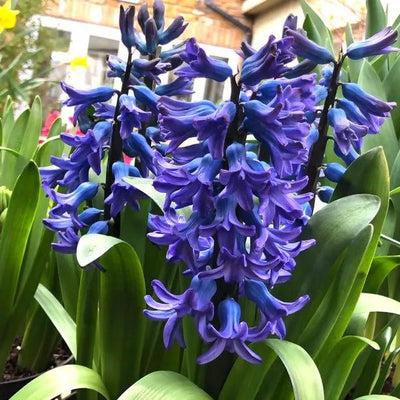
Hyacinths are among the best pot bulbs there are. Compact, upright, powerfully scented, and they flower at exactly the right height to enjoy from a chair or a doorstep. All five of our varieties — Delft Blue, Carnegie, Jan Bos, Fondant, City of Haarlem — are superb in pots. Five bulbs in a 20cm pot is a classic planting.
Dwarf daffodils — Tête-à-Tête, Minnow, Jetfire, February Gold, Topolino, Rip Van Winkle — are compact, sturdy, and don't topple over. They look right at pot scale in a way that full-size daffodils don't.
Crocus — all types. A wide, shallow bowl crammed with crocus is one of the simplest pleasures in gardening. Species crocus are the most graceful; Dutch hybrids are bolder. Both work.
Dwarf iris (Iris reticulata) — Harmony, Alida, Painted Lady. Tiny but vivid. Plant densely — 15–20 bulbs in a 20cm pot — for a startling February display.
Muscari — grape hyacinths are classic pot and window box bulbs. They multiply enthusiastically, which is an asset in pots and a nuisance in borders.
Cyclamen coum — a natural for shallow pots and troughs, flowering in the depths of winter when everything else looks bare.
Standard tulips work well in pots, but they need deeper containers than you'd think. The bulbs are planted 15–20cm deep, and they need root room below that. A pot at least 25–30cm deep is the minimum; 35cm is better. Shallow pots produce weak stems that flop. The taller the tulip, the deeper the pot needs to be. Darwin Hybrids and Single Late types in particular need a generous container. Most modern tulips won't reliably return in pots for a second year — the root volume is too restricted — so treat them as a one-season display and compost the bulbs afterwards (or plant them out in the garden and hope for the best).
Standard daffodils — Carlton, Mount Hood, Ice Follies are fine in larger pots (30cm+) but can look leggy and out of proportion in anything smaller. They're better in the ground, where they'll naturalise. Miniature daffs are just more satisfying at container scale.
Small alliums — Drumstick and Silver Spring are fine in deep pots. Millennium is compact enough to work well.
Snake's head fritillaries — surprisingly effective in a shallow terracotta pan with gritty compost. They like damp but well-drained conditions, which pots provide easily if you keep watering.
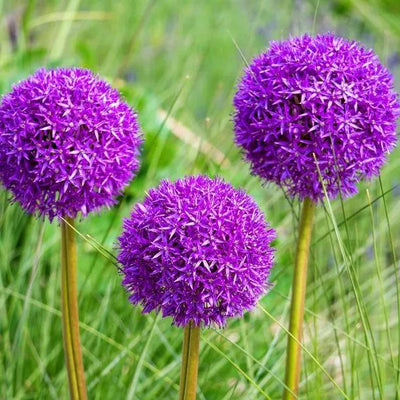
Tall alliums (Purple Sensation, Purple Rain) are top-heavy on 100cm stems, and their foliage dies back untidily just as the flowers open. In a border you can disguise this with companion planting; in a pot, the dying leaves are the main event. If you must try, use a heavy terracotta pot that won't blow over.
Crown Imperials — too tall, too heavy, and the smell is... memorable in an enclosed space.
Bluebells and wild daffodils are woodland naturalisers. Their whole purpose is to spread through grass and under trees. A pot defeats the point entirely.
Three things matter: depth, drainage, and material.
Depth: Match the pot to the bulb. Crocus and small bulbs need 15cm minimum. Daffodils and hyacinths need 20–25cm. Tulips need 25–35cm. For a bulb lasagne (layered planting), allow at least 30cm and ideally 35–40cm. Width matters less — a narrow deep pot is better than a wide shallow one for most bulbs.
Drainage: Non-negotiable. Every pot needs drainage holes. Bulbs sitting in waterlogged compost will rot. If you're using a decorative pot without holes, either drill some or use it as an outer sleeve around a plastic pot that does have drainage (but you will need to empty it after watering).
Material: Terracotta is best for bulbs. It's porous, so excess moisture wicks out through the walls, and its weight makes pots stable in wind. But terracotta can crack in hard frost, so bring valuable pots under cover in severe weather, or use frost-proof containers. Plastic is lighter and cheaper but doesn't breathe. Metal gets very cold in winter, which some bulbs don't appreciate. Glazed ceramic is fine but check it's frost-proof.
Use a free-draining, peat-free compost mixed with grit or perlite — roughly 3 parts compost to 1 part grit. The grit is not optional; it prevents the compost from becoming a sodden sponge over winter, which is the main way pot-grown bulbs fail. A layer of crocks, gravel, or broken terracotta over drainage holes stops compost washing through.
Fill the pot to the right planting depth (see our main growing guide for depth by genus), place the bulbs close together — almost touching — and cover. In pots, you plant much more densely than in the ground. A 25cm pot will comfortably hold 9–12 tulips, 12–15 daffodils, or 20+ small bulbs. The packed effect is what makes container planting so dramatic.
Water once after planting, then leave the pot to its own devices over winter. Don't water again until you see shoots in spring, unless the compost dries out completely in a spell of dry weather. Overwatering dormant bulbs is worse than underwatering them.
Position the pot somewhere that gets natural rainfall — not tucked under an overhang where rain can't reach. But don't leave it sitting in a saucer of water either. The pot needs to drain freely.
This is the technique that gets the most out of a single container. You layer different bulbs at different depths — deepest and latest at the bottom, shallowest and earliest on top — and they flower in succession, one layer pushing up past the next. The principle is one Christopher Lloyd championed in borders at Great Dixter: his view was a garden, or a pot, should never have a dead week.
In a 35–40cm deep pot, you can fit three layers comfortably:
Bottom layer (deepest): Tulips or large alliums. Plant at 15–20cm depth. Choose late-flowering types — Queen of Night, Negrita, Ballerina — for May colour.
Middle layer: Daffodils or hyacinths. Plant at 10–12cm depth. Tête-à-Tête, Minnow, or Thalia for April. Nestle them in the gaps between the tulip noses poking up from below.
Top layer (shallowest): Crocus, muscari, or dwarf iris. Plant at 5–8cm depth. These flower first — February and March — while the deeper layers are still underground.
Cover the final layer, water, and wait. From February to May, the pot will produce three successive waves of flowers from a single planting. It's remarkably effective and never fails to impress visitors who can't work out how one pot is still producing new flowers three months later.
Don't mix types in the same layer — keep each layer to one genus. The different growth rates and leaf shapes compete for light if they're at the same depth. Label the pot or take a photo of your planting plan. You may forget what's in there by March (we always do - Ed). And be generous with the compost — the more soil volume, the more nutrients are available, and you're asking a lot of plants to share a small space. One last tip, which we learned from our friend Camilla Carter who is a fabulous local gardener. If you have tulips in your lasagne, plant complementary wallflowers at the same time. They will flower along with the tulips, hide the foliage of the bulbs that went before and stop weeds colonising your pots.
Hyacinths are the classic forcing bulb — plant in October, keep cool and dark for 10–12 weeks, then bring them into warmth and light for flowers at Christmas or in January. You can use ordinary pots with compost, or special hyacinth forcing vases that hold the bulb above water.
The process: plant prepared hyacinth bulbs (sold specifically for forcing — ordinary bulbs won't have had the cold treatment they need) in September or October. Keep them somewhere cool and dark — a garage, a shed, an unheated spare room — at around 9°C for 10–12 weeks. When the shoot is 5–8cm tall and you can feel a flower bud in the tip, bring the pot into a cool room indoors. Not straight onto a radiator — gradual warmth produces a better flower. Within 2–3 weeks, you'll have flowers and a room full of scent.
Paperwhite narcissi are even easier to force. They don't need a cold period at all — just plant, water, and put in a light spot. They'll flower in 4–6 weeks. The scent is intoxicating (though some people find it overpowering). Plant a few bulbs every two weeks from October for a succession of indoor flowers through the winter.
Crocus, dwarf iris, and Tête-à-Tête daffodils can all be gently forced in the same way as hyacinths — cold period, then warmth — though they're less predictable than hyacinths and the results are more variable.
This is a question every container gardener asks. "The flowers are over, the pot is full of yellowing foliage, and I want the space for summer plants. What do I do with the bulbs?"
You have three options:
Option 1: Plant them out in the garden. Once the flowers are done, tip the contents of the pot into a hole in the garden and let them naturalise. This works well for daffodils, crocus, muscari, and alliums — all of which will establish and come back. Tulips are less reliable but worth trying. Water them in and leave the foliage to die back in place.
Option 2: Keep them in the pot. Let the foliage die back naturally (at least six weeks), feed with tomato food every fortnight, then stop watering once the leaves are yellow. Move the pot somewhere out of the way — behind a shed, under a bench. In September, tip the pot out, refresh the compost, and replant the bulbs at the correct depth. This works best for daffodils and the reliably perennial bulbs. Tulips rarely do well like this.
Option 3: Compost them. Honest, practical, and what most people do (with tulips anyway). Treat the display as one-season, buy fresh bulbs in autumn, and start again. No guilt — the display was worth it.
If you choose either option one or two, then feed the bulbs while the foliage is still green. That's the window when they are refuelling for the following year. A fortnightly drench with high-potash liquid feed (tomato food) makes a real difference to whether they come back strongly or not.
Most spring bulbs are completely hardy in the ground, but pots are different. The compost in a pot freezes much more easily than garden soil, and repeated freeze-thaw cycles can damage roots and bulbs. In most of lowland Britain, this isn't a serious problem — a week or two of moderate frost won't harm daffodils or tulips. But in prolonged cold spells (below -5°C for several nights), it's worth moving pots against a house wall where they get radiant heat, or wrapping them in bubble wrap or hessian. Don't bring them indoors — they also need the cold to develop properly.
Terracotta pots are the main casualties of hard frost. The moisture in the clay expands as it freezes and can crack the pot. Raising pots off the ground on feet or bricks improves drainage and reduces frost damage. Frost-proof terracotta is more expensive but a good investment if you leave pots out all winter.
Bulbs rotting: Overwatering or poor drainage. Check the holes aren't blocked. Add more grit to the compost next time.
Thin, floppy stems: Not enough light, or the pot was too warm too soon (common with forced bulbs brought indoors too quickly). Or the pot is too shallow and the bulbs don't have enough root run to anchor themselves.
Flowers but short stems: Late planting. The bulb had enough energy to flower but not enough root development to produce a full-length stem. Not a disaster — they'll be better next year if you feed them well and let the foliage die back naturally.
Nothing at all: Check the pot hasn't dried out completely over winter (unlikely but possible if it's under cover). Or check for vine weevil — the grubs eat roots and can destroy a potful of bulbs. Lift one and look for the white, C-shaped larvae in the compost. Biological nematode treatments are the best control. If you planted your bulbs in shop-bought compost, have a (sharp) word with the supplier.
For more on planting technique, compost, and feeding, see our complete spring bulb growing guide.






Comments (0)
Add a commentLeave a comment