
Contents
- 1 How do you grow fruit trees successfully in the UK?
- 2 Which fruit trees grow best in the UK climate?
- 3 What rootstock should I choose for a fruit tree?
- 4 When and how should you plant a fruit tree?
- 5 Do fruit trees need a pollination partner?
- 6 How do you prune fruit trees, and when should you do it?
- 7 What soil and feeding do fruit trees need?
- 8 How do you choose the right apple variety for your garden?
- 9 What about pears, plums, cherries, and quinces — how do they differ to grow?
- 10 What are the most common problems with fruit trees and how do you deal with them?
- 11 Can you grow fruit trees in a small garden or containers?
- 12 Is it worth planting a small orchard, and what should you include?
- 13 Frequently Asked Questions
- 13.1 How long does it take for a fruit tree to produce fruit?
- 13.2 Do I need to thin fruit on my trees?
- 13.3 Can I grow a fruit tree in a north-facing garden?
- 13.4 What is the best time of year to buy a fruit tree?
- 13.5 How often should I water a newly planted fruit tree?
- 13.6 Do fruit trees need feeding every year?
- 13.7 What is the easiest fruit tree to grow in the UK?
- 13.8 How do I know when to harvest apples?
- 13.9 Can fruit trees be grown in pots long-term?
- 13.10 What causes my apple tree to flower but not set fruit?
- 13.11 Should I buy a maiden tree or a two- or three-year-old tree?
- 13.12 Can I grow cider apples in a UK garden?
- 14 Related Products
- 15 Related Articles
How do you grow fruit trees successfully in the UK?
Growing fruit trees in the UK is straightforward when you match the right tree to your soil, space, and climate. Choose an appropriate rootstock to control size, plant at the correct depth, and prune consistently — most varieties will reward you with reliable harvests within two to four years.
Related guides
Which fruit trees grow best in the UK climate?
Apples, pears, plums, cherries, quinces, and damsons are all well-suited to the British climate and will thrive across most of the country with minimal fuss.
The UK’s temperate, maritime climate — cool winters, mild summers, reliable rainfall — is almost ideal for top fruit. All of the traditional orchard fruits need a period of winter chilling to break dormancy and set a good crop; British winters reliably provide this. The main challenge is late spring frosts, which can damage blossom, and the relatively short, often cloudy summers that limit the ripening of very late or very warm-season varieties.
In the north of England and Scotland, select hardy, early-ripening apple varieties rather than late-season dessert types. Cox’s Orange Pippin, for example, performs best in southern England, whereas varieties such as Bardsey Island or Beauty of Bath are more broadly reliable.
| Fruit Type | UK Suitability | Notes |
|---|---|---|
| Apple | Excellent — all regions | Widest variety choice; early-season cultivars for the north |
| Pear | Very good — south and midlands | Needs a warm wall or sheltered spot in northern gardens |
| Plum / Damson | Very good — all regions | Early blossom; shelter from late frosts is beneficial |
| Cherry | Good — all regions | Modern dwarfing rootstocks make netting for birds practical |
| Quince | Good — south and midlands | Thrives in moist, slightly acid soil; beautiful blossom |
| Nut (hazel/cobnut) | Excellent — all regions | Very hardy; productive even in shade |
Browse our full range at Shop All Fruit Trees or explore curated picks in our Best Garden Fruit Tree Varieties collection.
What rootstock should I choose for a fruit tree?
Rootstock determines the ultimate size of your tree, how quickly it comes into fruit, and how well it tolerates your soil — so it is arguably the most important decision you will make when buying a fruit tree.
Fruit trees are not grown on their own roots. They are grafted onto a rootstock chosen to control vigour. A dwarfing rootstock produces a compact tree that fruits early and is easy to manage; a vigorous rootstock produces a large standard tree suited to orchards or wildlife gardens.
| Rootstock | Crop | Final Height | Best For | First Fruit |
|---|---|---|---|---|
| M27 | Apple | 1.5–2 m | Containers, very small gardens | 2–3 years |
| M9 | Apple | 2–3 m | Garden trees, cordons, espaliers | 2–3 years |
| M26 | Apple | 3–4 m | Free-standing garden trees | 3–4 years |
| MM106 | Apple | 4–5 m | Open gardens, light soils | 4–5 years |
| Quince A | Pear | 3–4 m | Standard garden pear | 3–4 years |
| Pixy | Plum | 2.5–3 m | Small gardens | 2–3 years |
| Colt | Cherry | 4–5 m | Larger gardens | 3–4 years |
| Gisela 5 | Cherry | 2.5–3.5 m | Small gardens, netting practical | 2–3 years |
As a general rule: choose dwarfing rootstocks (M9, M26, Pixy, Gisela 5) for modern garden trees — they fruit faster and stay manageable. Choose semi-vigorous rootstocks (MM106, Colt) for poorer soils or where you want a larger, longer-lived specimen. See Fruit Tree Rootstocks and read our detailed guide to Choosing Rootstocks for Fruit Trees. Apple rootstocks are also covered in depth on our Apple Tree Rootstocks — Grafting Videos page.
When and how should you plant a fruit tree?
Bare-root fruit trees should be planted between November and March while the tree is dormant; container-grown trees can go in at any time of year, though autumn and early spring are still the best windows.
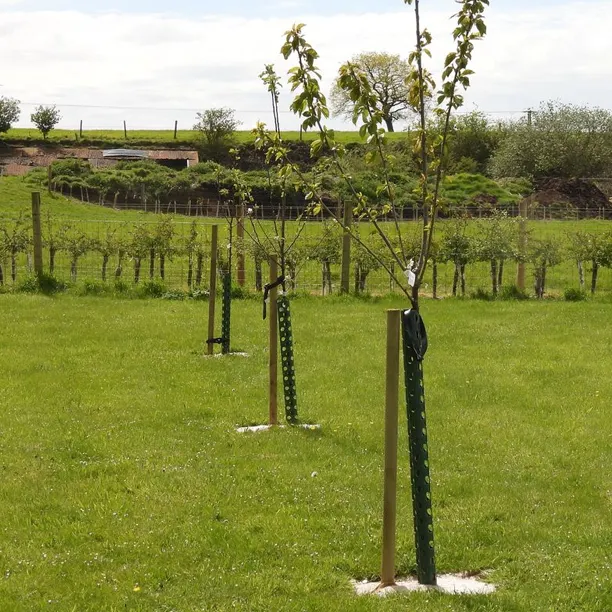
Bare-root trees — the form in which Ashridge Trees despatches most of its fruit trees — are dug fresh from the nursery field, have an excellent root system, and establish rapidly provided they are planted correctly. Here is the method:
- Prepare the site. Dig a square hole roughly twice the width of the root spread but no deeper than the roots require. Loosen the sides with a fork to help roots penetrate the surrounding soil.
- Check the depth. The graft union (the swollen kink near the base of the stem) must sit at least 10 cm above the finished soil surface. If it is buried, the scion (top variety) may root and the rootstock’s dwarfing effect will be lost.
- Stake before planting. Drive a short stake (60–75 cm above ground for a dwarf tree; a diagonal stake works well) into the hole before the tree goes in, to avoid damaging roots.
- Backfill and firm. Replace the soil — no compost or fertiliser in the planting hole at this stage, as this can discourage roots from spreading. Firm gently with your heel in layers.
- Mulch. Apply a 7–10 cm layer of well-rotted bark or garden compost in a 60 cm circle around the base, keeping it clear of the stem. This retains moisture, suppresses weeds, and moderates soil temperature.
- Water in. Even in winter, water thoroughly after planting to settle the soil around the roots.
Spacing depends on rootstock and form. A dwarf bush apple on M9 needs about 3–3.5 m between trees; a standard on MM111 needs 8–10 m. Cordons trained at 45° can be planted as close as 75 cm apart.
Do fruit trees need a pollination partner?
Most apples, pears, and sweet cherries are not self-fertile and require a compatible partner variety flowering at the same time — without cross-pollination, fruit set will be poor or absent.
Pollination is one of the most common reasons for disappointment with fruit trees, so it is worth understanding the rules clearly:
- Apples and pears are grouped into pollination groups (1–7 for apples) based on when they flower. You need two varieties in the same or adjacent groups within about 50 m of each other. A neighbour’s tree or a nearby crab apple often suffices.
- Plums and damsons include many self-fertile varieties (Victoria, Opal, Marjorie’s Seedling) that crop perfectly well alone, though a partner usually improves yields.
- Sweet cherries traditionally required a specific partner variety from the same compatibility group, but many modern varieties — including Stella, Sunburst, and Sweetheart — are self-fertile. Check the label before buying.
- Acid cherries (Morello and its relatives) are self-fertile.
- Quinces are self-fertile.
Read our comprehensive Guide to Fruit Tree Pollination and consult the Apple Tree Pollination Groups Chart or the Fruit Tree Cross-Pollination Charts for detailed compatibility information.
How do you prune fruit trees, and when should you do it?
Prune apples and pears in winter (November to February) to build a strong, open framework; prune plums, cherries, and other stone fruit in summer (June to August) to minimise the risk of silver leaf and bacterial canker entering pruning cuts.
The overriding objective of pruning is to create a balanced, open crown that admits light and air to ripening fruit. Here are the key principles:
- Remove the four Ds at any time of year: dead, damaged, diseased, and crossing branches.
- For young trees (years 1–3), focus on establishing the main framework branches. The open-centre (goblet) form is widely recommended for most free-standing trees. See our guide to Pruning New Maiden Fruit Trees — Open Centre Method.
- For established trees, spur-prune lateral shoots on apples and pears back to 2–4 buds in winter to build fruiting spurs. Remove any shoots crowding the centre.
- For plums, avoid heavy pruning; take out crossing wood and keep the centre open. Read our Pruning Plum Trees Guide.
- Never prune stone fruit in wet or frosty weather, and always use clean, sharp tools.
Cordon and espalier forms are pruned in late summer (August) rather than winter, cutting back the current season’s laterals to 3 leaves above the basal cluster. This technique is explained fully in Growing Cordon Fruit Trees — Wires and Pruning.
One important disease risk when pruning stone fruit is silver leaf disease, a fungal infection that enters fresh wounds. Read Silver Leaf Disease in Fruit Trees to understand the symptoms and how to avoid spreading it.
What soil and feeding do fruit trees need?
Most fruit trees prefer a well-drained, moderately fertile soil with a pH of 6.0–6.5; they are surprisingly tolerant of a range of soils, but waterlogging is fatal and should be avoided above all else.
Soil preparation: If your soil is heavy clay, improve drainage by incorporating grit and organic matter, or consider raising the planting area slightly. Sandy soils benefit from generous organic matter to improve moisture and nutrient retention. Extreme soil compaction should be broken up before planting.
pH: If your soil pH is below 6.0, apply ground limestone to raise it. A simple soil-test kit will tell you what you need to know.
Feeding regime:
- February / early March — apply a balanced general fertiliser (such as sulphate of potash and a nitrogen source) around the drip line. Avoid high-nitrogen feeds on established trees as they stimulate leafy growth at the expense of fruit.
- Autumn — apply a mulch of well-rotted compost or manure, keeping it away from the stem.
- Potassium is critical for fruit quality and disease resistance; wood ash is a traditional, effective source.
Container-grown trees are more demanding. Use a loam-based compost in a large pot (minimum 45 cm diameter for M9-rooted trees), feed fortnightly with a high-potassium liquid feed from May to August, and repot every two to three years.
How do you choose the right apple variety for your garden?
Choose based on how you want to eat the fruit (dessert, cooking, or cider), when you want it to ripen, how much disease resistance matters to you, and what your local climate is like.
Apple varieties are broadly divided into dessert (eating), culinary (cooking), and cider apples, with some — notably Blenheim Orange — performing admirably as both. Here are a few outstanding Ashridge varieties to consider:
| Variety | Type | Season | Character |
|---|---|---|---|
| Beauty of Bath | Dessert | Late July–Aug | One of the first ripe each year; sharp-sweet flavour; eat straight from the tree |
| Ashmead’s Kernel | Dessert | Oct–Jan | Intense, rich flavour; one of the finest English apples; good keeper |
| Arthur Turner | Culinary | Aug–Oct | Large, handsome fruit; cooks to a golden purée; reliable heavy cropper |
| Annie Elizabeth | Culinary | Nov–Apr | Outstanding late keeper; holds its shape when cooked; good scab resistance |
| Blenheim Orange | Dual purpose | Oct–Dec | Classic nutty flavour; vigorous, long-lived tree; Victorian favourite |
| Black Dabinett | Cider | Oct–Nov | Full bittersweet; highly regarded for single-variety or blended ciders |
| Bountiful | Culinary | Sept–Nov | Exceptionally heavy-cropping; disease-resistant; superb for cooking and juice |
| Adam’s Pearmain | Dessert | Nov–Jan | Aromatic, nutty Victorian variety; compact habit suits smaller spaces |
For a full guide to choosing, see Best Apple Tree Varieties — Choosing Guide UK or browse all Apple Fruit Trees. If you garden in the north or Scotland, read Best Cold-Hardy Apple Varieties for North and Scotland.
What about pears, plums, cherries, and quinces — how do they differ to grow?
Each fruit type has its own particular preferences and quirks, but the fundamentals — good drainage, open structure, appropriate pruning timing — apply across the board.
Pears require more warmth than apples to ripen well. They blossom slightly earlier and are therefore more frost-sensitive. Many pear varieties are best planted against a south-facing wall in cooler gardens. Conference is the most reliable all-round variety; Concorde and Beth are also excellent. Read Best Pear Tree Varieties — Choosing Guide UK. Browse Pear Fruit Trees.
Plums and damsons are vigorous and productive but prone to silver leaf if pruned at the wrong time. They blossom very early (March), so a sheltered site is valuable. Most home gardeners choose Victoria as a default — reliable, self-fertile, and versatile — but there are far more interesting varieties if you are willing to explore. See Plum, Gage & Damson Trees.
Cherries are split between sweet cherries (eaten fresh) and acid cherries (best cooked or preserved). Sweet cherries are vigorous unless on a Gisela rootstock; they ripen in June–July and must be netted against birds. Our Best Garden Cherry Varieties collection focuses on self-fertile, compact choices. For more help, read Best Cherry Trees for Fruit: A UK Buying Guide and the Cherry Tree Pollination Groups Chart.
Quinces are among the most rewarding and underplanted of British garden fruit trees. They are self-fertile, very hardy, ornamental, and virtually trouble-free. The fruit cannot be eaten raw but makes superb jelly, paste (membrillo), and preserves. Varieties to consider include the generous Meeche’s Prolific, the flavourful Vranja, and the excellent all-round Serbian Gold. Browse all Quince Trees.
What are the most common problems with fruit trees and how do you deal with them?
The most frequent issues affecting UK fruit trees are scab (apple and pear), silver leaf (stone fruit), brown rot, fireblight, and bird damage — most of which can be managed or prevented with good cultural practice.
| Problem | Crops Affected | Symptoms | Management |
|---|---|---|---|
| Apple / pear scab | Apple, pear | Dark scabby patches on fruit and leaves | Remove fallen leaves; choose resistant varieties; improve air circulation |
| Silver leaf | Plum, cherry | Silvery leaf sheen; purple stain in wood | Prune only in dry summer conditions; remove affected branches |
| Brown rot | All top fruit | Brown, rotting fruit with white pustules | Remove all mummified fruit; do not store damaged fruit |
| Fireblight | Apple, pear, quince | Scorched-looking, wilted shoots | Cut back to healthy wood (30 cm below visible damage); sterilise tools |
| Quince leaf blight | Quince | Brown spots on leaves; early leaf drop | Remove fallen leaves promptly; apply copper-based treatment in autumn |
| Codling moth | Apple | Maggots inside ripening fruit | Pheromone traps from May; encourage predatory birds |
| Birds | Cherry, gooseberry | Stripped crop just before harvest | Net trees on dwarfing rootstocks; fleece during blossom to protect from frost simultaneously |
Applying a winter wash to dormant trees each December or January is one of the most effective general hygiene measures available — it kills overwintering aphid eggs, scale insects, and other pests. For detailed information on scab, read Apple and Pear Scab Disease; for quince, see Quince Leaf Blight Disease.
Can you grow fruit trees in a small garden or containers?
Yes — with the right rootstock and training system, productive fruit trees can be grown in gardens as small as a terrace, or even on a sunny balcony in a large container.
The key is choosing a dwarfing rootstock (M9 or M27 for apples; Pixy for plums; Gisela 5 for cherries) and training the tree into a compact form. The most space-efficient forms are:
- Cordon — a single, angled stem with fruiting spurs; planted 75 cm apart; excellent for small gardens with a fence or wall.
- Espalier — a central stem with horizontal tiers of branches; very ornamental and highly productive per square metre of wall space.
- Fan — fan-shaped framework on a wall or fence; the preferred form for plums and cherries.
- Stepover — an extremely low, single-tier espalier; decorative edging for a kitchen garden bed.
For containers, choose M27 or M9 rootstocks for apples. Use a substantial (60 cm) terracotta or wooden planter, water regularly (daily in summer), and do not allow the compost to become waterlogged. Repot every two to three years and top-dress with fresh loam-based compost annually.
Is it worth planting a small orchard, and what should you include?
A mini-orchard of four to six trees provides a genuinely self-sufficient supply of fruit across a season, and it is more affordable than most people expect — particularly if you use bare-root trees and plant in autumn.
A well-chosen orchard should include varieties that ripen at different times, so you have fresh fruit from July through to January, plus keeping varieties to see you through winter. Consider also including at least one cooking apple alongside dessert fruit, and think about juice or cider if you have the space for more trees. Our Mixed Orchard Bundles take the guesswork out of selection and guarantee compatible pollination partners.
Nut trees — hazels, cobnuts, sweet chestnuts, and walnuts — make superb companions in a mixed orchard. They are highly productive, very hardy, and attractive to wildlife. Read Hazelnuts and Cobnuts — Growing Guide and browse Nut Trees.
If you are interested in heritage or unusual varieties, our Exotic / Wild / Nut Trees collection includes mulberries, medlars, and other less common orchard fruit worth exploring. The Bardsey Island Apple — said to have descended from a 1,000-year-old tree on Bardsey Island off the Welsh coast — is also well worth growing for its story alone, and is an excellent, scab-resistant variety to boot.
Frequently Asked Questions
How long does it take for a fruit tree to produce fruit?
Trees on dwarfing rootstocks typically fruit within 2–3 years of planting. Semi-vigorous and vigorous rootstocks take 4–6 years. Quinces and cherries often crop in year 3 or 4.
Do I need to thin fruit on my trees?
Yes — thinning in June (the “June drop”) to one fruit per cluster, 10–15 cm apart, produces larger, better-flavoured fruit and prevents the tree exhausting itself with an overabundant crop.
Can I grow a fruit tree in a north-facing garden?
A Morello cherry or a hardy apple will tolerate a north-facing aspect, but most fruit trees need at least half a day’s sun to crop reliably. A sheltered north-facing wall suits a Morello cherry fan well.
What is the best time of year to buy a fruit tree?
Autumn to early spring is best. Bare-root trees, available from November to March, are the most economical and best-establishing form. Order early for the widest variety selection.
How often should I water a newly planted fruit tree?
Water thoroughly once a week during the first growing season if rainfall is insufficient (less than 25 mm per week). Container trees need daily watering in warm weather. Established trees rarely need irrigation.
Do fruit trees need feeding every year?
Yes. Apply a balanced fertiliser in late February and mulch with organic matter in autumn. Potassium is particularly important for fruit quality; sulphate of potash applied in February is a reliable supplement.
What is the easiest fruit tree to grow in the UK?
Victoria plum, quince, and a self-fertile cherry such as Stella are among the lowest-maintenance choices. Apples on M26 rootstock are also very reliable with minimal intervention required once established.
How do I know when to harvest apples?
Cup the fruit in your palm and lift gently. If it parts from the branch easily, it is ready. Early varieties (July–August) do not store; late varieties (October onwards) improve with several weeks in a cool, dark place.
Can fruit trees be grown in pots long-term?
Yes, on dwarfing rootstocks. Use large, sturdy containers (minimum 60 cm), water consistently, feed weekly in summer, and repot every 2–3 years. Apple on M9 or M27 is the classic choice for container growing.
What causes my apple tree to flower but not set fruit?
The most likely cause is lack of a compatible pollination partner. Late frosts killing blossom and a shortage of pollinating insects are also common culprits. Check our Apple Tree Pollination Groups Chart to verify compatibility.
Should I buy a maiden tree or a two- or three-year-old tree?
A maiden (one-year-old) tree is cheaper and easy to train from scratch. A two- or three-year-old part-trained tree saves a year or two and is ideal if you want a quick result. Both establish well as bare-root plants.
Can I grow cider apples in a UK garden?
Absolutely. Cider varieties such as Ashton Brown Jersey and Black Dabinett grow exactly like dessert apples. Read Making Cider from Homegrown Apples for inspiration.
Related Products
- Shop All Fruit Trees
- Best Garden Fruit Tree Varieties
- Apple Fruit Trees
- Pear Fruit Trees
- Plum, Gage & Damson Trees
- Cherry Fruit Trees
- Best Garden Cherry Varieties
- Quince Trees
- Mixed Orchard Bundles
- Nut Trees
- Fruit Tree Rootstocks
- Apple Tree Rootstocks — Malling Series
Related Articles
- Best Apple Tree Varieties — Choosing Guide UK
- Best Pear Tree Varieties — Choosing Guide UK
- Best Cherry Trees for Fruit: A UK Buying Guide
- A Guide to Fruit Tree Pollination
- Apple Tree Pollination Groups Chart
- Fruit Tree Cross-Pollination Charts
- Choosing Rootstocks for Fruit Trees
- Pruning New Maiden Fruit Trees — Open Centre Method
- Pruning Plum Trees Guide
- Growing Cordon Fruit Trees — Wires and Pruning
- Silver Leaf Disease in Fruit Trees
- Apple and Pear Scab Disease
- Applying Winter Wash to Fruit Trees
- Making Cider from Homegrown Apples
- Best Cold-Hardy Apple Varieties for North and Scotland
Leave a Reply