What does “in the green” mean?
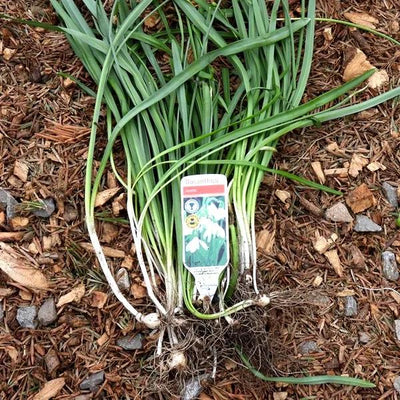
A dry bulb is dormant. Its roots have withered, it has no leaves, and you plant it in autumn. A bulb in the green is still growing, with live roots and foliage, and is moved in late winter or spring, usually just after flowering.
The name is a slight misnomer. Later in the season the leaves often arrive yellowing and limp. This is normal and does no harm. The work that matters happens underground, where the dying leaves are feeding next year’s flowers back into the bulb.
Why buy bulbs in the green?
- You can see they’re alive. These are the only bulbs that arrive with proof of life.
- Less stress, faster results. Moved in growth, they typically establish and flower sooner than the same species planted dry.
- No more guesswork. Your existing clumps are up and showing, so you can fill the gaps without spearing what’s already there.
- You know where you’ve planted. The leaves mark the spot.
There are trade-offs. Bulbs in the green are more fragile than dry ones, need planting within a day or two, and cost a little more. Nobody has run a proper trial to settle the question (the RHS sits politely on the fence), but snowdrops in particular are slow to get going from dry bulbs, and most experienced growers would rather move them in leaf.
Our bulbs in the green
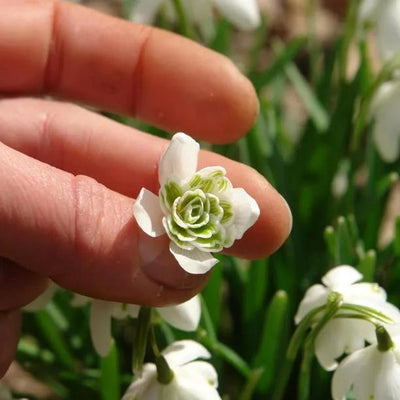
Snowdrops in the green (Galanthus nivalis)
The common snowdrop, and the one most worth buying this way. Nodding white flowers, each inner petal marked with a green “v”, from January to March at 10–15cm. They naturalise under deciduous trees and hedges, spreading into drifts if left undisturbed.
Shop snowdrops in the green →
Winter aconites in the green (Eranthis hyemalis Cilicica Group)
Waxy, buttercup-yellow cups, each sitting on a ruff of finely cut leaves, from January into March. Aconites hold the RHS Award of Garden Merit and are among the first flowers bees find in the year. They do their growing while the trees above are bare, which is why they thrive under horse chestnut and sycamore, where little else will. They need soil that doesn’t bake dry in summer.
Shop winter aconites in the green →
Native bluebells in the green (Hyacinthoides non-scripta)
The true British bluebell: violet-blue, honey-scented bells hanging from one side of an arching stem, 30–40cm tall, in April and May. They ask for dappled shade and moisture-holding soil, and they’re happiest under birch or along the foot of a country hedge. Wild bluebells are protected by law, and digging them from woodland to sell is illegal. Ours are field grown and never taken from the wild. To check a bluebell is native, look at the pollen: creamy white means native, while blue or greenish pollen suggests the Spanish or hybrid form.
Shop bluebells in the green →
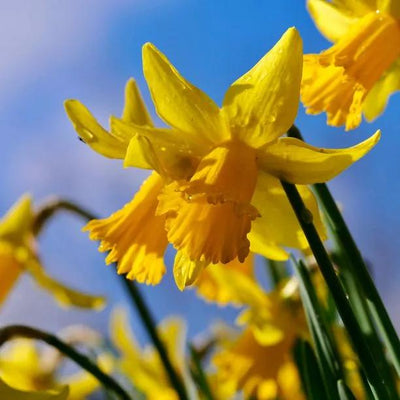
Wild daffodils in the green (Narcissus pseudonarcissus)
The Lent lily, Britain’s native daffodil. It is smaller and more graceful than any garden hybrid, with pale primrose petals around a deeper yellow trumpet, 20–30cm tall, in March and April. These were the daffodils Dorothy and William Wordsworth came across beside Ullswater in April 1802. Plant them in grass, an orchard or a woodland edge, and they will spread slowly into the kind of drift that looks as though nobody planted it.
Shop wild daffodils in the green →
When do bulbs in the green arrive?
The season runs from February into spring. Snowdrops and aconites come first, then bluebells and wild daffodils. Each batch is lifted just before despatch so the bulbs spend as little time out of the ground as possible. Bluebells are timed to arrive on a Thursday or Friday, so you can plant them that weekend.
How to plant bulbs in the green
- Plant on arrival if you can. If you can’t, keep them somewhere cool and out of the sun, with the roots damp, for no more than a day or two.
- Match the old depth. Look for the point on the stem where white turns to green. That line was the old soil level, so set it at soil level again.
- Plant in small clumps of three to five rather than singly. For bluebells, allow 40–50 bulbs per square metre.
- Firm in and water if the ground is dry.
- Leave the leaves alone. Let the foliage die back naturally, because it is feeding next year’s flowers.
For more detail, read How to Plant Daffodils in the Green and Winter Planting Snowdrops in the Green.
Frequently asked questions
Why are the leaves on my bulbs in the green turning yellow?
This is entirely normal, especially later in the season. The leaves are dying back and returning their nutrients to the bulb. As long as the bulb itself is firm, it is fine.
Are bulbs in the green better than dry bulbs?
For snowdrops, most growers think so, because they establish faster and flower sooner. Aconites and bluebells also transplant well in growth. Dry bulbs can succeed too, but you plant them blind in autumn.
When should I plant bulbs in the green?
Plant them as soon as they arrive, between February and spring. Don’t wait for the leaves to look perkier, because they won’t.
Can I plant bulbs in the green in pots?
Yes, but they do better in the ground. If you pot them up, plant them out in the garden once the foliage has died back.



 Sign In
 Saved items


 5 Star Service Rating




 Secure, One-Tap Checkout
 5 Star Feefo Rating
 Hand Picked, Delivered to Your Door!
 1 Year Bareroot Guarantee
 Platinum Trusted Service Award 2026
 Mail Order Plant Experts - Est. 1949
 1 Year Bulb Guarantee