Buying Cherry Blossom Trees Online:
Order Potted Cherry Blossom Trees Now For Spring Delivery
Order Bareroot Cherry Blossom Trees For 2026 Spring Planting Season
Cherry Blossom trees are among the most popular ornamental specimens for gardens and parks, giving some of the best flowering displays of any tree in spring.
They generally have good, sometimes truly outstanding, autumn colour, reaching a range of mature sizes from small to medium-large to suit most gardens.
Our range of three wild Cherry tree species is also listed in this section, which have less impressive flowers but much more wildlife value.
None of the flowering Cherries in this section carry fruit that humans would enjoy; browse our delicious sweet or sour cherry trees for those.
What size Cherry Blossom trees should I buy?
- If you are not in a hurry to get a full sized Cherry tree, we recommend starting with the smaller 6/8cm girth size.
- If you are in a hurry and need instant impact, then go for the 8/10cm girth size.
Standard trees are measured by their girth 1 metre above the ground, and young saplings are measured by height.
So, a 6/8cm Standard Cherry tree is much bigger than a 60/80cm Cherry sapling tree or hedge plant.If a tree is available in both sizes, it will be noted in the product description.
- Flowering cherries are generally easy to grow on any soils except waterlogged.
- Full sun or light shade.
- Growing on clay tends to reduce vigour, which is good for urban gardens.
- Their shallow roots will rise up in lawns and lift nearby paving stones, paths.
- Little to no pruning (remove suckers).
- Sheltered locations are best for blossom.
- Great pollution tolerance.
These shallow rooted trees are not ideal for small borders, and most of them do best planted in open ground, or on the edge of woodland.
Consider under-planting with early bulbs like Winter aconites and snowdrops.
Prune only where you have to in spring-summer, try to let the tree's natural form develop. Remove suckers from at or below the graft union.
The planting and delivery season for bareroot Cherry Blossom trees is November - March.
- When your order is ready: your mail order trees are delivered by next working day courier (not the next working day after ordering!)
- Friendly support: if there is anything wrong with your plants when you inspect them, Contact Us within 5 working days
All bareroot plants are covered by our Refund Guarantee, so you can give them a whirl with complete confidence.
Given proper care and attention, flowering cherry trees have a long life span and can live up to 250 years.
Which Cherry Blossom Tree Should I Choose?
Double flowered varieties look best singly where they can be admired from all sides, while single-flowering trees are traditionally used in rows or group plantings.
Spire has a columnar habit when young, suitable for small gardens, but Rancho and Amanogawa are even more fastigiate (thin and upright). Okame, with red pink early blossom, has shrub-like habit, while Kiku Shidare has big flower clusters with a small and weeping habit.
Kanzan, mid-pink, and Shirofugen, pink and white, are good larger trees.
The Autumnalis cherries, White and Pink, flower sometime between October-February, when there aren't many other flowers around.
Tibetica is not strictly in the club, but with its burnished mahogany bark provides four seasons of interest.
None of the flowering Cherries in this section carry fruit that humans would enjoy; browse our delicious sweet or sour cherry trees for those.
Where Can I Grow Cherry Blossom Trees?
Cherry blossom trees are hardy and should thrive in any well drained soil type with plenty of sun.
They do not like wet, waterlogged conditions, but otherwise thrive in heavy clay.
When and How do I Plant Cherry Blossom Trees?
You can plant Pot Grown Cherry Blossom trees at any time of year, and Bareroot trees during winter, except when the soil is frozen.
The best time to plant Cherry Blossom trees is from late Autumn to early Spring (November to March), using bareroot stock, which is cheaper, easier to carry and plant, and tends to establish even better than their pot grown equivalents.
Watch our Tree Planting Video for instructions.
Although optional, we strongly recommend using Rootgrow.
Aftercare:
Remember: the two biggest killers of recently transplanted trees are underwatering, and being choked by weeds and grass.
- Regular, thorough watering is vital during dry weather in their first spring and summer, and highly recommended the following summer, especially if there is a heat wave.
- Either remove weeds and grass by hand periodically, or use some form of mulch to suppress them.
Tree Planting Accessories
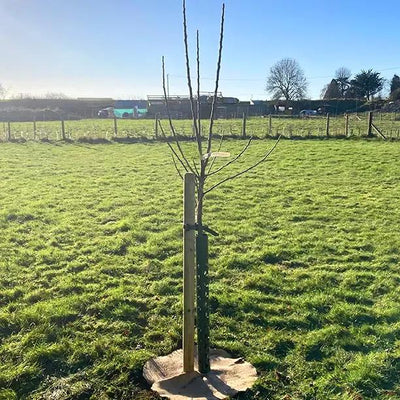
Standards that are 6/8cm in girth and upwards are quite big trees, so they need a tree planting stake and a tree tie (with a buffer between the tree and the stake) during their first couple of years.
A mulch mat is will suppress weeds & grass, and preserve moisture: remember that dry soil and competition with weeds are the two biggest killers of new trees.
Even with a mat, you should remove anything that manages to grow up between the mat and the trunk in late spring and summer.
You can buy those items separately, or save money with our Tree Planting Pack.
You definitely need a tree guard if there are deer or rabbits about.
In urban areas with no wild animals, tree guards are great for protecting against mowers and strimmers.For that purpose, you can cut one tree guard into several pieces about 20-25cm long, to act as skirting around the base of the tree.
Mycorrhizal Fungi
We cannot recommend using Rootgrow fungi enough: it makes a huge difference, especially with larger trees, which are scrambling to regrow the root systems that they lost when we dug them up, in order to support their now top-heavy growth above ground.
Mycorrhizal fungi assist the roots in accessing soil nutrients and water, and protect the roots from soil critters.
In return, the tree shares sugar with them, and the result can be over 50% more growth above ground!
When do cherry trees blossom and how big do they grow?
You can expect pink or white flowers after the first year, depending on the variety. Larger varieties of cherry tree can take longer to bloom. On average, flowering cherry trees are fast growers and take about 5-10 years to reach maturity.
When should you prune a flowering cherry tree?
Ornamental cherry trees grow quickly, so formative pruning is often necessary to remove ingrowing branches that point inside the canopy.
On mature trees, there will be spindly, typically upright growth along the main branches that should be cleaned off every couple of years as needed.
Unlike most trees and shrubs, winter is not the ideal time to prune cherries, due to the (admittedly low) risk of Silver Leaf Disease.
The best time to prune is during the growing season from Spring to late summer.
But as always, remove DDD wood at any time: Dead, Diseased or Damaged.
In general, it is best to use thinning cuts (removing an entire stem down to where it emerges from a larger branch or trunk) rather than heading cuts (cutting a stem part of the way along its length), because heading cuts on cherries tend to produce brushy, unattractive growth.
Cherries often produced suckers from the base, which should be removed when they are still new.
Cherry Blossom Culture & History
Japanese cherry trees, Sakura, are ritually admired in Hanami ceremonies, a poignant (also lively) yearly gathering in parks. People toast spring and the gods, admire the most special cherries in full blossom, and remember mono no aware, 'nothing lasts forever', the truth of the world's beauty being underwritten by its endings, for the cherry blossom is most lovely as the petals begin to fall, whispering "not long now".
In the UK, there is an annual build up to the cherry blossom display: first the snowdrops, then daffodils, then blackthorn (a cousin of wild cherries & plums), leading up to the Japanese Cherry Blossom in white and pink, followed by the flowers of quinces, apples and pears.
Collingwood "Cherry" Ingrams began gardening in the 1920s, and on a plant collecting mission to Japan became the British world authority on Japanese cherries. He bred hybrids and introduced new Japanese varieties to Britain, as well as saving the last Great White Cherry Tree.


 Sign In
 Saved items


 5 Star Service Rating




 Secure, One-Tap Checkout
 5 Star Feefo Rating
 Hand Picked, Delivered to Your Door!
 1 Year Bareroot Guarantee
 Platinum Trusted Service Award 2026
 Mail Order Plant Experts - Est. 1949