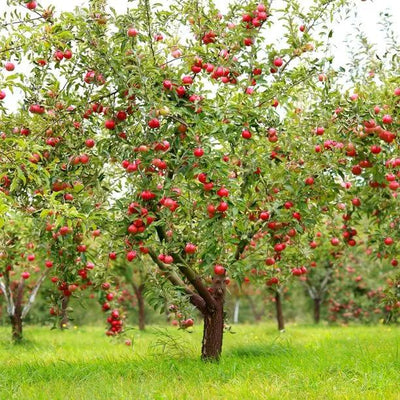
Buying Fruit Trees Online:
Order Potted Fruit Trees Now For Year-Round Planting
Order Bareroot Fruit Trees For 2026 Spring Planting Season
- When your order is ready: your mail order fruit trees are delivered by next working day courier (not the next working day after ordering!)
- Friendly support: if there is anything wrong with your plants when you inspect them, Contact Us within 5 working days
All bareroot plants are covered by our Refund Guarantee, so you can give them a whirl with complete confidence.
Fruit trees and soft fruit bushes are great value, easy to care for, and after a bit of patience, fun to harvest.
Fruit from your garden always tastes better than the irradiated, cold-stored stuff sold in supermarkets!
- Grown on the best soils for each group, developing strong root systems that will establish rapidly.
- Virus-free rootstocks & scion or budwood
Fruit trees and bushes are zero-rated for VAT.
What should I know about buying potted fruit trees?
The majority of trees in the UK are planted bareroot in the Winter planting season, November to March.
Pot-grown trees are equally good and can be planted year round as long as you water them!
Our potted fruit trees should be planted out promptly, either to open soil, or a larger container.
They could live in the pot they come in, with irrigation, for almost a year before urgently needing repotting. But that nursery pot is intended as a "lifeboat" to get the trees to your garden, not a long term home.
Which fruit trees can I buy in pots?
The most popular fruit tree varieties are both grown in pots, and sold bareroot.
Other wonderful varieties are only available bareroot, during the winter bareroot planting season (November to March).
To add colour to a new orchard while you wait for it to become productive, a cheerful range of garden bulbs planted between your trees in Autumn is a sure bet: a few clumps will transform the Spring display, but you could grow alleys of cut and wild flowers between rows of fruit trees.
Should I Buy Bareroot or Pot Grown Fruit Trees?
Bareroot plants are cheaper, easier to handle, and even more certain to establish well, but they are only available during winter, November to March.There is nothing wrong with pot grown fruit trees, which have the advantage of being ready to plant at any time, as long as you can water them without fail during the growing season.
FAQ
- How to Get Fruit Quickly? Remove all fruitlets after flowering in the first year they appear, and all or most of them in the second year.
- Fruit Tree Pollination An apple won't pollinate a cherry, and one apple tree will not pollinate another of the same variety. However, in most parts of the UK, there are already pollination partners in your area, especially for apples.
Fruit Tree Delivery Sizes: Maidens, Bushes & Half-Standards
Most of our fruit trees (sold bareroot or pot grown) are sold in more than one size: something to fit almost any garden.
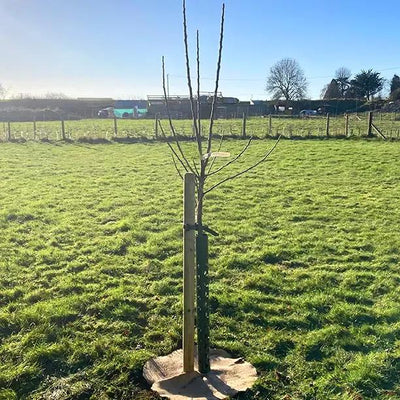
Maidens are unbranched, graftedone year prior.
- They are the youngest, cheapest fruit tree you can buy.
- They are the basic "building block" from which all other tree shapes are formed (apart from mini-patio trees).
"Bush" and half-standards forms are branched, grafted two or three years prior.
- They are the most popular options for most gardeners, giving you a real head start on a mature tree:
- The difference is that the bush form has a short trunk about 75cm tall, and the half-standard form has a trunk about 1.25cm tall.
- The bush form is easy to harvest and takes up less space. A strimmer may be easier to get under it than a lawnmower.
- The half-standard form produces more fruit, and you can push a mower around it more easily.
Read more about fruit tree sizes.
Choosing Fruit Trees
Quickly Choose the Best Variety Lists
What are the best fruit trees for the UK?
Our range of fruit trees includes well known supermarket varieties and old heritage favourites.
We try to give enough info to make a decision based on your area, but wherever you are, good soil and sun are ideal.
The apple and the blackberry are the essential British fruits, along with the blackcurrant for jelly (or Ribena!) and the gooseberry for dessert.
Fruit needs sun to sweeten, so in the shade it's good to grow acidic, sour varieties for cooking and jam, like a Bramley or Grenadier cooking apple, or the Morello sour cherry.
Our smallest fruit tree is Little Miss Figgy dwarf fig, perfect for a pot on a sunny patio, or for the front of a hot border.
- We no longer sell ready-made fan, espalier, or cordon fruit trees for training on wires: you can make your own by starting with a maiden tree.
- We no longer sell "Franken Family fruit trees" of multiple varieties grafted onto one tree; you can buy rootstocks to create your own.
Which Fruit Tree Shape Should I Choose?
The best fruit tree shape for you will mostly depend on how much space you have.
- For a normal town garden, a tree prepared as a bush (i.e. with a short trunk) is ideal, and should grow to under 3 metres.
- A half standard is a proper orchard tree that will reach around 4 metres.
- Selected varieties are available as ready-made cordons, which are grown diagonally on wires, usually against a sunny wall.
One-year-old maidens are the cheapest way to buy a fruit tree, from which you can make any shape; you must start with a maiden for training fans or espaliers.
Our fruit tree shapes page has more details.
Pruning Fruit Trees
You must prune your trees from the start. Failure to prune will result in an unproductive mess.
Prune fruit trees with sharp, clean tools.
Ideally, disinfect your tools with alcohol between each tree, and between each cut if there is any sign of disease.
As with any tree, remove DDD wood at any time: Dead, Diseased, and Damaged wood.
Do most pruning in winter, except on stone fruit (Prunus species: cherry, plum, gage, damson), which should ideally be pruned in dry weather during late spring and summer, when the sap is flowing, to prevent Silver Leaf disease.
Our pruning videos show you how easy it is to train maidens into your own Open Centre Bush or Half Standard forms, and cordons for spur bearing apples and pears (if you buy those forms ready-made, skip the year one video and start at year two).


 Sign In
 Saved items


 5 Star Service Rating




 Secure, One-Tap Checkout
 5 Star Feefo Rating
 Hand Picked, Delivered to Your Door!
 1 Year Bareroot Guarantee
 Platinum Trusted Service Award 2026
 Mail Order Plant Experts - Est. 1949