Order Potted Rose Bushes Now For Spring Delivery
Order Bareroot Roses For 2026 Spring Planting Season
High quality rose bushes are among the most popular British garden plants, often with beautifully scented and always sumptuous looking flowers beginning in late May with some varieties still going strong into the foothills of winter.
Roses are enormously tough, transplant reliably, tolerant of a range of conditions and soil types and respond well to pruning.
- Bareroot roses cost and weigh less than pot grown. They usually need less watering in their first year, and will generally outgrow their potted equivalents.
- Pot grown plants give you a longer planting season, make for prettier gifts (especially our gift wrapped roses!), and will grow happily in their pots if planting is delayed.
- Some varieties are only delivered in pots, others are delivered bareroot in winter and in pots the rest of the year.
Almost all our roses are grafted, using the best rootstocks. The young plants are grown in heavy clayey soil with masses of organic matter to give them the perfect conditions to grow into well-shaped plants with strong roots.
- When your order is ready: your mail order rose bushes are delivered by next working day courier (not the next working day after ordering!)
- Friendly support: if there is anything wrong with your plants when you inspect them, Contact Us within 5 working days
All bareroot plants are covered by our Refund Guarantee, so you can give them a whirl with complete confidence.
Types of Rose Bush
- Shrub: The classic, versatile border or hedging rose, includes Old and Modern varieties. Can be big enough to serve as a small climber.
- Hybrid tea (Modern bush rose): Among the best varieties for cut flowers, with one flower per stem. They tend to flower in three big flushes during summer, and typically tolerate partial shade well.
- Floribunda (Modern bush rose): Profuse clusters of flowers on each stem, that repeat bloom almost continuously all summer - this exertion means that they are not shade-tolerant. They are typically short, and good for low ornamental hedging. Modern bush rose.
- Climbing: Tidier and less vigorous than a rambler, with stiffer new stems. Flowers twice a year. Ideal for covering walls & growing along fences.
- Rambling: Bushier and more vigorous than a climber, with more flexible new stems. Usually flowers once a year. Ideal for hiding sheds & growing up a tree.
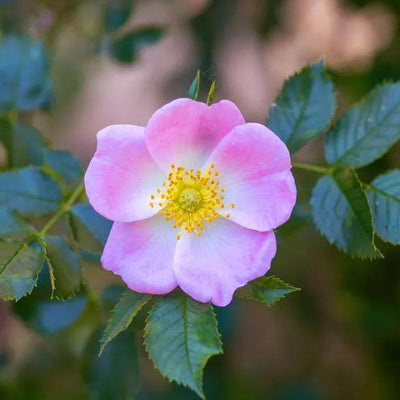
- Hedging / Wild: Rugged thorny hedge plants, usually in a mixed country hedge, or grown as a wildlife friendly barrier. They have small, simple flowers, and produce the best rose-hips for consumption.
- Patio: Most types of rose have dwarf varieties, perfect for growing in pots. Some of them are referred to as "ground cover roses" - in our opinion that is a stretching the definition of ground cover a bit too far, but it's close enough.
- Special Occasion: Purely based on their name, these are thoughtful gifts for all sorts of occasions, be they joyous or heartbroken.
A range of garden bulbs with a border edging of lavender is a classic combination to add interest around the base of rose bushes and cover up their legs a bit in spring.
Where Can I Grow Roses?
You can grow roses almost anywhere in the UK.
They are very hardy, and apart from waterlogged sites, there are roses suitable for any soil type, and shade-tolerant roses for North-facing walls.
The ideal growing conditions are in full sun, but most varieties will tolerate light shade as long as they are not crowded by neighbouring shrubs of the same height or taller.
Still, you will get the best flower displays in a sunny, sheltered location.
Roses love heavy clay soil as it does not waterlog in winter, but any soil with good drainage can be improved by digging in well-rotted organic matter, and then yearly mulching.
Rose Replant Disease
Replant disease affects several plants, especially roses and other plants in the Rosacea family.
It occurs when you remove an old rose, and plant a new rose straight away in the same soil.
There are three main ways to avoid rose replant disease:
- The easiest way: plant a different shrub!
- The easy way: wait at least a full 12 months before planting a new rose in the site of an old one. Grow some annual bedding plants there instead for the interim - annual Sweet Peas are great because their roots fix nitrogen, but any mix of wild flowers is good.
- The hard way: dig out a block of soil at least 1 metre square on the surface and 40-50cm deep, and replace the soil with fresh stuff. Lining the sides of the hole with thick, plain (not glossy) cardboard may help.
Whichever method you choose, apply Rootgrow fungi when you replant the new rose, and feed it with rose food during the growing season.
Choosing Roses
When choosing shrub / bush roses for any kind of mass planting, our advice is to use the same variety in groups of three, and to stick to a narrow palette of two or three colours.
Climbing and rambling roses are different: they tend to be planted singly, so choose according to eventual size when growing on a wall, fence or into a tree, in whatever colour you prefer.
Think about colour co-ordination more when you are growing mixed climbing roses on arches or pergolas.
Thorns are usually bad right next to paths, doors and windows - stumbling into them is no fun.
Which are the best rose varieties?
The most popular award-winning roses of all time for British Gardens are:
Vigour
Vigour comes up a lot when choosing roses, as it describes how tall and wide the variety will grow.
Depending on the garden, a lot of people are looking for either "the most vigorous one", or one that's "not too vigorous".
A vigorous rose can surmount sheds, trees and large walls. The biggest ramblers may be too much for a rciketty old pergola or shed, which could collapse under the weight!
Before you buy a rose, make sure its spread and height at maturity is suitable.
When and How Do I Plant Roses?
What is the best time to plant roses?
Bareroot roses are by far the best value, the easiest to handle & plant because they weigh so little, and offer the most selection.
- Bareroot roses are only planted from about November to the end of March, weather depending. The perfect months are November and March, but anytime in winter is fine.
• Plant potted roses at anytime, as long as you can water them during dry summer weather. In the hottest part of mid-summer, it is preferable to delay planting until the weather cools a bit to reduce stress on the plants.
How to Plant Roses
Soil preparation is an important investment: a rose bush should live for at least 30-40 years.
Dig a square planting hole that is comfortably wide enough to spread the roots out, so they do not touch the sides, but not so deep that the graft union is buried*.
Improve the soil that you removed by adding about 25% well-rotted compost/manure before returning it to the hole, unless you are planting in clay, in which case add nothing to the hole. When planting bareroot roses, it often helps to make a small mound at the bottom of the planting hole to "sit" the rose on and to spread its roots out over.
Wet the roots, and then sprinkle them with Rootgrow before backfilling the hole.
Water well immediately, and all through their first spring and summer.
*How Deep Should I Plant My Rose?
The short answer is that it really doesn't make a huge difference in most cases: you can plant so that the graft union is above soil level, at soil level, or a couple of inches below soil level.
The advantage of burying the graft union is that the rose will be very stable in the ground and won't suffer from "wind rock", which tends to affect taller shrub roses.
The advantage of keeping the graft union above ground is that it will always be completely clear which shoot are root suckers that need to be removed.
Even with a deep planted rose, it should still be obvious which is which: a sucker will have bright green bark and leaves, unlike most garden roses which are tinged with at least a little red.
If a sucker gets old enough to flower, they will be in small clusters, with a single row of white petals and yellow anthers.
Aftercare
Thereafter, deadhead, prune according to the type of rose (lots of advice on this), rake up and burn leaves and prunings and mulch in spring with well-rotted compost.
Do roses need a lot of water?
All new plants need to be watered well during their first, and possibly second, year while they establish deep roots.
In hot weather, most established roses like watering to keep on flowering well. With scented varieties, it is better to water thoroughly once every week or two in dry weather; more regular watering tends to impair their aroma.
Try not to water the whole plant, only the roots, to reduce risk of fungal diseases.


 Sign In
 Saved items


 5 Star Service Rating




 Secure, One-Tap Checkout
 5 Star Feefo Rating
 Hand Picked, Delivered to Your Door!
 1 Year Bareroot Guarantee
 Platinum Trusted Service Award 2026
 Mail Order Plant Experts - Est. 1949