


Only 1 Left
Sold as:

from £6.99

Only 3 Left
Sold as:
from £19.99
 5 Star Service Rating




 Secure, One-Tap Checkout
 5 Star Feefo Rating
 Hand Picked, Delivered to Your Door!
 1 Year Bareroot Guarantee
 Platinum Trusted Service Award 2026
 Mail Order Plant Experts - Est. 1949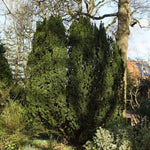
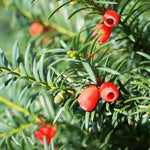
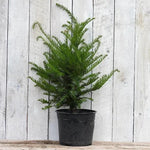
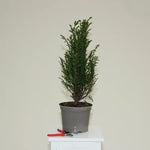
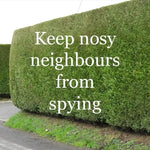
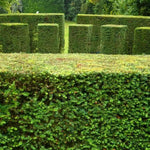





Yew hedging (Taxus baccata) is the classic dense evergreen conifer for the sharpest formal hedge going — deep green, tight-clipping, and unlike almost every other conifer, able to regrow from old wood if you ever need to cut it hard back. It's slow to earn its reputation for slowness: young plants can put on a metre in under three years.
Most conifers punish a hard cut with a permanent brown gap — cut back into old wood on a leylandii or a thuja and nothing grows back. Yew is the standing exception. Renovate an old, gappy yew hedge hard, right back into bare wood, and it answers with fresh green growth from the cut surface. That single trait explains why centuries-old yew hedges and topiary survive in gardens where lesser conifers would have been dug out and replaced generations ago.
It asks for little beyond drainage. Full sun or full shade, chalk or clay, exposed or sheltered — yew copes with all of it, and once established shrugs off drought that would scorch most evergreens. The only ground it won't tolerate is permanently waterlogged soil.
Yew has as strong a claim as any tree to being Britain's longest-established native — the Fortingall Yew in a Perthshire churchyard is widely reckoned the country's oldest tree, with age estimates ranging from 2,000–3,000 years (Woodland Trust) to as much as 5,000 years (Forestry and Land Scotland). Nobody can date it precisely, because old yews rot hollow from the centre, erasing the growth rings that would tell the true age (Woodland Trust).
That same toughness made it a weapon: the Mary Rose, Henry VIII's flagship, went down in 1545 carrying at least 137 complete yew longbows, all recovered intact by the Mary Rose Trust — a rare, dated snapshot of just how central yew once was to English military power. The tree's toxicity has a modern use too: paclitaxel, the cancer drug derived from yew, traces back to compounds first identified in the tree's foliage and bark.
Yew is almost always grown alone, as the dark, formal backdrop that makes everything planted in front of it look better — a border of climbing roses or bright herbaceous colour reads far more strongly against solid yew than against a fence or wall. Within the hedging range, it pairs editorially with green beech and hornbeam as the evergreen alternative where you'd rather not wait for a deciduous hedge to thicken. If instant height matters more than establishing your own bareroot hedge, our rootballed yew gives you a mature hedge from day one. Browse the full evergreen hedging range for other formal options.
Ashridge hedging is grown under contract by specialist UK growers, to our specification — never surplus stock from elsewhere. We're one of the UK's largest bareroot hedging sellers, with a purpose-built cold store keeping stock in top condition through the season. Bareroot yew is guaranteed to grow for 12 months, correctly planted and cared for.
Yes — every part of the plant except the soft red flesh around the seed is highly toxic, and this includes dried hedge clippings. Never plant yew where horses or livestock can reach it, and keep dogs and children from chewing cuttings after a trim.
Yes — uniquely among common conifers, yew regrows reliably from old wood, so a hard renovation cut back to bare stems will regenerate. Do it in early spring and expect fresh growth within a season.
Rootballed yew gives you an instant, mature hedge rather than young whips that take years to thicken — useful where privacy is needed now. It comes at a premium, and unlike bareroot yew it isn't covered by the 12-month guarantee.
Plant smaller bareroot yew at 3 per metre, 33cm apart, in a single row. Larger plants can go in at wider 50cm spacings.
No — the 12-month guarantee covers bareroot yew, planted and cared for correctly. Potted yew, being evergreen rather than a winter-delivered deciduous plant, sits outside that guarantee.
Once a year, in late summer, is enough for a mature yew hedge — one of the lowest-maintenance formal hedges you can grow.


 Sign In
 Saved items