


Sold as:

from £10.95

Sold as:
from £19.99
 5 Star Service Rating




 Secure, One-Tap Checkout
 5 Star Feefo Rating
 Hand Picked, Delivered to Your Door!
 1 Year Bareroot Guarantee
 Platinum Trusted Service Award 2026
 Mail Order Plant Experts - Est. 1949
 1 Year Bulb Guarantee
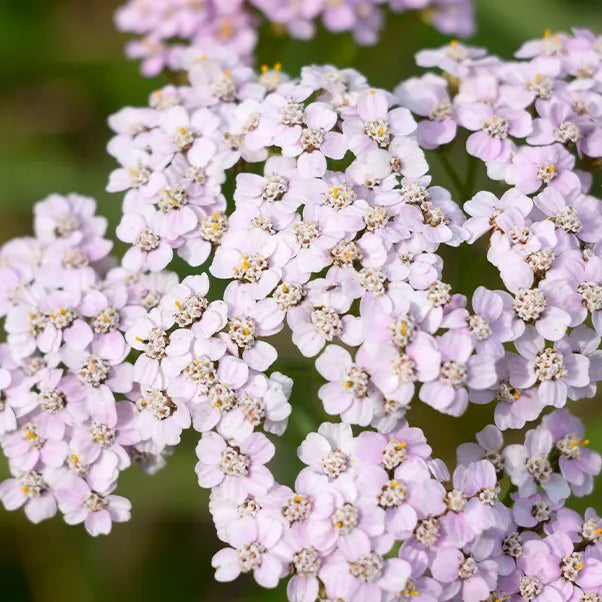




Achillea millefolium 'Love Parade' is a pale pink yarrow with flat-headed flower corymbs over feathery grey-green foliage, reaching 60cm in flower. It blooms from June through August, tolerates poor dry soil and drought once established, and is one of the better pink millefoliums for holding its colour without fading to white in the sun.
Achillea millefolium cultivars vary a good deal in colour stability — some start pink and quickly bleach to near-white in warm weather. Love Parade holds its pale pink rather better than most, which is the main reason to choose it over the straight species. The flower heads are the characteristic flat-topped corymbs of yarrow, appearing from June, and each one is composed of dozens of tiny individual florets that are excellent for pollinators — bees work them for weeks. The foliage is the finely divided, fern-like grey-green that gives yarrow its common name (Achillea is native to Britain and the feathery leaves were supposedly used to staunch wounds). Cut the spent flower heads off once they fade and you will generally get a second, smaller flush in late summer.
Yarrow is one of the most drought-tolerant border perennials available. Once established, Love Parade asks for almost nothing — poor, well-drained soil, full sun, and the occasional haircut. Heavy, rich, or wet soils produce lush growth and floppy stems; poor soil keeps it compact and upright. It spreads steadily by rhizomes and can be divided every three or four years to maintain vigour and to increase stock. For naturalistic or low-maintenance plantings it is hard to fault.
Yarrow belongs in the naturalistic border — the prairie or meadow style — where its flat flower-heads create a horizontal layer that contrasts with upright or airy forms. Centaurea montana flowers earlier in May and June with rich blue thistle-like flowers, and the two planted together give successive waves of colour through summer. Echinacea White Swan follows later in July and August with daisy forms that complement the flat achillea heads. For a strongly pink-and-blue combination, Caradonna salvia makes an excellent vertical spike against the horizontal achillea plate. The lavender collection offers the same sun-and-drought requirements and silver foliage that sets off the pale pink.
We use peat-free compost and biological pest controls throughout. Achillea is among the most generous and unfussy perennials you can plant — we stock it with confidence in almost any sunny spot. Every plant is guaranteed. See the full perennial range.
Yes, steadily, by underground rhizomes. This is generally useful for filling gaps in a border, and the plant rarely becomes a problem. Divide every three to four years in spring to keep it vigorous and to prevent the centre of the clump becoming woody and bare.
It copes with clay if the drainage is reasonable, but it does best in free-draining or even poor soil. Heavy clay that stays wet in winter leads to root rot and short-lived plants. If your clay is heavy, plant on a slight mound or incorporate grit at planting.
All pink achillea millefolium cultivars fade to some degree in full sun and high temperatures — it is in the nature of the pigment. Love Parade holds its colour better than many, but some fading in midsummer is normal. Cut the faded heads off promptly and the new flush tends to come in a cleaner pink in cooler late-summer conditions.
Love Parade is a single-colour selection — pale pink. Summer Pastels is a seed-raised mix producing plants in a range of pastel colours including pink, salmon, lilac, cream, and yellow. Love Parade gives you a consistent pure-pink planting; Summer Pastels gives you a mixed palette with natural variation across the clump.
Yes — yarrow is one of the best perennials for pollinators. The flat corymbs provide landing platforms for a wide range of bees, hoverflies, and butterflies. Each individual flower head is composed of dozens of small florets, providing substantial quantities of nectar over a long season.


 Sign In
 Saved items