


Sold as:

from £10.95

Sold as:
from £19.99
 5 Star Service Rating




 Secure, One-Tap Checkout
 5 Star Feefo Rating
 Hand Picked, Delivered to Your Door!
 1 Year Bareroot Guarantee
 Platinum Trusted Service Award 2026
 Mail Order Plant Experts - Est. 1949
 1 Year Bulb Guarantee
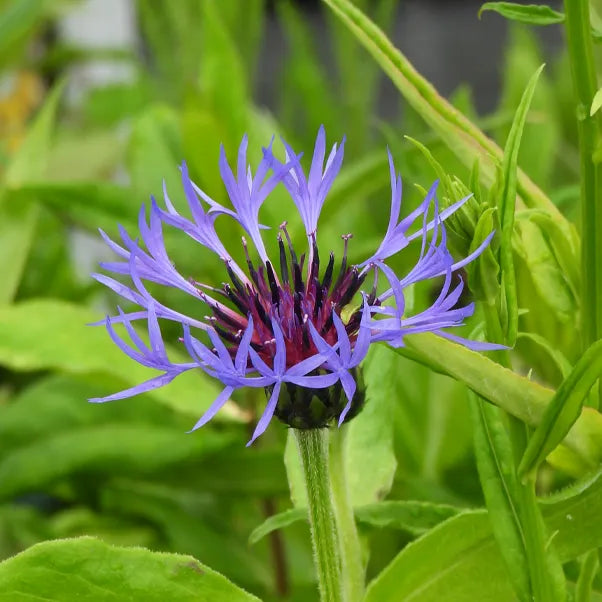




Centaurea montana is a perennial cornflower with large, rich blue flowers in May and June — a deeper, truer blue than most blue perennials — over silver-grey foliage at about 50cm. Cut back hard after the first flush and it flowers again in September. Fully hardy, tolerates poor soil, and invaluable for early summer colour.
The perennial cornflower opens in May, sometimes earlier, and the blue it produces is one of the more honest blues in the garden — not indigo-purple like some salvias, not washed-out blue-mauve like many campanulas, but a clear, saturated cornflower blue with contrasting purple-red inner florets. The flowers are large for a centaurea, each one a good 5–6cm across with the characteristic spidery, fringed petals of the genus. They are excellent for cutting, and pollinators — bumblebees particularly — find them irresistible from the moment they open. The foliage is silver-grey and woolly, making a good ground-level presence even when the plant is not in flower.
Cut back hard to the base once the first flush fades — this is important — and you will get a second flowering in September. This makes Centaurea montana more generous in its season than its relatively brief initial flower period suggests. The genus name comes from the centaur Chiron of Greek mythology, who was said to have used the cornflower to heal a poisoned arrow wound — which perhaps tells you something about the confidence people have always had in this plant's effectiveness, if not its pharmacological credentials. It spreads gently by rhizomes and self-seeds in a well-mannered way that is easy to manage.
The blue of Centaurea montana sets off warm and pale colours particularly well. Achillea Love Parade in pale pink flowers at the same time in June, and the two planted together give a classic blue-and-pink combination at similar heights. Achillea Summer Pastels introduces a mixed palette of creams and salmons alongside the centaurea blue. For height contrast behind, Delphinium Black Knight continues the blue theme at 150cm from June onwards, creating a blue palette at different levels. The lavender collection shares the same sun and drainage requirements and flowers slightly later, carrying the silver-and-blue combination into August.
We use peat-free compost and biological pest controls. Centaurea montana is one of those plants that earns its place in the border every year without any fuss — a reliable perennial for early summer colour that cuts well and brings in the bees. Every plant is guaranteed. See the full perennial collection.
Yes, if you cut it back hard after the first flush in June or July. Cut the whole plant down to within a few centimetres of the ground — don't be timid about it — and you should get a second flowering in September. Without cutting back, the plant uses its energy setting seed and the second flush either doesn't materialise or is very thin.
It is a close relative but a different plant. The annual cornflower (Centaurea cyanus) is smaller-flowered, shorter-lived, and grows from seed each year. Centaurea montana is a perennial — it comes back each year from the same rootstock, reaches a larger size, and has substantially bigger individual flowers. Both are blue, both attract pollinators, but they belong to different growing systems.
Yes, gently, by short rhizomes and self-seeding. Neither is aggressive. In most borders the spread is useful for filling gaps, and unwanted seedlings pull up easily. If you are growing it in a controlled formal setting, deadhead after the first flush (before cutting back for the second) to reduce seeding.
It prefers it. Rich, heavy soil leads to floppy stems and reduced flowering. Well-drained, ordinary to poor soil in full sun is the sweet spot. It is particularly good in chalk and limestone gardens, gravel gardens, and anywhere that drains freely.
Excellent. The deep, fringed flowers are particularly attractive to bumblebees, which work them intensively from May. It also attracts butterflies and various beetle species. The early flowering season (May onwards) makes it useful at a time when many other perennials have not yet opened.


 Sign In
 Saved items