


Sold as:

from £10.95



Sold as:
from £19.99
 5 Star Service Rating




 Secure, One-Tap Checkout
 5 Star Feefo Rating
 Hand Picked, Delivered to Your Door!
 1 Year Bareroot Guarantee
 Platinum Trusted Service Award 2026
 Mail Order Plant Experts - Est. 1949
 1 Year Bulb Guarantee
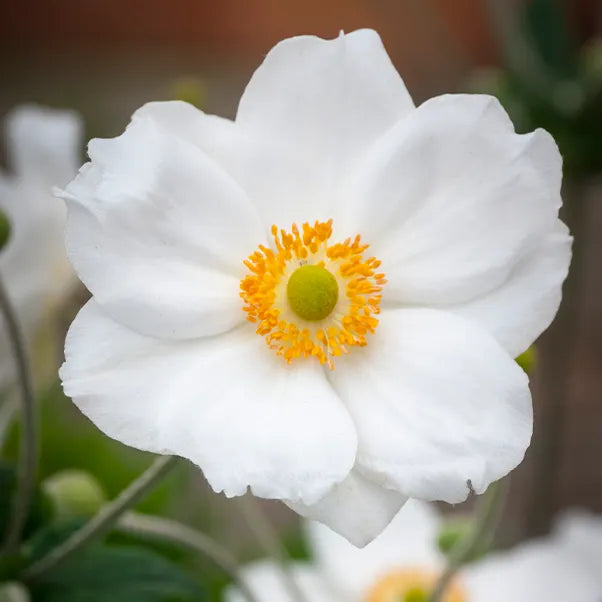




Anemone Snow Angel is a compact white-flowered Japanese anemone, reaching about 60cm with single flowers of clean white around a boss of golden stamens. It flowers from August into October, more manageable in spread than many Japanese anemones and well suited to smaller gardens.
Where the classic white Japanese anemone Honorine Jobert can reach 120cm and spread with real vigour, Snow Angel stays at around 60cm and is rather better behaved about spreading. The flowers are single, saucer-shaped, and a very clean white — five petals around a central knot of yellow stamens that catch the low September light nicely. It shares the season of all Japanese anemones: August to October, occasionally stretching into November in a mild autumn. This is a genuinely useful attribute. The late summer garden often lacks white at eye level, and Snow Angel provides it without drama.
Like all Anemone × hybrida cultivars, Snow Angel spreads by underground rhizomes. It is slower and less assertive than some, which may explain its appeal to gardeners with smaller spaces. Plant it once in a position it suits — part shade with reasonably moist soil is ideal, though it copes with sun — and it will reward you with a steadily expanding clump that needs nothing from you except to be left alone. The same caveat applies as to all Japanese anemones: it dislikes being moved. Choose the spot, plant it, and do not change your mind.
Snow Angel is made for pairing with its pink counterpart Queen Charlotte — the same season, complementary colours, matching scale. Together they give a fortnight of layered pink and white through August and September that is hard to achieve with any other combination. For foliage interest through the season, the hosta range provides substantial contrast underneath, particularly the blue-green and gold varieties. Earlier in the year, Bergenia Fire and Ice bridges the gap — white flowers from February, then handsome evergreen leaves through summer while Snow Angel builds its stems.
We use peat-free compost and biological pest controls, and the team that grows your plants packs your order and answers your questions. Japanese anemones are among the least demanding and most rewarding perennials for autumn colour — Snow Angel's compact habit makes it particularly useful for smaller spaces. Every plant is guaranteed. See the full perennial collection.
Both are single white Japanese anemones, but Snow Angel is significantly more compact — 60cm against Honorine Jobert's 120cm — and spreads more slowly. Honorine Jobert holds the RHS AGM and has a slightly larger flower; Snow Angel is the better choice for smaller gardens or for growing at the front of a border.
They tolerate deep shade but flower less freely than in part shade or dappled light. Part shade — under a deciduous tree or on a north-facing border that gets some indirect light — is ideal. Full sun works well if the soil stays moist. Deep shade against a building or under a dense conifer is the one situation to avoid.
Reasonably so. Deer tend to leave Japanese anemones alone, though no plant is entirely deer-proof where pressure is high. In most gardens with occasional deer visits they come through untroubled.
Yes — they often do very well in clay, which retains the moisture they like. The main requirement is that it does not become waterlogged in winter. Improve drainage with horticultural grit at planting if your clay is particularly heavy, but do not add excessive organic matter as this can make Japanese anemones too comfortable and very vigorous.
Spring, just as growth is appearing. Dig out sections of root with a spade and replant immediately. Don't be too gentle about it — they can take rough handling better than you might expect. Autumn division is sometimes done but spring is more reliable as the plant recovers more quickly in rising temperatures.


 Sign In
 Saved items