

Sold as:

from £6.99

Sold as:
from £19.99
 5 Star Service Rating




 Secure, One-Tap Checkout
 5 Star Feefo Rating
 Hand Picked, Delivered to Your Door!
 1 Year Bareroot Guarantee
 Platinum Trusted Service Award 2026
 Mail Order Plant Experts - Est. 1949




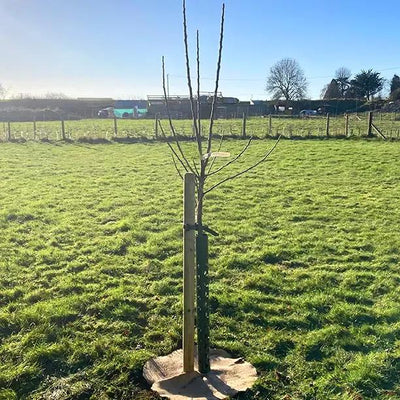
These are bareroot walnut saplings: small, light, and inexpensive, suited to hedgerow planting, woodland edges, and agroforestry schemes where you want to put in walnut numbers rather than a single specimen. The 20/40cm size is a whip: a single stem, easy to plant by the hundred if needed, and well proven to establish reliably if the ground is prepared and weeds are kept clear. The 60/80cm size gives you a more substantial sapling with a little more presence from the start.
These will not look like much for the first few years. Walnut establishes slowly, and some shoot tip die-back in year one is normal and nothing to worry about. Given time, good drainage, and sun, they become a fine tree, with golden autumn colour, aromatic foliage, and eventually walnuts, though on a seedling sapling you are looking at a decade or more before a meaningful crop. If a cropping nut tree is the goal, our pot-grown Buccaneer Walnut is the better starting point. If you want to plant walnut into a field boundary, a mixed hedgerow, or a farm woodland scheme, this is where to start.
In a mixed hedgerow or farm woodland, walnut combines well with other native and near-native trees. Hazel works particularly well: it establishes quickly, provides structure and nuts far sooner than the walnut, and coppices freely if you want to manage it. Field maple, hornbeam, and blackthorn all sit comfortably in the same planting. For a simple two-species hedgerow with strong autumn interest, walnut and hazel is a reliable combination. Browse our full edible nut tree range for companion species, or our ornamental standards if you want a single established specimen tree rather than saplings.
Bareroot saplings sourced from specialist nurseries, handled correctly and delivered during dormancy. All plants guaranteed. Which? Gardening Best Plant Supplier, driven by customer recommendations.
Size on arrival. The 20/40cm is a whip: a single stem, easy to plant in quantity, and cheaper. The 60/80cm is a more substantial sapling with a short branching structure. Both will reach the same size at maturity. For large-scale planting, the 20/40cm is the standard choice; the 60/80cm suits smaller schemes where you want a little more presence from day one.
A long time from now. Seedling-grown walnut saplings typically take 10 years or more before they crop reliably. These are planted for the landscape, not the larder. If nut production within a few years is the objective, the Buccaneer Walnut (a named grafted cultivar) is the right tree.
Yes. Walnut is one of the more challenging trees to establish and shoot tip die-back in year one is standard and expected. Don't pull the tree. Keep weeds clear within a metre, water in dry spells through the first summer, and give it time. By year two or three, a well-sited walnut sapling will be growing away strongly.
Yes, though it needs some consideration. Walnut produces juglone, a compound that inhibits some plants in its root zone, so it's not a good neighbour for apple trees or most vegetables. In a farm hedgerow or woodland mix with other trees and native shrubs it sits perfectly well. Hazel, field maple, and hornbeam are all fine companions and won't be affected.
Walnut is typically used as a standard tree within a mixed hedgerow rather than as the hedging plant itself. For a field boundary mix, plant one walnut per 8-10 metres, interspersed with faster-establishing hedge species like hazel, blackthorn, or field maple planted at 3-5 per metre. This gives you a mixed native hedge with walnut standards emerging above the hedge line over time.




 Sign In
 Saved items