

Sold as:

from £6.99

Sold as:
from £19.99
 5 Star Service Rating




 Secure, One-Tap Checkout
 5 Star Feefo Rating
 Hand Picked, Delivered to Your Door!
 1 Year Bareroot Guarantee
 Platinum Trusted Service Award 2026
 Mail Order Plant Experts - Est. 1949
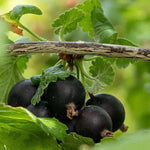


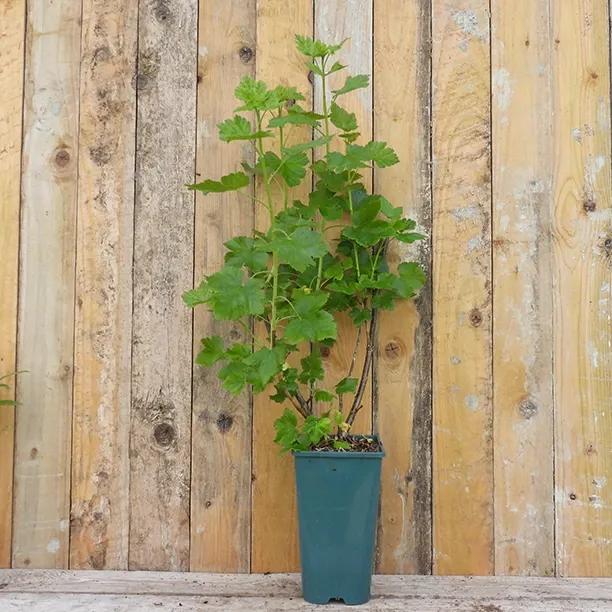




Jostaberry is a vigorous, spineless cross between a Gooseberry and a Blackcurrant, with fruit the size of the first and the flavour of the second, ripe in July or August. It is self-fertile, crops well, and tolerates light shade.
'Original Jostaberry' jostaberry is a complex hybrid of blackcurrant, Ribes nigrum, European gooseberry, Ribes uva-crispa, and American gooseberry, Ribes divaricatum. It has the larger size of the gooseberry, the rich colour of the currant, and the flavour progresses from the former to the latter as it ripens. It's a thornless, vigorous, disease resistant and productive plant that copes well in the shade of trees, making it a real hit with food forest owners.
Browse all soft fruit, or our other hybrid berry bushes.
Remarkably shade tolerant, they're quite hungry feeders and love manure and top quality mulches. The plants themselves are hardy, but their flowers can be ruined by late spring frosts, so be prepared with horticultural fleece to protect them.
Prune out the most productive wood when it's three or four years old, and remove ingrowing new stems to maintain an open centred bush. Jostas are also great for training against a wall.
Very vigorous, it's easy to pin the ends of shoots against the ground so they set root, and make a new plant.
The name Josta, pronounced "yosta" at home, is made from the German for blackcurrant and gooseberry, johannisbeere and stachelbeere.
Following early British attempts to breed a thornless gooseberry in the late 1800's that led to the unproductive Ribes × culverwelli, work on this complicated hybrid began in Germany in 1926.
Early generations of promising plants were almost all destroyed by Allied carpet bombing in WWII.
Eight survived the war, and further refinement led to the original Josta being released in 1977, and it's still the most widely sold cultivar today.
The fruit doesn't lend itself to machine harvesting, which is why it's not commonly found in shops.
There is a very similar hybrid from the USA called ORUS 8 (the best in the series, apparently), which has thorns.
Grow Jostaberry beside its parents. Ben Connan is an early, compact Blackcurrant, and Invicta is a Gooseberry from our range. Buckingham Tayberry is another hybrid berry. The RHS says to grow a Jostaberry as you would a Blackcurrant, so our Blackcurrant growing guide applies. Dust bareroot roots with Rootgrow as you plant.
Ashridge has sold plants since 1949 and is a Which? Best Plant Supplier 2025. Your Jostaberry comes bareroot while dormant, or pot-grown for planting in any month. Bareroot plants are guaranteed for 12 months, and so is a potted plant delivered leafless between November and March.
Young fruit is sharp, like a Gooseberry, and good for jam and cooking. As it ripens it sweetens towards Blackcurrant, and fully ripe fruit is good raw.
No. The RHS describes the bushes as self-fertile, so one plant crops on its own.
The RHS gives it 1.5 to 2.5 metres tall and 1 to 1.5 metres wide. It is vigorous, so give it room.
No. The bushes are spineless, which makes picking easy.
When it is dormant in winter. The RHS advises keeping an open-centred, goblet-shaped bush and taking out some of the older, unproductive stems each year.
It tolerates light shade, and the old page has long recommended it under trees. A sunny, sheltered site gives the best crop. Mulch it every year with manure or compost.
Bareroot plants are delivered from November to April, while they are dormant. Pot-grown plants can be delivered and planted in any month when you find them in stock.


 Sign In
 Saved items