









 Sign In
 Saved items
 Secure, One-Tap Checkout
 5 Star Feefo Rating
 Hand Picked, Delivered to Your Door!
 1 Year Bareroot Guarantee
 Platinum Trusted Service Award 2026
 Mail Order Plant Experts - Est. 1949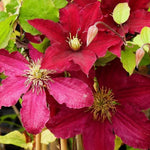
Out of Stock


Select form
Select a product

Single Plants
Select Size
 Which Best Plant Supplier 2025
 Delivered across the UK
 Platinum Trusted Service Award
About Niobe Clematis Plants
- Variety: Niobe, pruning group 2 – the deepest, richest red in the clematis range
- Latin name: Clematis 'Niobe'
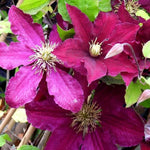
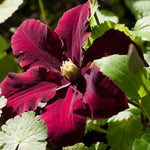
- Flower: Deep velvety claret-red, 12–15cm across, with lime-gold anthers
- Scent: None
- Climbing method: Leaf-stalk tendril climber
- Height: To 3m (10ft)
- Flowering: June–September (two flushes)
- Pruning group: 2 – light trim in February, tidy after first flush
- Planting depth: Plant 8–10cm below pot level
- Hardiness: H6 – fully hardy throughout the UK
- RHS AGM: Yes (confirmed December 2024)
- Sold as: Grown peat-free in P9 and 3L deep pots
- Plant outdoors: Year-round
- Delivered: March–November typically. Collection from Castle Cary also available
Clematis Niobe – The Red One
If you want a dark red clematis, this is the darkest one we grow. Niobe is that deep velvety claretty colour that Tudor kings wore. It looks almost black in certain lights, but its lime-gold anthers make it look like a jewel in the sunlight. If your author waxes lyrical it is because he loves this clematis and cannot imagine a garden without it. The blooms are not huge at 10–15cm across, and you get two viewings. The first in June when the flowers are more profuse and larger and an encore in August and September. Niobe was bred by Wladyslaw Noll in Poland around 1970 and it was Jim Fisk, the great Suffolk clematis nurseryman, who brought it to Britain in 1975 when it was given an AGM which it has held ever since.
At about 3 metres tall Niobe is a manageable mid-sized climber to plant against a pergola or a good climbing rose such as Lady of the Lake. The trick with Niobe is getting the background right; very dark red flowers need contrast to look their best. Against a light-rendered wall, pale stone, or a weathered fence the colour will stop most visitors to your garden in their tracks. It likes some sun during the day as well; in shade the dark red seems muddy rather than velvety and the flowers lose much of their appeal. There is a lady member of a local horticultural society who exhibits Niobe every year. She always "elbows" other exhibits out of the way so she can place her where the light from outside is strongest. She often wins when it is sunny. So a south or west-facing wall is what Niobe needs.
Red and Purple on the Same Wall
Niobe loves contrast so a clematis like The President in rich purple-blue and in the same planting hole gives you something that Fabergé might have designed. In their own way, they are both jewel-like and though neither is subtle, they work very well together. Nelly Moser is quite different - that pale pink with a carmine bar lightens the whole picture and gives Niobe the contrast she needs. A climbing rose in white or soft pink is the obvious choice (New Dawn is the one everyone suggests, and everyone suggests it because it works). Lavender at the base, Hidcote or Munstead, shades the roots and adds its own purple in the lower part of the planting as does Rosemary; nifty if the kitchen is near.
We Grow What We Believe In
We do not pretend to grow every clematis ever bred; we grow the ones we believe in and Niobe has been on our list for as long as anyone here can remember. If the variety you want is not among them, we will happily point you towards a specialist grower who stocks it. Better to lose a sale than sell you the wrong plant, and better to recommend a competitor than have you waste your money on something we cannot vouch for.
Frequently Asked Questions
Which clematis pruning group is Niobe?
Group 2, which means a light prune in February rather than the hard cut that Group 3 clematis get. Take out the dead and weak stems and shorten the rest to a pair of strong buds. The old wood is where the best June flowers come from, so do not be tempted to cut the whole thing to the ground. After the first flush has finished, deadhead, and you should get a second round from August on the new growth.
What is the best planting depth for Niobe?
Plant with the crown about 8–10cm below the soil surface. Dig a wider hole than you think you need, improve the backfill with compost, and water in well. Our planting depth guide will tell you the rest.
Does Niobe need full sun?
It does best with at least half a day of direct light to keep that rich, velvety colour. A south or west wall is ideal. East-facing will work but the flowers fade faster in morning sun. If your wall is genuinely shaded, The President holds its purple far better without direct light and is probably a better choice.
How wilt-resistant is Niobe?
No more resistant than any other large-flowered clematis, which is to say not very. But if you plant it at the right depth the crown sits underground and will regrow even if wilt strikes. In practice wilt is much less common than people think and most gardeners never encounter it at all. Our growing guide covers wilt in more detail.
Does Niobe flower twice?
The main show begins in June on the previous year's wood with masses of large flowers and a richer, deeper colour. The second flush begins in August or September on the current year's growth. It lasts longer than the summer show but is more of steady stream of smaller flowers than the explosion of larger blooms you see earlier in the year. If you deadhead after the first flush the plant can put more energy into the repeat performance.
What goes well with a dark red clematis?
Anything pale. White roses, silver-leaved artemisia to shade the roots, or even a pale yellow Graham Thomas honeysuckle on the same trellis.
Who was Niobe?
Niobe was a queen in Greek mythology who boasted that she had more children than the goddess Leto. Apollo and Artemis punished her by killing all of them. She wept until the gods turned her to stone, but even as a rock she went on weeping.