
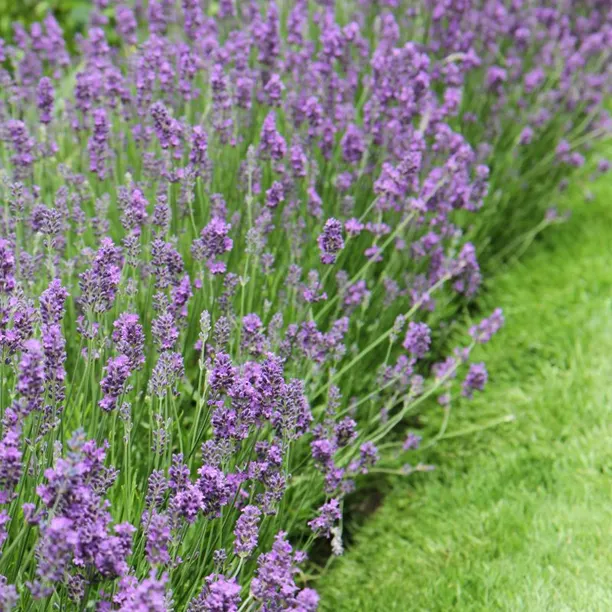
How do you plant a lavender hedge that looks solid from year one?
Planting a lavender hedge successfully comes down to three decisions made before you put a single plant in the ground: choosing the right variety, spacing correctly, and always planting into warm soil. Get those three things right and a well-knit, fragrant line is achievable within a single growing season.
Related guides
- Harvesting Lavender Flowers
- How to Cut Back Lavender Plants in Late Summer
- How to grow lavender — planting, feeding, soil and year-round care
- How to Water Lavender — When, How Often, and How Much
- Is Lavender Native to the UK?
Which lavender varieties are best for hedging?
Not all lavenders make equally good hedges. The best hedging varieties are compact, reliably bushy, and respond well to annual clipping without dying back to bare wood.
For a formal, clipped edge — the kind you see bordering paths in kitchen gardens and parterres — you want a variety with naturally tight, mounding growth. Hidcote is the benchmark: it forms a dense, upright dome to around 40 cm, clips cleanly, and produces deep violet-blue spikes reliably every year. Munstead is slightly shorter and broader, with lavender-blue flowers that appear two or three weeks earlier than Hidcote — making it a better choice if you want colour by late June.
For an informal cottage-style hedge with a looser profile, consider planting groups of three different but compatible varieties side by side. Miss Katherine (deep pink), Loddon Pink (soft blush) and Melissa Lilac (pale lilac) all reach a similar height and create a gently mixed-colour effect that looks intentional rather than random. Ashridge also offers a ready-chosen Mixed English Lavender Hedge Pack that takes the guesswork out of combining varieties.
For a taller, more substantial boundary, the Dutch hybrid (lavandin) Grosso will reach 60–80 cm and produces the longest, most fragrant spikes of any lavender in cultivation — it is the variety grown commercially for oil production across Provence. Bear in mind that lavandin varieties flower later than English lavenders and are not reliably hardy in very exposed northern gardens.
| Variety | Type | Mature height | Best use | Colour |
|---|---|---|---|---|
| Hidcote | English | 35–45 cm | Formal clipped hedge | Deep violet-blue |
| Munstead | English | 30–40 cm | Formal or low edging | Lavender-blue |
| Miss Katherine | English | 45–60 cm | Informal or mixed hedge | Deep pink |
| Grosso | Dutch hybrid | 60–80 cm | Tall boundary / scent | Mid-violet |
| Phenomenal | Dutch hybrid | 60–75 cm | Tall hedge, wet winters | Blue-violet |
| Little Lady | English | 25–35 cm | Low edging / containers | Soft blue-violet |
Browse the full range on the Best Lavender for Hedging collection page.
What spacing should you use for a lavender hedge?
For a formal, gap-free hedge the standard Downderry-recommended spacing is 40–45 cm between plants, measured centre to centre. This is tight enough to knit together within one full growing season yet gives each plant room to establish without competing.
Spacing choices hinge on three factors: the variety’s mature spread, the formality of the finished hedge, and how quickly you want the gaps to close.
| Hedge style | Plant spacing | Number of rows | Notes |
|---|---|---|---|
| Formal clipped edge (path or border) | 40 cm | 1 | Hidcote or Munstead; clip to shape annually |
| Solid formal hedge (taller boundary) | 40–45 cm | 1–2 (staggered) | Two staggered rows give density faster |
| Informal cottage hedge | 45–50 cm | 1 | Groups of three varieties; less clipping needed |
| Low edging (30 cm or under finished height) | 30–35 cm | 1 | Little Lady or Beezee Dark Blue |
If you plant informally in groups of three, stagger each trio so the central plant in one group sits opposite the gap between the two in the next. This gives a full, undulating line rather than a rigid rank.
When is the best time to plant a lavender hedge?
Plant lavender into warm soil — soil temperature above roughly 10 °C — which in most of the UK means late April through to late September. Early autumn (August–September) is particularly good because the soil is at its warmest after a full summer, yet the cooler air temperatures mean plants suffer less transplant stress.
Avoid planting into cold, wet winter soil. Lavender roots need oxygen; waterlogged, cold ground encourages root rots and shocks the plant before it has any chance to settle. If your plants arrive before conditions are ready, keep them in their pots in a sheltered spot and water sparingly until you can get them in.
Spring planting (April–May) works well on free-draining soils in southern England. In Scotland, northern England, or on heavy clay, late spring (May–June) is safer because soil warms more slowly and late frosts remain a risk for newly planted stock.
How should you prepare the soil before planting?
Lavender demands excellent drainage above all else. On free-draining, slightly alkaline or neutral soils very little preparation is needed; on heavier or more acidic ground you will need to improve the planting area first.
Work the entire planting strip, not just individual holes. For a 1 m wide strip along a path, dig to a full spade’s depth (30 cm), remove any perennial weeds, and incorporate sharp horticultural grit at a ratio of roughly one part grit to three parts existing soil. On very heavy clay, raise the entire strip by 10–15 cm using a mix of topsoil and grit — lavender planted above the surrounding level drains away from its crown far more readily.
Do not add rich compost, manure, or fertiliser to the planting strip. Lavender originates from stony Mediterranean hillsides and produces the most compact, fragrant growth on lean, relatively poor soils. High fertility encourages lush, floppy stems that are more susceptible to disease and winter damage.
If your soil is acidic (below pH 6.5), work in ground limestone or calcified seaweed at the rate suggested on the packet. Lavender strongly prefers a pH between 6.5 and 8.0.
How do you plant a lavender hedge step by step?
Follow these steps on the day of planting, preferably on a dry, overcast day to reduce transplant stress.
- Mark your line. Use a taut string line or a length of timber to mark a perfectly straight (or deliberately curved) planting row. Measure and mark plant positions along the line with canes.
- Soak the rootballs. Stand the plants in their pots in a tray of water for 20–30 minutes before planting. A dry rootball in contact with dry soil is the single commonest cause of slow establishment.
- Dig planting holes. Each hole should be the same depth as the rootball and roughly twice as wide. On improved soil, no deeper preparation is needed per hole.
- Check the planting depth. The top of the rootball should sit level with the surrounding soil surface, or very slightly above it on heavier ground. Burying the crown even a centimetre or two invites stem rot.
- Firm in without compacting. Use your fingers to press soil around the rootball firmly, removing air pockets, but avoid stamping heavily around the stem.
- Water in well. Give each plant a generous settling-in watering — roughly half a watering-can per plant — even if rain is forecast. This closes any remaining air gaps around the roots.
- Mulch (optional but useful). A 3–5 cm layer of fine gravel or grit around the plants (keeping it clear of the stems themselves) conserves moisture, reflects warmth back up to the foliage, and dramatically improves crown drainage.
How many lavender plants do you need per metre of hedge?
At 40 cm spacing you need 2.5 plants per linear metre; in practical terms, order 3 plants per metre and you will have one spare for losses or gaps. At 45 cm spacing you need just over 2 plants per metre — order 2–3 depending on the length of your hedge.
| Hedge length | Plants at 40 cm spacing | Plants at 45 cm spacing | Recommended order (inc. 10% spare) |
|---|---|---|---|
| 2 m | 5 | 4–5 | 6 |
| 5 m | 12–13 | 11 | 14 |
| 10 m | 25 | 22 | 27–28 |
| 20 m | 50 | 44 | 55 |
For long runs, the Mixed English Lavender Hedge Pack or bulk ordering from the hedging collection is the most cost-effective approach.
How do you get a solid line in the first year?
The key to a visibly knitted hedge by autumn of the planting year is encouraging lateral spread rather than vertical growth. This means a light tip-prune and consistent but not excessive watering through the first summer.
About four to six weeks after planting, once you can see active new growth, pinch or lightly clip the growing tips of each plant by no more than 2–3 cm. This interrupts apical dominance and prompts the plant to push out side-shoots — exactly the bushy, outward-spreading growth that fills gaps and knits the hedge into a continuous mass.
Do not allow the plants to flower heavily in their first season. Removing flower buds as they form — which feels counterintuitive — directs the plant’s energy into root and stem development rather than seed production. A hedge that establishes its root system properly in year one will be far more resilient and even in subsequent years.
Water during dry spells in the first summer, but not routinely. Once established (after 8–12 weeks in the ground), lavender is drought tolerant and overwatering is more damaging than underwatering. A good rule of thumb: water when the top 5 cm of soil is completely dry and the plant shows the earliest signs of wilting. See our dedicated guide on how to water lavender for precise guidance.
Should you prune a lavender hedge in its first year?
Yes, but lightly. A gentle tip-prune after planting and deadheading through the first summer are beneficial. A hard structural prune should wait until the plant is fully established — typically the second year.
In the second autumn or following spring, you can give the hedge its first proper shaping prune: clip back by up to one-third of the green growth, following the natural dome shape of each plant. Never cut back into old, grey, leafless wood on established plants — lavender does not regenerate from bare wood reliably. For more detail, read our full guide on how and when to prune lavender.
What problems should you watch for in a new lavender hedge?
Most problems in newly planted lavender hedges come down to one of four causes: poor drainage, planting into cold soil, planting too deep, or inconsistent aftercare. Here is how to recognise and address the most common issues.
| Symptom | Most likely cause | Remedy |
|---|---|---|
| Yellowing leaves, slow growth | Waterlogging or overwatering | Improve drainage; reduce watering frequency |
| Grey mould at base of stems | Botrytis (grey mould) fungus | Improve airflow; remove affected material; gravel mulch |
| One or two plants dying while neighbours thrive | Crown buried too deep or local drainage problem | Replant slightly higher; add grit beneath rootball |
| Uneven gap in the hedge line | Plant failure or poor establishment | Replace with same variety at same spacing; plant in warm soil |
| Leggy, open growth; hedge looks thin | Not tip-pruned; too much shade or rich soil | Tip-prune to encourage bushing; assess site conditions |
Lavender diseases, including more serious fungal problems, are covered in full on our lavender diseases guide.
Can you plant a white or pink lavender hedge?
Absolutely. White and pink lavender hedges are unusual and genuinely striking, particularly alongside darker foliage or stone paths. The key is choosing varieties that share a similar vigour and mature height so the hedge stays even.
For a white hedge, Arctic Snow is the cleanest, most reliable choice — it forms a compact, well-branched mound with pure white spikes and is a true Lavandula angustifolia, so fully hardy. Edelweiss is a white Dutch hybrid with larger flower spikes and a taller habit if you want more height.
For pink, Miss Katherine gives the deepest, most saturated pink; Loddon Pink is softer and more pastel; Melissa Lilac sits at the lilac end of pink. Planting all three alternately in groups creates a pastel ombré effect rather than a single solid colour.
Will lavender grow as a hedge in partial shade?
Lavender strongly prefers full sun — at least six hours of direct sunlight daily — and will not perform well as a hedge in deep or persistent shade. In partial shade (three to five hours of direct sun), some English varieties will survive but growth will be slower, more open, and less fragrant, and flowering will be significantly reduced.
If your planting position receives morning shade but afternoon sun, Havana is worth considering — it shows better tolerance of less-than-ideal light conditions than most. However, if the site is genuinely shady, a different hedging plant will serve you better. Lavender hedging is fundamentally a full-sun proposition.
Frequently Asked Questions
How far apart should lavender plants be for a hedge?
Plant lavender 40–45 cm apart (centre to centre) for a formal hedge that knits together within one season. For informal groupings, space plants 45–50 cm apart in groups of three different varieties.
What is the best lavender for a formal clipped hedge?
Hidcote is the standard choice — dense, upright, and responsive to clipping. Munstead is slightly lower-growing and flowers two to three weeks earlier.
Can you plant lavender in autumn?
Yes. Late August and September are excellent planting times — the soil is at its warmest, which aids establishment. Avoid planting after October when soil temperatures drop below 10 °C.
How many lavender plants do I need for a 10-metre hedge?
At 40 cm spacing you need 25 plants; at 45 cm spacing, 22 plants. Order 10% extra to cover any losses — roughly 27–28 plants for a 10-metre run.
Should I feed lavender after planting?
No. Lavender thrives on lean, infertile soil. Adding fertiliser encourages soft, floppy growth that is more disease-prone. Good drainage is far more important than nutrition.
Why is my new lavender hedge dying in patches?
Patchy failure almost always results from poor drainage, crowns buried too deep, or planting into cold soil. Check drainage first; if individual plants are sunk below the soil line, lift and replant them slightly higher.
What is the best lavender for a low path edging under 30 cm?
Little Lady and Beezee Dark Blue are both compact enough to stay under 35 cm and work well for low edging at 30–35 cm spacing.
Can I plant a two-row lavender hedge for extra density?
Yes. Stagger two rows 35–40 cm apart with plants offset (not directly behind each other). This creates a denser hedge faster, particularly useful for taller lavandin varieties like Grosso.
Does lavender hedging work on clay soil?
Only with significant soil improvement. Dig in plenty of sharp grit and raise the planting strip 10–15 cm above the surrounding level. A gravel mulch around the crowns also helps. See the hedging collection for suitable varieties.
When should I give a new lavender hedge its first hard prune?
Wait until the second year of growth. Prune after flowering, removing up to one-third of green growth, but never cut into bare, woody stems. Our pruning guide covers this in full.
Is a mixed-variety lavender hedge harder to maintain than a single-variety hedge?
Slightly, because different varieties may flower and need pruning at slightly different times. Choose varieties of similar vigour and height — the Mixed English Lavender Hedge Pack is pre-selected for compatibility.
Can lavender be used as a wildlife-friendly hedge?
Yes — lavender is outstanding for pollinators, attracting bees and butterflies in large numbers throughout summer. It works particularly well near vegetable gardens and in wildlife corridors. Browse the Best Garden Lavender collection for top pollinator varieties.
Related Products
- Best Lavender for Hedging
- Hidcote English Lavender
- Munstead English Lavender
- Mixed English Lavender Hedge Pack
- Grosso Dutch Lavender
- Phenomenal Dutch Lavender
- Miss Katherine Lavender
- Arctic Snow White Lavender
- Little Lady Lavender
- English Lavender Collection
- Dutch Hybrid Lavender Collection
- Shop All Lavender
Related Articles
- How to grow lavender — planting, feeding, soil and year-round care
- Types of lavender — the differences between English, French and Dutch lavender
- How and when to prune lavender — including woody plants and different types
- How to Cut Back Lavender Plants in Late Summer
- How to Water Lavender — When, How Often, and How Much
- Lavender — First Trim in February or March
- Lavender Diseases — Causes and Treatment
- Harvesting Lavender Flowers
- Growing lavender in pots and containers
Leave a Reply