
A tree in a pot travels with its own soil. A bare-root tree – dug from the field while dormant, with no pot and no compost – travels with nothing but its packing. From November to March that’s how most trees leave Castle Cary, because it’s the best way to plant a tree. It is also the most exposed way to post one.
Here’s what happens to your tree between our field and your front door.
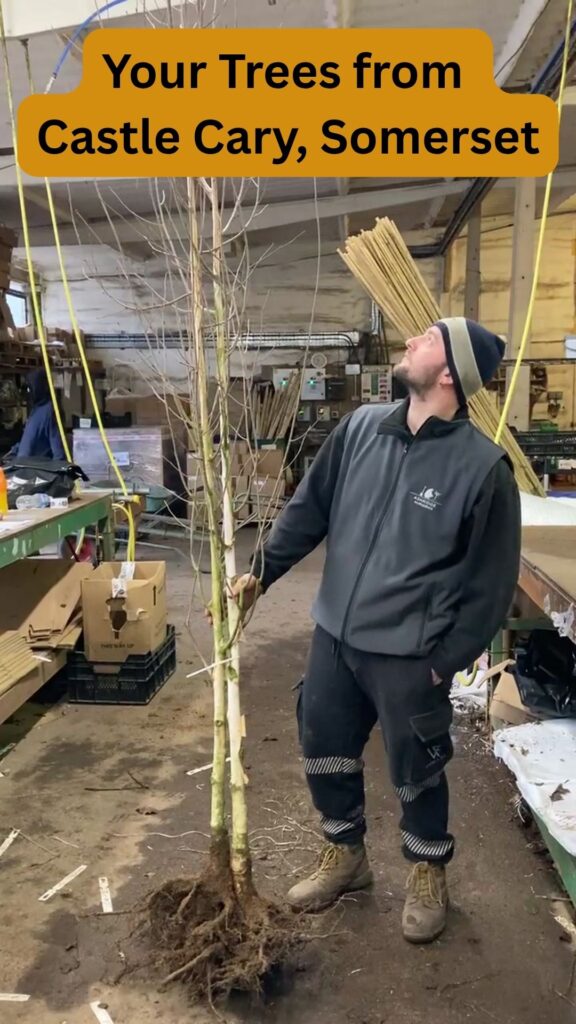
Lifted while it sleeps
Your tree comes out of the ground in winter, when it has no leaves to keep watered and barely notices the move. The roots are the part that matters, so before anything else happens, someone looks them over by hand.
Roots bagged, with water
Bare roots must never dry out. A few minutes in a cold wind does them more harm than several days in a sealed bag. So your tree’s roots go into a bag made from recycled plastic, extra water goes in after them, and the bag is closed tight around the stem.
That water keeps the roots damp on the road, and it’s why they’ll still be wet when you open the box.
Caned, taped and tied
A dormant tree is tougher than it looks; it just needs holding still. Each one gets a cane to take the knocks on the road, so the stem doesn’t have to.
Tree and cane are then wrapped and taped together. When Joe trains new packers, his advice is to tape like a helter skelter, winding round and down the tree. It gives the job a steady rhythm, and every tree comes out wrapped the same way.
Finally the branches are tied in with string, so they can’t rub against each other or the box on the journey. Leave the string on until the tree is in the ground – it’s far easier to carry and plant that way. Then cut off every piece. String left on a stem tightens as the tree grows, and will eventually strangle the branch it was put there to protect.
Most couriers treat a long box kindly. Occasionally one doesn’t. If your tree arrives damaged, tell us and we’ll put it right.
Your name, and its passport
Every tree carries a label with your name on it and its plant passport. Any plant for planting sent by mail order in Great Britain must have one. It gives the botanical name, the country the plant was grown in, and a code that traces it back to the nursery, and it shows the plant meets UK plant health rules. If a pest or disease ever turns up, the passport means it can be traced quickly.
Keep the label until the tree is planted. In winter, one bare twig looks much like another.
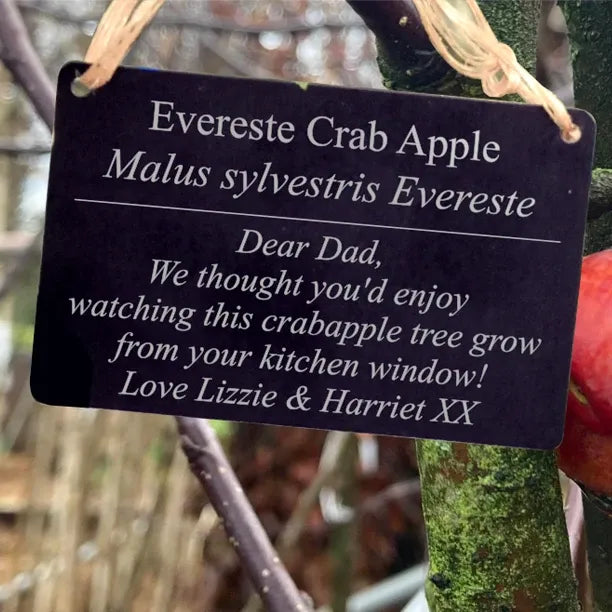
A personalised tag for larger trees
Order a 6/8 or 8/10 girth tree – one whose trunk measures 6–8cm or 8–10cm round at 1m above the ground – and a personalised tree tag comes free. It’s added to your basket automatically, and you write your message on it there.
People use them to mark a gift, a commemorative planting, or the memory of someone they’ve lost. Others simply want to know, years from now, what they planted and when.
When your trees arrive
Open the box the day it arrives and check the roots are still damp.
If you’ll be planting within the week, open the top of the packaging but leave the roots in their bag, and keep your plants somewhere cold and out of the sun – outside is ideal. A hard frost won’t hurt them. Moving them while they’re frozen will, so leave them be until they’ve thawed.
If a week passes and planting is clearly going to be later still, you can heel them in: dig a shallow trench, lay the plants on their sides with their roots in it, and cover the roots with soil. It isn’t essential, since your plants will be fine in their bags, but it may give you peace of mind.
Either way, don’t leave it too long. In the South, bare-root plants need to be properly in the ground by the end of March. In the North you can usually get away with planting well into April.
After that, it’s over to you. Plant it well and it will repay you for decades.


Leave a Reply