Container-grown hedging plants - plant all year round.
Generally speaking, hedging is put in the ground over winter, using young bareroot plants when they are dormant.
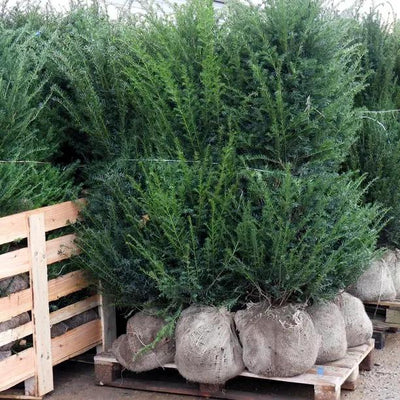
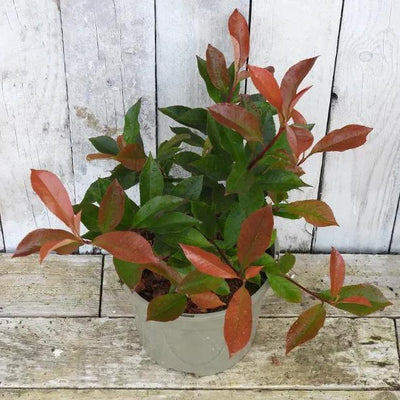
However, some circumstances call for a more instant, mature hedge – which is where container-grown (or potted) hedging plants play their part.
Why choose potted hedging?
Among the most common reasons for choosing pot-grown hedging is the need for instant privacy or screening when moving to a new home, to repair a damaged or dying hedge, or to fill a small gap in your borders.
However, perfectly valid excuses also include "being an impatient gardener" or simply "wanting a bit of a change!"
The humble hedge can play many roles within a garden – most commonly as an attractive living barrier along a garden boundary to keep unwanted visitors out. Or, to keep excitable children and pets in!
More often than not, privacy and security are the primary considerations when choosing your hedging plants.
Benefits of pot-grown hedging
Although hedging is most commonly sold as 'bare root' plants for ease of transport, pot-grown plants have the benefit of being able to be planted year-round (as opposed to being limited to the dormant period between late autumn and early spring).
And as they have been growing in a pot all their lives, their roots are fully formed and undisturbed, meaning that with the right preparation and care, they can be quicker to take to their new homes.
There are many hedging plants to choose from, and it's quite important to select the right plants for the job, depending on your needs, the local environment, the planting location, and soil condition.
Large hedging or quick screening
If a very large hedge or screen is required, a conifer hedge in the form of the ubiquitous leylandii (cupressocyparis leylandii), or the slightly darker green Lawson's cypress (Chamaecyparis lawsoniana), or the broadleaf evergreen Common laurel (Prunus laurocerasus), are all great choices.
Their evergreen form, coupled with the speed with which they grow, make them popular options for gardens that require a good level of privacy quickly.
Evergreens generally tolerate most soils and aspects. But vigour should not be underestimated; the High Hedges Act was specifically drawn up as a result of neighbourly feuds over potentially giant Leylandii.
Hedging of this type is usually planted between 60-150cm apart; closer if it is to be kept clipped and further apart if it is to grow on into a large screen of trees. Plants can be clipped up to 3 times throughout the growing season, and it's very important to do so as if you let these hedges grow unchecked, and need to cut them back hard, they will not reshoot from old wood.
(oh, and whenever you clip any hedge, please check for active birds' nests before you start!)
Urban hedging
Popular choices for an urban environment are privet (Ligustrum), yew (Taxus baccata), box (buxus sempervirens), beech (fagus sylvatica) and hornbeam (Carpinus betulus).
These (with a few caveats here and there) will thrive in a wide range of soil conditions, in both sun and shade, and are not significantly affected by pollution or poor, compacted soils. They can all be kept tightly clipped to create a lovely dense hedge (beech and hornbeam are less tightly defined, but can offer a more interesting and lively texture as a result).
As with most medium-sized hedges, plant them at 3 per metre in a single row. Plants can be pruned 2-3 times over the growing season to keep them tidy. Sparse, straggly plants respond well to being cut back hard, re-shooting quite happily.
Hedging for coastal conditions
Coastal conditions can be particularly challenging for plants. Sites are often exposed, soil is poor and sandy, and the air is salty.
If you live near the coast, good choices for hedging include Portugal laurel (Prunus lusitanica), Viburnum tinus, holly (Ilex aquifolium), and Pyracantha (Red Column and Orange Glow).
Each of these will make a neat, compact hedge with plenty of visual interest.
Better still, all of these are good providers of food and habitat for wildlife.
Holly and Pyracantha also have the benefit of spiky protection if you're looking for a hedge to keep unwanted visitors at bay.
Hedging for security
Most hedge plants can be grown to provide a solid, secure boundary. But where a truly impassable barrier is required, thorny hedging is your best option.
A fantastic spiky shrub to use for this purpose is barberry (we especially like red Japanese Barberry – Berberis thunbergii 'Atropurpurea'). It forms an informal hedge of around 2-3 metres high.
Holly and hawthorn are popular alternatives, but barberry is a plant with lots of year-round interest: in spring it produces attractive little yellow or yellow-orange flowers, which turn to colourful berries in summer; and with stunning coloured leaves turning shades of red, orange and purple in autumn.
Barberry will cope with most well drained soils and can be planted in full sun or partial shade. Plants should be spaced at 3 per metre. As quite an informal hedge, it requires minimal pruning and can be clipped back lightly after the fruits have faded.
Larger gardens and countryside plots
For the larger countryside garden a mixed native hedgerow has terrific benefits. Aesthetically it provides a barrier that is truly in keeping with the surrounding countryside and leads the eye gently to the landscape beyond the garden.
But more importantly they provide a vital home and food source for many forms of wildlife that are struggling with an ever decreasing habitat.
Suitable plants would include hawthorn, blackthorn, field maple, hazel, dogwood, viburnum, wild roses, oak, beech, hornbeam, yew, and holly.
A country hedge can be planted at 3 plants per meter in a single row. However, if a thicker wider hedge is desired you can plant 6 plants per meter in a staggered double row.
Native hedges are usually pruned every other year, to allow their blossoms and fruits to develop more naturally and fully, and to create as little disturbance as possible to the creatures that call it home.
We have a range of mixed hedging packs, available during the bare root season from November to April, including:
Formal hedging
Dwarf hedges can be used to provide structure within a garden design in the rather grand form of parterres and knot gardens. It's a trend which has never really gone away and still frequents contemporary Chelsea gardens year-on-year.
Yet, it is equally at home in a modest garden, defining external boundaries or partitioning smaller internal areas.
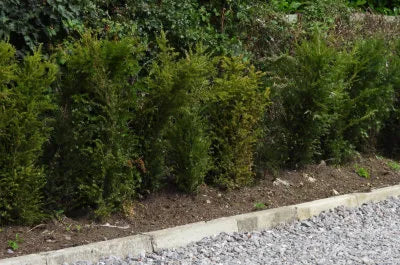
Traditionally the most common plant used for this purpose is box (Buxus sempervirens), however yew (Taxus baccata) would also make a wonderfully neat formal hedge. Both are very dense, slow-growing plants with small evergreen leaves, that can be tightly clipped.
Plants should be planted along a carefully defined line, as central to the line as possible to ensure straightness, in a single row at 4 plants per metre.
Formal hedges are generally pruned twice throughout the growing season, as needed, with the first in late May and the second before the end of August.
Hedging checklists
To get you started, here are a few little checklists to help you think about what you need from your hedge!
1. Purpose
Why do you need a hedge and what do you want it to achieve? Prioritise which specific attributes are important to you:
- To provide privacy
- To reduce noise
- For security
- As a windbreak
- To attract wildlife
- To screen unsightly objects
- To enclose livestock
- Good autumn colour
- Attractive blossoms
- Child friendly (no thorns and not poisonous!)
- Formal or informal
2. Environment
What are your site considerations? Is it:
- Sheltered or exposed
- Sunny or shady
- High altitude
- Coastal
- Urban
It's a good idea to have a look at what is (and what is not!) growing in your local area to help inform your decision.
3. Soil Type
What are the characteristics or your soil?
Preparation & planting
- Dig over a strip of ground around 60-90cm wide. Remove any weeds, grass and roots
- Dig in plenty of moisture retaining organic matter, such as well rotted manure or compost
- For poorly draining soils add some horticultural grit, or for especially problematic areas create a ridge to plant into
- If a perfectly straight line is required, use string and stakes to help mark precisely where the centre of each plant needs to go
- Space your plants according to their individual requirements: for smaller, more delicate hedges plant closer together; plant wider apart for larger, taller hedging; or plant in a staggered double row for more substantial,secure hedging
- Dig the planting holes so that the plants will be planted to the same depth as the soil level in the pot
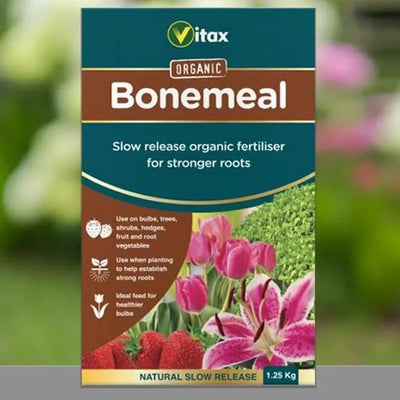
- Add a good dressing of bonemeal and Rootgrow mycorrhizal fungi to each planting hole, lightly mix into the soil
- Place each plant in their individual holes and, making sure they are straight and at the correct depth, back-fill with soil and firm into place
- Water plants in really well
Aftercare
- Keep newly planted hedges well watered in dry weather until they become fully established
- Prune according to the plants individual requirements; 2–3 times through the growing season for a formal hedge and up to every other year for a countryside hedgerow
- Keep the area weed free to eliminate competition; this can be achieved through hand weeding or using a weed suppressing membrane
- Top dress annually with a good mulch of manure or compost in autumn
All that's left now is to relax, sit back and enjoy your hedge!









 Sign In
 Saved items
 Secure, One-Tap Checkout
 5 Star Feefo Rating
 Hand Picked, Delivered to Your Door!
 1 Year Bareroot Guarantee
 Platinum Trusted Service Award 2026
 Mail Order Plant Experts - Est. 1949








Comments (2)
Add a commentThank you for your request. Beech or hornbeam would be fine, however if your ground is liable to damp, i.e. does not drain well , beech does not like wet conditions. Our general advice would be to plant bareroot plants in the soil, as containers restrict growth and stress the plants in the long term. You would need 3 plants per metre. You can plant anytime from now to the end of March depending on the weather.
Dear Sir,
I live next to a main road and would like to provide some protection against pollution and benefits for wildlife.
There is currently a small wall, 450mm high on top of which is a fence, 650mm high. I intend to leave them there and grow the hedge behind (on the house side).
The total length of space for hedging is 5200mm.
I would like to use Beech or Hornbeam in containers (preferably square or rectangular ones).
Please can you advise me on feasabikity, availabilty of suitable plants and approximate costs.
With many thanks,
Nick.
Leave a comment
Please note, comments need to be approved before they are published.