
Last updated: July 2026
BN11: Planting New Hedges
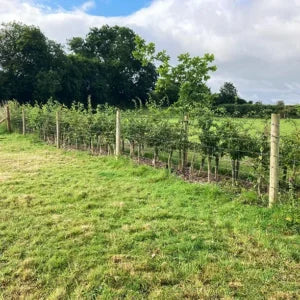
The most popular hedge related Countryside Stewardship Grant for our customers is the BN11: Planting New Hedges.
How Much Money Can I Get?
- The grant is currently £22.97 per metre.
- Hedge plants start from under £7 per metre if you buy our best value BN11 compliant hedge pack.
- Planting accessories will be up to another £7 per metre, depending on what you need.
- At under £14 per metre, you have at least £9 per metre to pay for planting, and from £16 per metre with no accessories.
The accessories are bamboo canes for supporting plastic spirals, and mypex weed suppression fabric with pegs, or without pegs.
- If there is no risk of herbivore or rodent grazing, you won’t need spirals & canes, and it’s better not to use them where they are unnecessary.
- Mypex fabric is almost always recommended for new rural hedges that aren’t going to get much attention (unlike your garden hedge). However, you can do without it as long as you weed the hedge and water well in dry weather, especially on dry soils.
When Can I Apply? (2026 Update)
BN11 now sits under the wider Capital Grants 2026 offer, and it’s due to reopen for applications in late July 2026. A few things worth knowing before you jump in:
- Demand usually outstrips the budget. Last year plenty of applications got held up simply because the required evidence wasn’t ready to go with them — so it’s worth gathering your maps, historic records and photographs before the window opens, not after.
- You’ll need to be registered on the Rural Payments service to apply online. If you haven’t used it before, or your business details have changed, it’s worth logging in and checking everything’s up to date now rather than scrambling in a queue later.
- If your application is worth more than £50,000, you’ll be asked for a letter from a qualified accountant confirming you have the funds to cover the work upfront (grants are paid after the work’s done and claimed, not before).
- Tenant farmers — if your tenancy doesn’t run for at least 5 years from the start of the agreement, you’ll need a landlord’s countersignature (a Land Ownership and Control Form).
Basic Requirements to Qualify for the Grant:
You don’t have to be a farmer with a field to qualify.
The new hedge must be on a site where you have “management control” of both sides of the boundary, and one or more of the following:
- there was a hedgerow in the past – as shown on historic maps or other records
- creation would extend or link existing lengths of hedgerow
- creation will help reduce soil erosion and run-off (which you can argue is anywhere there is soil and rain!)
- creation will help capture ammonia emissions from slurry or digestate stores, livestock housing or free-range areas for poultry or pigs
- access to open access land is not obstructed
If grazing animals are in the field with the new hedge, it must be fenced off with at least 1.5m wide spacing for it to grow into when mature: set fencing at least 1.2m from the centre of the hedge, or, if there is a bank, as close to the base of the bank as possible
Requirements for Planting a BN11 Compliant Hedge:
- apply any herbicide to a 1.5m strip in the August or September prior to planting only
- carry out planting work between 1 November and 31 March (this is when bareroot plants are delivered)
- prepare the ground along a 1.5m wide strip to provide good soil conditions and as little competition from other vegetation as possible
- Plants must be:
- 2-year-old transplants at least 450mm to 600mm high (plant nurseries all write this as 40/60cm, which is the smallest size that country hedging is delivered in)
- dominant native species (hawthorn, blackthorn or hazel), with no one species making up more than 70% of the total (so you need two species minimum, but could add as many as you like)
- planted in a staggered double row 40cm apart with a minimum of 6 plants per metre (see our double row hedge diagram)
- kept clear of weeds until they are established (this is so important: weeds can absolutely choke your new hedge)
- remove individual guards and tree shelters once the plants are established (they often fall apart by themselves in sunny conditions, especially if you choose bio-spirals)
- replace all failures in the following planting season (our bareroot hedging plants are guaranteed, so we have got you covered)
- trim the newly planted hedge in at least the first 2 years to encourage bushy growth, allowing the hedge to become taller and wider at each cut (we recommend cutting at least 50% of the new growth, if not more)
- gap sizes of 20m or less don’t qualify for BN11
Documents & Records
To submit with your application:
- photographs of the completed work
- historic map or other records to show that the proposed location of the hedge planting either:
- is on an original footprint,
- extends existing hedges,
- contributes to the reduction of soil erosion and run-off – this can be marked on any map including the Farm Environment Record (FER)
To keep and submit on request
- consents or permissions
- the dates, locations and methods of weed control
- the dates of planting
- details of age, height and species planted
- photographs to show the planned location for each length of hedge planting
- receipted invoices, or bank statements where a receipted invoice is unavailable
How to Apply
Applications for BN11 are made through your Rural Payments Agency online account. In short:
- Sign in (or register) via the Rural Payments service.
- Start a Capital Grants application and add the BN11 item.
- Submit your supporting evidence — maps, historic records, photographs — ideally within 10 days of submitting the form, so your application doesn’t stall in review.
- Once approved, you’ve got up to 3 years to complete the planting and claim.
Can’t apply online? You can also call the RPA on 03000 200 301 (Mon–Fri, 8.30am–5pm).
For the full official rules, the gov.uk BN11 page and the Capital Grant finder are the best up-to-date sources — worth bookmarking, as rates and rules do get reviewed each year.



Leave a Reply