





 Sign In
 Saved items


October 16th 2025•
Trees
How to Plant a Tree With a Stake
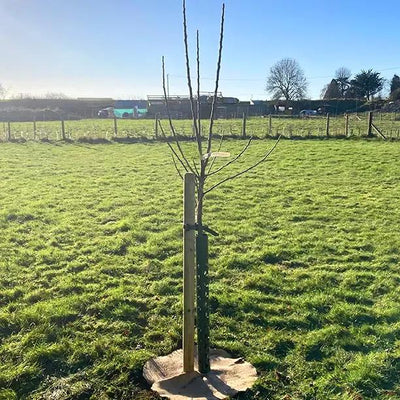
Planting with a stake is optional but highly recommended.
Read More
 5 Star Service Rating




 Secure, One-Tap Checkout
 5 Star Feefo Rating
 Hand Picked, Delivered to Your Door!
 1 Year Bareroot Guarantee
 Platinum Trusted Service Award 2026
 Mail Order Plant Experts - Est. 1949
18/04/2026
Images by kind permission of Thomas Kirisits, Josef Wampl, Christian Freinschlag, Katharina Kräutler and Michaela Matlakova of the Institute of Forest Entomology, Forest Pathology and Forest Protection (IFFF), Department of Forest and Soil Sciences, University of Natural Resources and Life Sciences, Vienna (BOKU), Vienna, Austria
We at Ashridge Nurseries have had a number of enquiries, from both customers and others, about the health of their trees. However, the fact that we are well into autumn, when even healthy ash trees are losing their leaves, means that any diagnosis isn’t straightforward.
We hope that the collection of pictures in this article will help you to decide more clearly whether your trees are infected, or simply getting ready for the winter. We’ve also had enquiries about plants other than ash that are exhibiting leaf loss. It’s important to recognise that the fungus causing ash die back, Chalara fraxinea, ONLY INFECTS ASH (Fraxinus being Latin for the ash family). You can rest assured that trees other than ash (including Mountain Ash, which is a rowan and completely unrelated) will not be affected by the ash die back fungus. If you’re concerned about a tree other than ash, your first call should be to a local nursery or tree surgeon.
This section presents a gallery of ash dieback disease symptoms. It shows examples (from countries outside of the UK) of branch lesions, leaf loss, crown dieback, and, finally, the sexual stage of the fungus, a trumpet-shaped mushroom called Hymenoscyphus pseudoalbidus. It is this final stage that will release Chalara fraxinea spores into the air, looking to reinfect ash tree leaves.
Fig 1: In the foreground is a (presently) healthy common ash (Fraxinus excelsior) with a leafy crown – and in the background, a diseased ash having had most of its crown die back to the trunk.


Fig 3: Lesions caused by the Chalara fraxinea fungus.

Fig 4: If you cut into the tree or split a slimmer branch lengthways, you can see how deeply the disease penetrates
Fig 5: Once the lesion has encircled the branch, it cuts off all nutritional support above it. This causes leaf loss from the tips of the branches inwards, giving Chalara fraxinea its common name of Ash Dieback Disease.

Fig 6: Ash die back is progressive. As it spreads and its lesions grow, more leaves are lost closer to the trunk and the tree loses its crown, until the entire tree has ‘died back’.
 More diseased ash - Photo T. Kiritsis
 Severely diseased ash tree
Fig 7: The reproductive stage of the disease (Hymenoscyphus pseudoalbidus) thrives in damp vegetation on the floor. These small trumpet-shaped mushrooms will eventually release ash die back spores into the air to find new ash leaves to infect.
 Reproductive stage of chalara fungus ready to release new spores
Many ash tree owners and suppliers are talking about disease resistant ash species. Dr Kirisits of the University of Natural Resources and Applied Life Sciences in Vienna (a botanist who has been studying the disease full time since 2009, and who is a world expert on the subject) advises caution regarding claims that some ash species and varieties may be immune as more time and more observations are needed. Until test plantings and subsequent monitoring has taken place, no ash should be regarded as die back resistant. Overall, Fraxinus excelsior (Common Ash) and Fraxinus angustifolia (Narrow-Leafed Ash) appear to be highly susceptible, along with most of their varieties. The reproductive stage of C. fraxinea (Hymenoscyphus pseudoalbidus) has also been recorded in Europe on Fraxinus pennsylvanica, F. nigra, F. americana (Green Ash, Black Ash and American Ash, all from North America) and F. mandshurica (Manchurian Ash, from Asia). More exotic examples such as Fraxinus ornus (Southern European Flowering Ash) do not show the same susceptibility but would be of very limited value in the British climate. In fact, climatic conditions have a significant impact on the growth and spread of the disease. Countries with ash trees in damper climates (such as the UK) will have a tougher time containing the disease than drier, warmer regions on the continent. It also follows that in warmer urban areas, especially where leaves are routinely removed from streets, the risk is somewhat lower than rural farmland. Dr Kiritsits thinks this is important - good hygiene reduces the impact of the disease. As such, the advice and action around washing boots, animals, cars, tools and anything else that may have been in contact with the fungus should be taken very seriously.
There are three important points to take from this article:
Ash die back seems to be carried on imported stock, the wind, and via moisture. There are infected woods in the UK that were almost certainly infected “naturally”. There are about 80 million ash trees in the UK and any widespread treatment is simply not feasible. We must therefore resign ourselves to losing some large proportion of the ash tree population over the coming years. Not all, however, as some are naturally resistant to the disease. In 2011 there were 21 countries in the European Union that had ash die back, but all have ash trees surviving with no apparent ill effects in forests that have been decimated by the disease. So there is hope – in time we will inevitably propagate from resistant trees and breed even more resistant varieties.


Comments (2)
Add a commentI hate to disagree, but I think it does matter.
The two are fundamentally different. Honey fungus attacks through a “root system” (called rhizomorphs). It therefore travels relatively slowly but kills incredibly fast. It is not species specific (by the way, ash are not resistant to honey fungus – very few tree species are). It is preventable in the sense that it cannot cross barriers so planting susceptible trees inside an impermeable barrier in the top 6" of soil should keep them safe. Honey fungus also tends to attack weaker and more stressed subjects, so the best prevention is to improve the soil using loads of organic matter such as well rotted manure, compost and so on. Healthy plants have their own defences.
Ash die back is different in a number of significant respects. It is spread by the wind and so can move many miles a year. It is species specific – it only attacks members of the Fraxinus family. It is indiscriminate – it attacks them all. And, critically, it does not seem that many Fraxinus have a defense system that can repel it. It is also not preventable and not treatable.
My mountain ash (rowan) died of a honey fungus infection this year. Ash are resistant to honey fungus, rowan are resistant to ash dieback. It doesn’t really matter to the tree which fungus kills it.
Leave a comment
Please note, comments need to be approved before they are published.