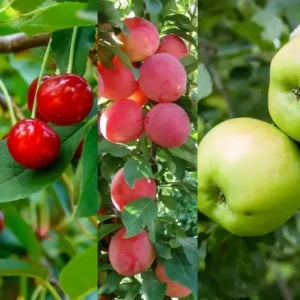
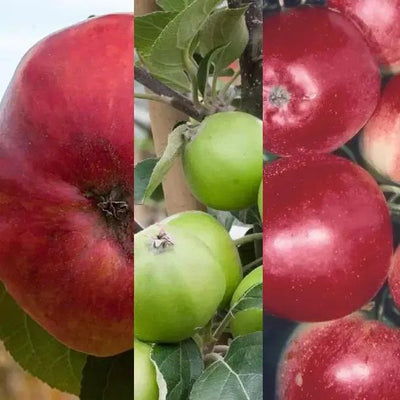
Buying Apple Trees Online:
Order Bareroot Apple Trees For Spring Planting
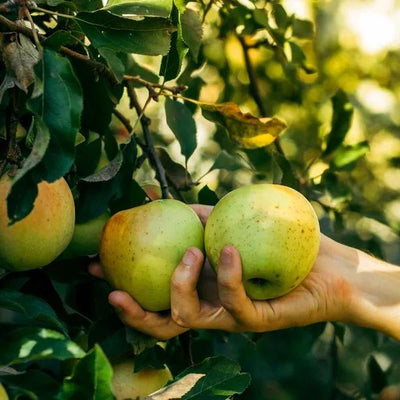
The humble apple tree is more widely planted by UK gardeners than any other fruit variety.
Selected varieties are available pot grown year round.
- Uses: Eating, cooking, juicing and cider apple production
- Good Points: Huge variety of tree, shape, blossom, cropping time
- Position: Grow almost anywhere below 600 feet above sea level, where there is drainage and light
Dwarf Apple Trees
There are two kinds of dwarf tree, both of which are suitable for large pots.
- Those that you, the owner, prune and train to restrict their growth, such as cordons and espaliers. You make them from maidens (1-year-old trees), which could also be grown into a normal-sized tree if you let them.
- Those that are "naturally" small due to the specialist grafting techniques and restrictive rootstocks, known as patio, mini, or dwarf fruit trees (which we don't sell). Even without pruning, they will never become a normal-sized tree.
Buying Apple Trees
For most gardens, it makes sense to start with a bush or half-standard, where available.
Remember that if you want espaliers, cordons or stepovers you will need to start with a maiden (selected varieties are available as ready-made cordons).
Barerooted trees are only delivered between November and the end of March, the winter planting season.
- When your order is ready: your mail order fruit trees are delivered by next working day courier (not the next working day after ordering!)
- Friendly support: if there is anything wrong with your plants when you inspect them, Contact Us within 5 working days
All bareroot plants are covered by our Refund Guarantee, so you can give them a whirl with complete confidence.
Apple trees grow best in a warm, sunny spot, with some shelter from extreme winds and plenty of moisture.
But they can handle most soils apart from bogs and shallow chalk, and crop well at altitudes up to 800 feet (even higher, in the right sunny position).
There are varieties that cope with severe frost pockets, and they can be trained on wires as short as 30-40cm tall (stepovers), or in rows with only 60–90cm between plants (cordons), so there is a variety for practically every garden!
Our Guide to Buying Apple Trees goes into more detail.
Which Apple Varieties Should I Choose?
We sell over 100 varieties, roughly grouped into eaters, cookers, ciders, juicers (most apples are good for at least two of those purposes).
The Best Apple Varieties for the British Home Grower
- The single best all-round, multipurpose apple that is great for eating, cooking, juicing, and cider is James Grieve.
- The two best normal eating apples for the home grower are Red Windsor for the West, and Red Falstaff for the East. The best russet apple is Norfolk Royal Russet.
- The best cooking apple is Bramley's Seedling.
- The best cider apples are "vintage quality", meaning that you only need that one variety for a full-bodied brew. There are four basic cider flavour categories, and the best vintage apples in each are: Kingston Black (Bittersharp), Browns Apple (Sharp), Sweet Coppin (Sweet), and Harry Masters (Bittersweet).
The most popular supermarket varieties (all of which taste far better home-grown) are:
- Golden Delicious: Sweet and more chewy than crisp.
- Braeburn: Sharper than Golden delicious, but still sweet, and very crisp. Only suitable for warm Southern areas.
- Gala: A milder flavour than the others on this list, medium-crisp.
- Granny Smith: Almost citrus-sharp and very firm: a love-it-or-hate-it green eater that also cooks nicely!
- Cox's Orange Pippin: Superb aromatic flavour. Not ideal for organic growing: Sunset is a great alternative.
- Various Russets (Egremont, Herefordshire, Norfolk Royal): Mild flavour with hints of nut, relatively soft flesh, perfect with cheese.
Other considerations:
- Cropping period: Discovery is one of the first to ripen, around the end of August. Winter Gem is not ready until the end of October.
- Size: Pitmaston Pineapple is ideal for a child's lunch box, whereas as Howgate Wonder is the record holder for largest exhibition apple.
What is an apple rootstock?
To propagate a given fruit tree, you take a cutting (scion) and graft it onto a rootstock, which primarily controls the tree's vigor. You might think of the scion as the body of a car, and the rootstock as the engine: the fruit is the same, but the rate of growth and final size of the tree is different.
Learn more about and buy your own apple rootstocks.
Almost all of our apples are on British grown MM106 rootstocks, apart from some vigorous bushes on M26: each tree's product page will tell you.
Can I grow apples in my garden? Probably yes!
Apples are grown all over the UK, and almost every "normal" garden is suitable.
The main places they won't grow is in waterlogged soil, right on the coast exposed to salt winds, on shallow chalk, in full shade, and up a windy mountain.
If you live in Scotland or colder inland regions of the North, browse our short list of Hardy Apple Trees.
- Soil: light soils can be improved with compost & mulch. Heavy clay soils are fine as they are, provided drainage is adequate.
- Light: apples need sun to ripen well. Sour cooking apples and cider apples tolerate partial shade better than sweet eaters.
- Altitude: under 700 feet is good, by around 800 feet you need to have windbreaks, and bee hives nearby.
- Frost pockets: choose apples for cold regions.
- Wind: even self-fertile apples are pollinated by insects, which struggle in very windy spots.
- Size: our guide to fruit tree shapes explains your options.
How to Grow Apple Trees
Your trees need water in dry weather while they establish, yearly mulch in spring, pruning (see section below) and preventative, organic measures against pests:
- Use winter wash when the leaves have come off to kill overwintering insect eggs.
- Apply grease or grease bands to stop wingless female moths climbing into your tree to lay eggs.
- After pruning and leaf-fall, rake up the litter under the tree and burn or remove it - it's safer not to compost it, unless you will use the compost away from your trees.
- Keep a mulched circle around the trees free of vegetation, including grass, but do not pile mulch up against the trunks.
When and How do I Plant an Apple Tree?
When is the best time to plant apple trees?
The best time to plant apple trees is in winter, using bareroot stock.
Pot grown trees can be planted at any time during the rest of the year, as long as you are absolutely certain to water them well.
How to Plant an Apple Tree
You have two main choices with apples. Either grow them:
- As a normal freestanding tree in the "bush" form (with a short trunk under 1.2 metres) or half-standard form (with a trunk between 1.2 and 1.5 metres tall)
- Trained flat using support wires (usually against a wall) as cordons, espaliers, or step-overs.
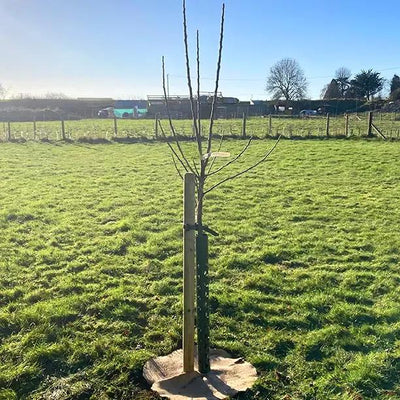
Apple trees must be planted at the same depth in the ground as they were in the pot or ground before being transplanted.
Growing fruit trees requires nutritious soil, with good levels of moisture retention, so improve sandy or poor soils with well rotted organic matter before planting.
Clay soil does not need improving, only mulch over the surface after planting.
Watch our Fruit Tree Planting video, (we highly recommend using Rootgrow).
When and How do I Prune my Apple Tree?
Pruning your apple trees is essential to maintain an open, airy structure where light can reach the fruit.
You are not hurting the tree - think of pruning like weeding: you are removing excess, crowded growth so that the beautiful, productive growth that you do want can thrive.
When to Prune Apple Trees
The best time for most apple tree pruning work is from late Autumn to early Spring, when the leaves have fallen and the tree is dormant.
However, there is no harm in pruning your apple tree at other times of year.
In the case of restricted forms that are trained on wires, like espaliers, cordons, and step-overs, summer pruning is used in addition to winter pruning to control the vigour of the tree.
As always, remove DDD wood at any time: Dead, Damaged, or Diseased.
How to Prune Apple Trees
What are the different types of apple tree?
The basic apple types are:
- Eaters, or dessert apples: These tend to be sweet, and are good to eat fresh. Some are delicious straight off the branch and some are best ripened off the branch for a couple of weeks.
- Cookers: These are usually large, and too acidly sour to enjoy fresh. The cooking process changes the flavour to a mouth watering tanginess.
- Cider: If you bite into an unknown apple and it tastes disgusting and/or has a terrible mushy texture, it is probably a cider variety! There are four main categories (Sharp, Sweet, Bitter-Sweet and Bitter-Sharp), and many of the most popular varieties are high in the bitter tannin.
- Juicers: This is more of an "extra" category, as few apples are only grown for juicing - they are usually good for at least one of the above purposes as well.
The basic apple shapes are:
- Maidens are the youngest, cheapest fruit tree you can buy: unbranched, grafted one year prior. They are the basic "building block" from which all other tree shapes are formed (including wire-trained shapes like cordons, fans, and espaliers).
- "Bush" and half-standards forms are the most popular options for most gardeners, giving you a real headstart on a mature tree: branched, grafted two or three years prior.
- The difference is that the bush form has a short trunk about 75cm tall, and the half-standard form has a trunk about 1.25cm tall.
- The bush form is easy to harvest and takes up less space.
- The half-standard form produces more fruit, and you can push a lawn mower around it more easily.
How big a crop will I get?
A mature half-standard will produce between 100-250kg of apples, while a cordon might manage about a 20-50kg.
On a like for like basis, crop size is determined by three things:
- Quality of cultivation: A well-tended tree will produce a much larger crop than a neglected one.
- Variety: A Bramley carries 50% more by weight than Lord Derby (but in our opinion the latter is even tastier).
- Shape: A half standard will yield much more than a cordon of the same variety.
Apple Tree Pollination
Most apple trees are not reliably self-fertile, so they need a compatible pollination partner (i.e. a different apple variety) that flowers at about the same time, and local bees to do the work.
The best pollinators are actually Crab Apple trees like Golden Hornet and John Downie.
- In most of the UK, apples and compatible crab apples are so common that there is usually one in your immediate area.
In a remote, windy area, it pays to ensure pollination by having more than one compatible apple tree in your garden; local habitats / hives for wild and honey bees help a lot.
Learn more about apple tree pollination.


 Sign In
 Saved items


 5 Star Service Rating




 Secure, One-Tap Checkout
 5 Star Feefo Rating
 Hand Picked, Delivered to Your Door!
 Platinum Trusted Service Award 2026
 Mail Order Plant Experts - Est. 1949
 1 Year Bulb Guarantee