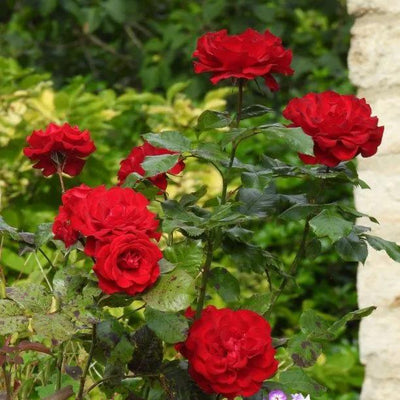
Order Potted Climbing Rose Bushes Now For Spring Delivery
Order Bareroot Climbing Roses For 2026 Spring Planting Season
Climbing roses are your most reliable garden wall hangings, giving you waves of flowers and scent for up to six months. Against a house, they need sturdy support wires, but with a little guidance at the start, they can also clamber freely along fences or into trees.
Rambling roses have their own listing, although there is some overlap. What's the difference between a rambler and a climber?
Browse our full range of rose bushes.
Pot grown stock uses peat free compost wherever possible. Bareroot roses are grown on heavy clay in a well drained site (heaven for rose roots) and lifted to order.
- When your order is ready: your mail order rose bushes are delivered by next working day courier (not the next working day after ordering!)
- Friendly support: if there is anything wrong with your plants when you inspect them, Contact Us within 5 working days
All bareroot plants are covered by our Refund Guarantee, so you can give them a whirl with complete confidence.
The Best Climbing Roses for Shady Sites & North Facing Walls
Few roses will bloom well in truly full, overcast shade, but on a North facing wall with open sky above them, these roses will perform nicely.
In very approximate order of shade tolerance (best to less best):
- Iceberg - Climbing Version (Semi-Double, White, to 2.5m – 4m)
- Golden Showers (Semi-Double, Yellow, to 3m)
- Danse du Feu (Double, Red, to 2.5m – 4m)
- Zephirine Drouhin (Double, Deep Pink, to 1.5m – 2.5m)
- Chris (Double, Yellow, to 3m)
- New Dawn (Full, Light Pink, to 1.5m – 2.5m)
- Cécile Brünner (Full, White, to 2.5m – 4m)
- Madame Alfred Carrière (Full, White-Pale Pink, to 4m – 8m)
- Constance Spry (Full, Pink, to 1.5m – 2.5m)
- Compassion (Full, Apricot-Pink, to 3m)
Rambling roses are a different story: being much closer to wild roses in their genes, they generally perform well in less sunny conditions, and with a bit of creative tying-in, they can fulfil about the same role as climbing roses.
Where Can I Grow Climbing Roses?
You can grow climbing roses almost anywhere in the UK. They are very hardy, and apart from waterlogged sites, there are roses suitable for any soil type, and shade-tolerant roses for North-facing walls. Roses love heavy clay soil, but any soil with drainage can be improved.
Still, you will get the best flower displays in a sunny, sheltered location.
Rose Replant Disease
Replant disease affects several plants, especially roses and other plants in the Rosacea family. It occurs when you remove an old rose, and plant a new rose straight away in the same soil.
There are three main ways to avoid rose replant disease:
- The easiest way: plant a different shrub!
- The easy way: wait at least a full 12 months before planting a new rose in the site of an old one. Grow some annual bedding plants there instead for the interim - annual Sweet Peas are great because their roots fix nitrogen, but any mix of wild flowers is good.
- The hard way: dig out a block of soil at least 1 metre square on the surface and 40-50cm deep, and replace the soil with fresh stuff. Lining the sides of the hole with thick, plain (not glossy) cardboard may help.
Whichever method you choose, apply Rootgrow fungi when you replant the new rose, and feed it with rose food during the growing season.
When and How Do I Plant Climbing Roses?
What is the best time to plant climbing roses?
Bareroot roses are by far the best value, the easiest to handle & plant because they weigh so little, and offer the most selection.
- Bareroot roses are only planted from about November to the end of March, weather depending. The perfect months are November and March, but anytime in winter is fine.
• Plant potted roses at any time, as long as you can water them during dry summer weather. In the hottest part of mid-summer, it is preferable to delay planting until the weather cools a bit to reduce stress on the plants.
How to Plant Climbing Roses
Watch our short video on planting a Climbing Rose against a fence.
Soil preparation is an important investment: a rose bush should live for at least 30-40 years.
Dig a square planting hole that is comfortably wide enough to spread the roots out, so they do not touch the sides, but not so deep that the graft union is buried.
Improve the soil that you removed by adding about 25% well-rotted compost/manure before returning it to the hole.
Wet the roots, and then sprinkle them with Rootgrow.
Don't plant your roses too deep.
Water well immediately, and all through their first spring and summer.
When and How Do I Trim Climbing Roses?
The best time to cut back your climbing rose is in winter, when the leaves have fallen.
Most Climbing roses flower twice in the summer, and you should deadhead - lightly trim - them after the first flush to encourage the best re-flowering.
Read more about pruning climbing roses.



 Sign In
 Saved items



 5 Star Service Rating




 Secure, One-Tap Checkout
 5 Star Feefo Rating
 Hand Picked, Delivered to Your Door!
 1 Year Bareroot Guarantee
 Platinum Trusted Service Award 2026
 Mail Order Plant Experts - Est. 1949