


Sold as:

from £10.95

Sold as:
from £19.99
 5 Star Service Rating




 Secure, One-Tap Checkout
 5 Star Feefo Rating
 Hand Picked, Delivered to Your Door!
 1 Year Bareroot Guarantee
 Platinum Trusted Service Award 2026
 Mail Order Plant Experts - Est. 1949
 1 Year Bulb Guarantee
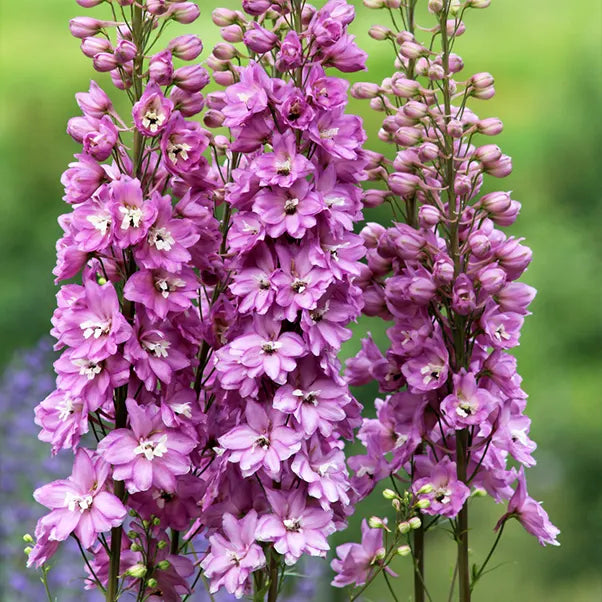




Delphinium 'Astolat' is a Pacific Giant hybrid with pink-lilac flowers and a contrasting dark eye, reaching 150cm in June and July. It is one of the most spectacular summer-flowering perennials available, demanding full sun, rich soil, staking, and slug protection — but giving back a great deal in return.
The Pacific Giants take their names from Arthurian legend — Galahad, Black Knight, Astolat. Astolat is where Elaine lived in Tennyson's retelling of the legend, the tower above the river from which she watches the knights ride to Camelot. The name suits the flower: there is something romantically impractical about a delphinium that needs staking, slug protection, and rich soil to achieve its full height of 150cm, but which, when it gets all three, is one of the most impressive sights in a June garden. The spires of Astolat are pink-lilac — warmer than the blue-purple of Black Knight, more complex than the white of Galahad — with a contrasting dark bee at the centre of each individual floret that gives close-up interest as well as the overall column of colour.
Pacific Giants are seed-raised, which means there is slight variation between individual plants in exactly the same way as with any seed-selected variety. The colour range within 'Astolat' is relatively tight — pink through lilac — but expect some natural variation. They are shorter-lived than the named British show delphiniums (three to five years is realistic) but they achieve their full height and impact in the first year, which is more than can be said for some alternatives. Protect the emerging shoots from slugs in early spring with whatever method you favour — this is non-negotiable. And stake at 30cm before the stems need it.
Delphiniums belong at the back of the border, and their companions should acknowledge the scale. Campanula latifolia Alba at 120cm provides white bells at a complementary height through the same June-July window. Delphinium Galahad alongside in pure white and Delphinium Black Knight in deep violet create the classic mixed-Pacific-Giants border combination. At mid-border level, Lupin Gallery Red in June and Centaurea montana in blue provide the layered cottage garden palette that delphiniums traditionally anchor from the top.
We use peat-free compost and biological pest controls. Delphiniums are demanding plants and we won't pretend otherwise — but grown well they are genuinely unmatched for drama in the June border. The people who grow your plants are the same people who pack your order and answer your questions. Every plant is guaranteed. See the full perennial collection.
Yes — always. At 150cm in full flower the stems are vulnerable to wind and rain, and a toppled delphinium does not recover. Put stakes in early, when the plants are about 30–40cm tall, before the stems have got heavy enough to matter. A ring support, a few canes tied with soft twine, or proprietary delphinium supports all work well.
The emerging shoots in spring are the critical moment — slugs find young delphinium growth irresistible and can destroy a plant before it has had a chance to establish. Use whichever control method suits your garden: copper tape around the crown, nematodes, organic iron phosphate pellets, or simply go out with a torch on damp evenings in March and April. Once the stems are above 30cm and the leaf texture has toughened up, slug damage becomes much less of an issue.
Yes, for three to five years in most gardens — they are perennials, not annuals. They tend to be shorter-lived than the named British show varieties, but they achieve their full impact quickly. After five or six years the crown may become congested and flowering declines; lift and divide in spring, or simply replace.
Sometimes. Cut the main spike back to the first side shoot after the primary flowers are over, and feed with a liquid fertiliser. In a good year, side shoots extend and produce a second, smaller flush in late August or September. It is not as reliable as the first flush, but worth attempting.
The Pacific Giants (Astolat, Black Knight, Galahad etc.) are seed-raised, relatively vigorous, and readily available. The named British show varieties — cultivars like 'Bruce', 'Blue Dawn', 'Emily Hawkins' — are vegetatively propagated from selected clones and represent the highest breeding standard, with many holding the RHS AGM. Pacific Giants give you impressive colour quickly; named show varieties give you maximum precision and longevity at higher cost.


 Sign In
 Saved items