


Sold as:

from £10.95

Sold as:
from £19.99
 5 Star Service Rating




 Secure, One-Tap Checkout
 5 Star Feefo Rating
 Hand Picked, Delivered to Your Door!
 1 Year Bareroot Guarantee
 Platinum Trusted Service Award 2026
 Mail Order Plant Experts - Est. 1949
 1 Year Bulb Guarantee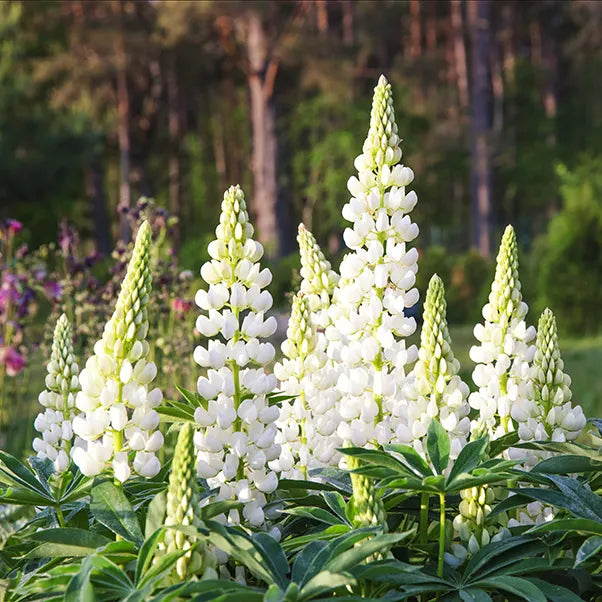




Lupinus 'Gallery White' is a dwarf lupin reaching 50cm with clean white flower spikes in May and June. The white lupin in the Gallery's compact format is among the most versatile: it works in almost any colour scheme, it brightens shaded positions that a coloured lupin cannot lift, and it pairs naturally with everything from blue centaurea to deep red companions.
Most gardeners choose lupins for their colour — the pinks, bicolours, purples, reds. But there is a case for white as the first choice. White lupins bridge any colour gap in the May and June border, they are not dominated by adjacent strong colours the way pale pink or yellow can be, and they have an airy quality in the early summer garden that gives them more presence than their modest size suggests. Gallery White at 50cm gives you all of this at a scale that works in smaller gardens and containers where the taller West Country series cannot go. The flowers are a clean, unqualified white — the species form can carry a faint cream tinge in some conditions, but Gallery White is the whitest of the white lupins in common cultivation.
The cultural requirements are identical to Gallery Red: neutral to acid, free-draining soil in full sun, slug protection in early spring, prompt deadheading for a second flush. Lupins are short-lived perennials — three to five years — but they self-seed and a colony, once established, tends to persist. The seeds are toxic and should be kept away from children and pets. Lupin aphid, a large grey-green pest that colonises the flower stems, is worth watching for in May and June — it can be controlled with a soft soap spray or simply rubbed off by hand.
White is the lupin that suits the most combinations. The pairing with Gallery Red — red and white at matched height and season — is the most direct, and two or three of each together gives a confident red-and-white front-border combination in May and June. For a softer blue-and-white palette, Centaurea montana flowers at the same time and provides the blue against which Gallery White reads particularly clearly. Delphinium Galahad at 150cm behind echoes the white lupin at greater height, creating a white vertical theme across the border. For late season, Echinacea White Swan carries the white into July and August after the lupins have finished.
We use peat-free compost and biological pest controls. Gallery White is the compact lupin for gardeners who want white in early summer without committing to the scale and permanence of the West Country varieties — a practical, versatile choice for most garden settings. Every plant is guaranteed. See the full perennial collection.
Yes — all parts, particularly the seeds and pods, contain quinolizidine alkaloids that are toxic if eaten. Garden lupins carry higher alkaloid levels than the edible lupini beans used in Mediterranean cooking. Keep children and pets away from the seeds and pods in particular. Normal gardening contact does not cause harm; wash hands before eating after handling.
Yellowing usually indicates alkaline soil — lupins need a neutral to slightly acid pH and suffer in lime-rich or chalk soils. A soil pH test will confirm this; lower acidity with sulphur chips if needed. A slight pink flush on white flowers is normal as they age and is not a problem; flowers starting pink and fading to white would suggest the plant is mislabelled or has come from seed that was cross-pollinated.
Lupin aphid (a large, grey-green, waxy aphid) colonises flower stems in May and June. Spray with a dilute soft soap solution — one tablespoon of washing-up liquid in a litre of water — or simply rub the colonies off with your fingers. Check under the leaves as well as on the flower stems. Natural predators including parasitic wasps will assist if you avoid broad-spectrum insecticides.
Free-draining, neutral to slightly acid soil in full sun. Lupins have a deep taproot and need room for it to grow — they dislike compacted or waterlogged ground. Avoid chalk and limestone soils; avoid heavy clay that sits wet in winter. Sandy loam or light garden soil with added organic matter is ideal. Do not add lime or alkaline fertilisers.
Once in May and June is the main event. Deadhead promptly — cut the whole spike back to a side shoot while the lower flowers are still opening — and feed with a liquid fertiliser. A second, smaller flush often follows in August. Without deadheading, seed set stops further bud development and the second flush either does not come or is very thin. The second flush is never as spectacular as the first but is well worth encouraging.


 Sign In
 Saved items