
What Are the Best Trees for Small Gardens in the UK?
The best trees for small gardens stay genuinely compact — under around 8 metres at maturity — while offering at least one season of strong ornamental interest, whether that is blossom, autumn colour, attractive bark, or wildlife value. Choosing the right species and variety from the outset saves years of remedial pruning and prevents the common mistake of planting a tree that eventually overwhelms the space.
Related guides
- Best Trees for Autumn Colour
- Flowering Cherry Trees: Best Ornamental Cherries for UK Gardens
- How to Choose and Plant a Garden Tree
How Small Is a “Small Garden” When Choosing a Tree?
For practical planting purposes, treat any garden under roughly 200 square metres — or any plot where the house or boundary is within 10 metres of the planting position — as a small garden. This matters because mature tree height, canopy spread, and root spread all need to be comfortable within those constraints without causing structural damage or loss of light to neighbours.
A useful rule of thumb is to keep your planting distance from buildings to at least half the tree’s expected mature height. For a tree that tops out at 6 metres, that means staying at least 3 metres clear of the house wall. Always check for underground services before digging.
The categories below use these size bands:
| Category | Mature Height | Typical Canopy Spread | Best For |
|---|---|---|---|
| Patio / very small | 2–4 m | 1.5–3 m | Containers, tiny courtyards |
| Small garden | 4–8 m | 3–6 m | Most residential gardens |
| Medium garden | 8–15 m | 6–10 m | Larger plots, screen planting |
Browse our curated range of small garden trees for species already selected with compact habits in mind.
Which Ornamental Trees Suit Small Gardens Best?
Ornamental cherries, crab apples, rowans, and compact maples are the workhorses of the small garden because they deliver multi-season interest without outgrowing their welcome. Each of these genera contains named varieties specifically bred or selected for restrained size and neat habit, which makes choosing a cultivar just as important as choosing a species.
Ornamental Cherry (Prunus)
Few trees rival a flowering cherry for spring drama. Varieties such as Prunus ‘Kiku-shidare-zakura’ (Cheal’s Weeping Cherry) stay under 4 metres and suit even tiny gardens, while ‘Kanzan’, perhaps the most widely planted cherry in Britain, matures at around 8 metres with a distinctive vase shape. Cherries are generally tolerant of most well-drained soils and are unfussy about aspect. Explore our full range of cherry blossom trees.
Crab Apple (Malus)
Crab apples are arguably the single best all-round tree for a small British garden: clouds of blossom in April and May, colourful fruit lasting into winter, and excellent wildlife credentials. Malus ‘Evereste’ is a consistent RHS Award of Garden Merit holder, reaching about 7 metres. Malus ‘Red Sentinel’ holds its bright-red fruits well into February, providing winter food for thrushes and blackbirds. See our full selection of crab apple trees.
Rowan (Sorbus)
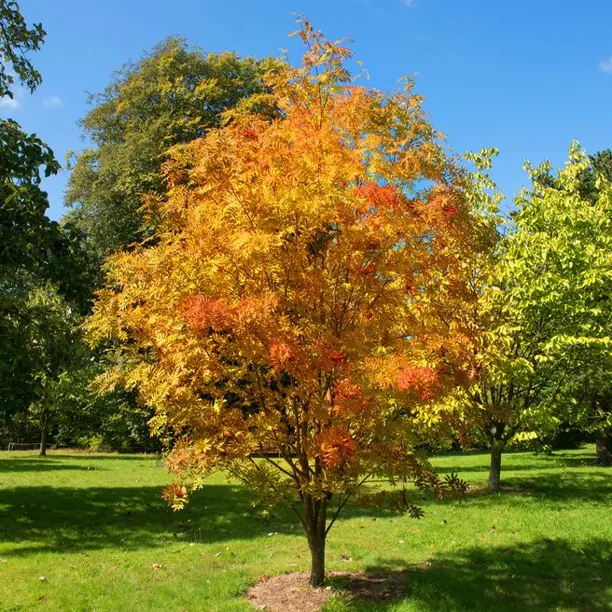
Rowans are native to Britain, tolerant of exposed sites and poor soils, and offer white spring blossom, good autumn leaf colour, and berries in shades from scarlet to pink to white. Sorbus aucuparia (common rowan) grows to around 10–15 metres in open ground but is far more restrained in garden soil and responds well to light formative pruning. Yellow- and white-berried varieties such as ‘Joseph Rock’ (amber-yellow berries, superb autumn colour) stay closer to 8 metres. Shop rowans and whitebeams.
Compact Maple (Acer)
Several maples are naturally suited to smaller spaces. The Amur Maple (Acer tataricum ginnala) rarely exceeds 5–6 metres, colours brilliantly in autumn, and tolerates exposed, cold gardens well. The Field Maple (Acer campestre) is Britain’s only native maple, wildlife-friendly, and easily kept at any size by pruning. For a more architectural choice, Crimson Sentry Norway Maple has a tight columnar habit reaching 8 metres tall but only 2–3 metres wide — perfect where space is at a premium. See the full maple trees range.
What Are the Best Native Trees for Small Gardens?
Native trees support far more insect species than exotic ornamentals, which in turn supports birds and bats — so even a single well-chosen native tree has real ecological value. The good news is that several British natives are genuinely compact or can be managed to stay so.
| Species | Mature Height | Key Feature | Wildlife Value |
|---|---|---|---|
| Field Maple (Acer campestre) | 6–10 m (easily pruned) | Golden autumn colour | High — aphids feed many birds |
| Hawthorn (Crataegus monogyna) | 5–10 m | May blossom, red haws | Very high — top 5 for insects |
| Rowan (Sorbus aucuparia) | 8–15 m | Berries, autumn colour | High — berries eaten by 60+ species |
| Silver Birch (Betula pendula) | 10–20 m | White bark, light canopy | Very high — 300+ insect species |
| Crab Apple (Malus sylvestris) | 4–8 m | Blossom, fruit | High — fruit, nectar, nesting |
Silver birch deserves a special mention despite its ultimate height. Its canopy is airy enough that light levels beneath it remain high, and its roots are relatively fine and non-invasive compared with species such as willow or poplar. A single multi-stemmed birch can make a beautiful focal point in a garden of 100 square metres or more. Browse our birch trees and hawthorn trees. For a fuller overview of the best native species, see our guide to native British trees.
Which Trees Give the Best Autumn Colour in a Small Garden?
For concentrated autumn colour in a confined space, compact maples and rowans are hard to beat, offering fiery reds, oranges, and golds without the scale of a full-sized tree. Selecting the right named variety ensures you get reliable colour rather than the variable results from seed-grown specimens.
| Tree | Autumn Colour | Mature Height | Link |
|---|---|---|---|
| Amur Maple | Brilliant scarlet-red | 5–6 m | Buy Amur Maple |
| Royal Ruby Field Maple | Deep burgundy-red | 6–8 m | Buy Royal Ruby |
| Elsrijk Field Maple | Yellow-gold | 8–10 m | Buy Elsrijk |
| Rowan ‘Joseph Rock’ | Orange, red, purple | 7–8 m | Browse Rowans |
| Silver Birch | Soft yellow | 10–20 m | Browse Birches |
For a deeper dive into varieties chosen specifically for their autumn display, see our guide to best trees for autumn colour.
Are Columnar Trees a Good Choice for Small Gardens?
Columnar (fastigiate) trees are excellent for small gardens because they provide significant height and presence while taking up very little ground-level space — some varieties are less than 2 metres wide at maturity. They work well as focal points, to frame a view, or to add vertical structure without casting heavy shade.
The most reliable columnar choices for small gardens include:
- Crimson Sentry Norway Maple — deep purple-red foliage all season, tight upright column, around 8 m × 2 m.
- Fastigiate Hornbeam (Carpinus betulus ‘Fastigiata’) — classic formal shape, excellent in exposed gardens, 10–15 m but very narrow.
- Wheatley Elm (Ulmus minor ‘Sarniensis’) — among the more resistant elms, elegant vase shape; see our elm trees range.
- Italian Cypress (Cupressus sempervirens) — the classic Mediterranean column; suits warmer, drier parts of southern England best; see our conifers and evergreens.
One caveat: some columnar conifers sold as “compact” in garden centres can eventually reach considerable heights, so always check the expected 20-year height, not just the plant label description.
What Trees Grow Well in Pots for Very Small or Paved Gardens?
Container growing is an excellent solution for paved gardens, roof terraces, and patios where there is no open soil, and several small trees perform very well when given a large enough pot and regular feeding. The key constraint is root volume: a container tree needs a minimum 60-litre pot to thrive long-term, and the larger the pot the better.
Top choices for containers include Japanese Maples (Acer palmatum cultivars), bay trees (Laurus nobilis), and compact crab apples. Japanese Maples are particularly well suited to pots because their naturally shallow, fibrous root system does not demand enormous volumes of compost, and the container environment actually helps moderate the moist-but-well-drained conditions they prefer. See our Japanese Maple plants for a suitable starting point.
For full guidance on container-grown trees, read our advice article: 15 Ideal Trees for Growing in Pots.
Which Small Garden Trees Cope Best with Clay Soil?
Many small gardens, particularly in the Midlands and parts of southern England, have heavy clay soils that become waterlogged in winter and crack in summer. Several compact trees handle these conditions well, but others — particularly most ornamental cherries — struggle badly on waterlogged clay and are best avoided unless drainage is improved first.
| Tree | Clay Tolerance | Notes |
|---|---|---|
| Crab Apple (Malus) | Excellent | One of the most clay-tolerant ornamental trees |
| Hawthorn (Crataegus) | Excellent | Tolerates even poorly drained heavy clay |
| Field Maple (Acer campestre) | Good | Prefers neutral to alkaline; dislikes waterlogging |
| Rowan (Sorbus) | Good | Avoid very heavy, permanently wet clay |
| Ornamental Cherry (Prunus) | Poor | Prone to waterlogging-related dieback on clay |
| Silver Birch (Betula) | Moderate | Better on sandy or loamy clay than puddled subsoil |
For more detail on matching tree species to clay conditions, read our full article on trees for clay soils.
Should You Buy Bare-Root or Pot-Grown Trees for a Small Garden?
Bare-root trees — lifted from the field during the dormant season (November to March) — establish more quickly and cost significantly less than pot-grown equivalents, making them the better choice for most small garden planting projects. Pot-grown trees offer flexibility because they can be planted at any time of year, but they are generally more expensive and can be more prone to root circling if left in the pot too long.
For small garden planting, the practical recommendation is:
- Bare-root, November–March: Best value, fastest establishment, widest variety choice. Plant as soon as possible after delivery.
- Pot-grown, April–October: Pay attention to watering in the first summer — newly planted trees are far more vulnerable to drought than established ones.
- Root-balled: Mainly relevant for larger semi-mature specimens; less common for the compact trees covered here.
Whichever form you buy, stake the tree correctly at planting to prevent wind-rock damaging the developing root system. Our guide to how to plant a tree with a stake covers everything you need to know.
What Are the Most Common Mistakes When Choosing Trees for Small Gardens?
The single biggest mistake is underestimating ultimate size. Many trees sold in garden centres look perfectly manageable at 1.5 metres in a pot but will reach 20 metres or more within 30–40 years. Below are the most frequent errors, and how to avoid them.
- Planting large species “because I can keep it trimmed”. Heavy annual pruning is expensive, disfigures most trees, and shortens their lifespan. Start with a naturally small species instead.
- Ignoring spread as well as height. A tree 6 metres tall with an 8-metre canopy spread can cause as much shading and encroachment as a much taller one with a narrow crown.
- Planting too close to the house. Root damage to drains and foundations is rare with most ornamental trees in normal soil, but it is real with species such as willow and poplar on shrinkable clay. Keep these well away from buildings.
- Forgetting about the neighbour’s side. A tree planted 1 metre from a boundary will soon have canopy extending well over next door. Discussion and planning ahead avoids disputes.
- Choosing on blossom alone. A tree that looks beautiful for two weeks in May but does nothing for the other 50 weeks is a wasted opportunity. Prioritise multi-season interest.
What Are Ashridge Trees’ Top Picks for Small Gardens?
Drawing together all the criteria above — compact size, multi-season interest, ease of establishment, and UK hardiness — here are our top recommendations across different planting scenarios.
| Scenario | Top Pick | Why | Max Height |
|---|---|---|---|
| Tiny garden, big blossom | Ornamental cherry | Unbeatable spring flower power | 4–8 m |
| Best all-rounder | Crab Apple ‘Evereste’ | Blossom, fruit, wildlife, autumn colour | 7 m |
| Autumn colour focus | Amur Maple | Brilliant red, compact, cold-hardy | 5–6 m |
| Narrow space / columnar | Crimson Sentry Maple | Purple foliage, very narrow crown | 8 m × 2 m |
| Heavy clay soil | Hawthorn | Tolerates almost any soil, wildlife gold mine | 5–10 m |
| Pot / patio | Japanese Maple | Superb foliage, shallow roots, elegant habit | 2–4 m |
| Wildlife garden | Rowan | Nectar, berries, nesting, autumn colour | 8–12 m |
| Light shade, airy canopy | Silver Birch | Dappled shade, white stem, catkins | 10–15 m |
Frequently Asked Questions
What is the best tree for a very small garden?
A crab apple such as Malus ‘Evereste’ is outstanding for very small gardens, offering spring blossom, autumn fruit, and wildlife value in a compact 6–7 metre tree. Browse crab apples.
Which trees stay small permanently?
Naturally small species such as Amur Maple, dwarf ornamental cherries, and Japanese Maple cultivars genuinely stay compact without requiring heavy pruning to contain them. Choose species, not just varieties labelled “dwarf.”
How far from the house should I plant a small garden tree?
As a safe minimum, plant at least half the tree’s expected mature height away from buildings. For a 6-metre tree, that means at least 3 metres clear of the house wall and foundations.
Can I plant a tree close to a fence?
Allow at least half the mature canopy spread as clearance from a fence. Discuss with neighbours before planting anything near a shared boundary, as overhanging branches become their right to cut back.
What is the fastest-growing small garden tree?
Among compact species, ornamental cherries and rowans grow reasonably quickly — 30–50 cm per year in good conditions. Explore our fastest growing trees collection for species prioritised by growth rate.
Do small garden trees need staking?
Yes, in most cases. A short stake positioned at 45 degrees is best practice for the first two growing seasons to prevent wind-rock. Read our full tree staking guide for detail.
Which small trees are best for wildlife?
Hawthorn, crab apple, rowan, and field maple are the top four for combined insect, bird, and pollinator value. See our native British trees range for species proven to support UK wildlife.
Are ornamental cherries suitable for clay soil?
Most ornamental cherries perform poorly on waterlogged clay, becoming prone to disease and dieback. On heavy clay, crab apple or hawthorn are far safer choices. See our clay soil guide.
What small tree has the best autumn colour?
The Amur Maple is outstanding for its reliable scarlet-red autumn display in a compact 5–6 metre tree. Royal Ruby Field Maple is another excellent option.
Can I grow a tree in a pot in a small garden?
Yes — Japanese Maples, bay trees, and compact crab apples all do well in large containers (60 litres minimum). Read our guide: 15 Ideal Trees for Growing in Pots.
When is the best time to plant a small garden tree?
Bare-root trees should be planted November to March while dormant. Pot-grown trees can be planted year-round, but autumn and early spring planting gives the best establishment results with least irrigation needed.
What is a columnar tree and is it suitable for a small garden?
A columnar (fastigiate) tree grows tall but very narrow — some under 2 metres wide — making them ideal where height is wanted without canopy spread. Crimson Sentry Maple is a fine example.
Related Products
- Small Garden Trees — full collection
- Amur Maple (Acer tataricum ginnala)
- Crimson Sentry Norway Maple
- Royal Ruby Field Maple
- Elsrijk Field Maple
- Field Maple
- Japanese Maple Plants
- Crab Apple Trees
- Cherry Blossom Trees
- Rowan & Whitebeam Trees
- Maple Trees
- Birch Trees
- Hawthorn Trees
- Native British Trees
- Conifers & Evergreens
Leave a Reply