
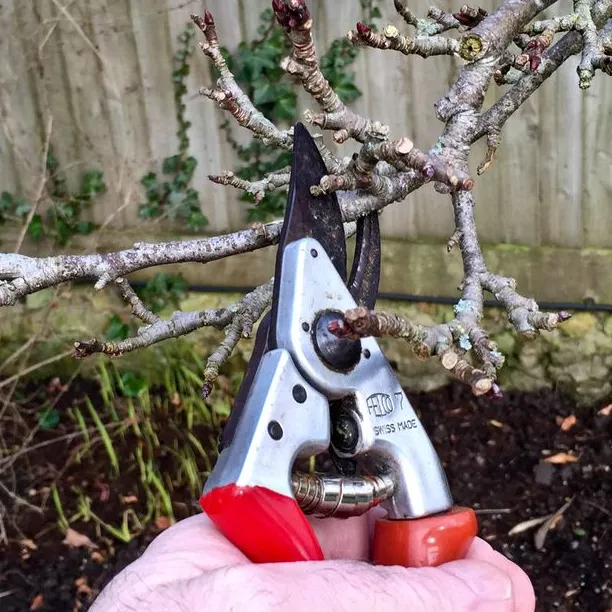
What is the correct way to prune fruit trees?
Pruning fruit trees means selectively removing branches to improve their shape, health, and cropping. Done correctly and at the right time of year, it encourages strong new growth, lets light and air into the canopy, and can double the quality of your harvest. Done badly — or at the wrong season — it can invite disease, reduce fruiting, or weaken the tree for years.
Related guides
Why do fruit trees need pruning at all?
Left unpruned, most fruit trees become overcrowded, shaded canopies that produce masses of small, poor-quality fruit — or none at all. Pruning solves several problems simultaneously.
A fruit tree’s instinct is to grow outward and upward rather than to fruit heavily. Annual pruning redirects the tree’s energy away from vigorous vegetative growth and into fruit buds. It also removes dead, diseased, and crossing branches before they can spread problems through the whole tree, and keeps the tree at a manageable size for picking and maintenance.
There are four main goals every time you pick up the secateurs:
- Structure — a framework of strong, well-spaced branches that won’t snap under a heavy crop.
- Light — sunlight reaching into the centre of the canopy so fruit colours and ripens properly.
- Air circulation — reducing humidity inside the canopy to limit fungal diseases such as apple and pear scab.
- Renewal — encouraging young, productive wood to replace old, exhausted spurs and laterals.
When is the best time to prune fruit trees?
The correct season depends almost entirely on the type of fruit tree: apples and pears are pruned in winter; stone fruits (plums, cherries, damsons, gages, peaches, and apricots) must be pruned in summer. Getting this the wrong way round is one of the most common and damaging mistakes home growers make.
| Fruit type | Best pruning window | Why this timing? |
|---|---|---|
| Apples & pears | November – early March (dormant season) | Tree is dormant; wounds heal before new growth; low disease pressure |
| Plums, damsons & gages | June – August (actively growing) | Active sap flow seals wounds quickly; silver leaf disease spores are lowest in summer |
| Sweet & acid cherries | July – August (immediately after harvest) | Same silver leaf risk as plums; wounds heal before autumn |
| Peaches & apricots | May – July (growing season) | Avoid cold wounds; peach leaf curl pressure lower once canopy is thinned |
| Quinces | November – February (dormant) | Treated like pears; light pruning only needed |
| Figs | Late February – March (just before growth) | Protect embryo fruitlets that overwinter on shoot tips |
Never prune stone fruits in autumn or winter. The silver leaf fungus (Chondrostereum purpureum) releases spores from autumn through to spring, and open wounds are highly vulnerable. Infected wood develops a silvery sheen on the leaves; left untreated the disease is fatal.
What tools do you need for pruning fruit trees?
Sharp, clean tools make cleaner cuts that heal faster and carry less disease risk. Blunt blades crush rather than cut bark, leaving ragged edges where fungal spores take hold.
The basic kit for most garden fruit trees:
- Bypass secateurs — for any stem up to the diameter of a pencil. Use bypass (two blades crossing) rather than anvil (one blade crushing onto a flat plate) for the cleanest cut.
- Long-handled loppers — for branches up to about 3–4 cm in diameter.
- Pruning saw — a folding or fixed-blade saw for anything thicker. Never use a general-purpose wood saw; the blade is too coarse.
- Sharpening stone and whetstone — keep blades honed.
- Sterilising solution — methylated spirits or a dilute bleach solution wiped on blades between trees prevents cross-contamination of diseases such as fireblight.
Wound sealants (pruning paint) are not routinely recommended by modern arborists for most cuts, as they can trap moisture. The exception is large cuts on stone fruits, where a thin application of a bitumen-based sealant may provide some protection against silver leaf entry while the wound is at its most vulnerable.
How do you prune apple and pear trees?
Apple and pear trees are pruned in winter, and the approach depends on whether the tree is young and being trained, or an established tree being maintained. Both species fruit on similar wood — mainly on short, knobbly growths called spurs, and on two-year-old laterals — so the pruning principles are identical.
Pruning a young apple or pear tree (years 1–3)
The first few years of pruning are about building a sound framework. The most common shape for a garden tree is the open-centre bush (also called open vase), which keeps the canopy low, accessible, and well-lit. See our detailed guide to pruning new maiden fruit trees using the open-centre method for step-by-step instructions.
- Year 1 (maiden whip): Cut the main stem to about 75–90 cm from the ground, just above a healthy bud. This forces the tree to break into lateral branches.
- Year 2: Select 3–5 evenly spaced lateral branches as your main scaffold arms. Shorten each by half to an outward-facing bud. Remove any competing leaders or branches growing inward or crossing.
- Year 3: Shorten the selected scaffold branches by about a third. Begin shortening strong laterals to 4–6 buds to develop fruiting spurs.
Pruning an established apple or pear tree
Once the framework is in place, winter pruning is largely about renewal and balance. Work through this checklist each year:
- Remove the 3 Ds first: dead, diseased, and damaged wood. Cut back to healthy tissue.
- Remove any branches that are crossing or rubbing — these create wounds and harbours for disease.
- Thin out any overcrowded spurs. Old spur systems can become congested and produce tiny fruit; thin back to leave only 2–3 buds per spur cluster.
- Shorten strong, upright shoots (water shoots) by two-thirds, or remove them entirely if they are too vigorous.
- Cut back laterals that fruited last year to 2–4 buds to encourage new spur development.
- Stand back and check: you should be able to throw a hat through the canopy without it catching.
| Variety characteristic | Pruning note | Example varieties |
|---|---|---|
| Tip-bearing — fruits at shoot tips, not on spurs | Do not shorten laterals; thin whole branches instead | Beauty of Bath, Blenheim Orange |
| Spur-bearing — fruits on short stubby spurs | Standard spur-pruning applies; thin congested spur systems | Ashmead’s Kernel, Adam’s Pearmain |
| Partial tip-bearer — fruits on tips and spurs | Prune some laterals, leave others; remove crossing wood only at tips | Arthur Turner, Bardsey Island |
| Very vigorous — e.g. on MM111 rootstock | Hard pruning stimulates more vigour; prune lightly and consider rootstock choice | Bountiful, Annie Elizabeth |
Tip-bearing apple varieties are particularly important to identify before you start, because shortening every lateral will remove all the fruit buds. If in doubt, look at the shoot tips in winter: fat, rounded flower buds at the very tip of a shoot (rather than only along the sides) indicate tip-bearing habit. Our apple varieties choosing guide notes fruiting habit for each variety.
How do you prune plum, damson, and gage trees?
Plums, damsons, and gages must be pruned between June and August when the tree is actively growing and silver leaf disease spores are at their lowest. Summer pruning is the single most important rule for all stone fruit.
The structure to aim for is similar to apples — an open-centre bush or a half-standard — but plums are naturally more vigorous and tend to produce a lot of upright growth. Focus on:
- Removing the 3 Ds (dead, diseased, damaged) as a priority.
- Thinning out congested growth in the centre to allow light and air to penetrate.
- Shortening whippy laterals to 6 leaves to encourage spur development and fruit for next year.
- Removing suckers from the rootstock at the base — pull rather than cut these if possible, as cutting stimulates more.
Do not remove more than about one-quarter of the canopy in a single season. Plums and gages respond to hard pruning with a flush of even more vigorous, unproductive growth. Our full pruning plum trees guide covers the subject in depth.
Browse our full range of Plum, Gage & Damson Trees.
How do you prune cherry trees?
Cherries — both sweet and acid — should be pruned in July or August, immediately after picking, for the same reason as plums: to minimise silver leaf risk and allow wounds to heal before autumn. Sweet cherries fruit on the previous year’s wood and on spurs; acid cherries (such as Morello) fruit almost entirely on the previous year’s wood, so the approach differs.
| Cherry type | Where it fruits | Pruning approach |
|---|---|---|
| Sweet cherry | Spurs and 2-year wood | Minimal pruning; remove dead/crossing wood; shorten long leaders by one-quarter |
| Acid cherry (e.g. Morello) | Previous year’s shoots | Renewal pruning: cut back a proportion of fruited shoots to a new lateral each year |
Acid cherries are pruned more like raspberries than apples — you remove the wood that has just fruited and encourage the new shoots that will carry next year’s crop. This renewal approach keeps the tree productive and avoids the bare-legged look of neglected trees. For variety recommendations and pollination advice, see our best cherry trees for fruit buying guide and our cherry tree pollination groups chart. Browse all cherry fruit trees.
How do you prune trained fruit trees (cordons, espaliers, fans)?
Trained forms — cordons, espaliers, fans, and step-overs — require a two-season pruning regime: winter pruning to build the framework, and summer pruning to restrict growth and promote fruiting spurs.
Summer pruning of trained apples and pears is based on the Lorette system:
- From mid-July, cut back all new laterals growing directly from the main stem or branch to 3 leaves above the basal cluster of leaves.
- Cut back sub-laterals (shoots growing from existing spurs or last year’s cut-back laterals) to 1 leaf above the basal cluster.
- In winter, remove any secondary growth that has developed since summer, cutting back to 2–3 buds.
Summer pruning diverts energy from leafy growth into swelling existing fruitlets and ripening spurs. It is not optional for trained trees — without it, trained forms quickly become a tangled mass that defeats the purpose of the shape. Our dedicated guide to growing cordon fruit trees — wires and pruning covers the full technique.
Fan-trained stone fruits (plums, cherries, peaches) require a different approach: you train new shoots to fill gaps in the fan during summer, and remove shoots growing directly out from the wall or fence (these will never lie flat). After fruiting, cut back the shoots that carried fruit to a replacement lateral lower on the branch — the same renewal principle as acid cherries, applied to the whole fan.
How does rootstock affect how you prune a fruit tree?
Rootstock controls the ultimate size of the tree and how vigorously it responds to pruning. Pruning a naturally dwarfing tree too hard can push it into excessive vigour; pruning a very vigorous rootstock tree too lightly leaves you with an unmanageable giant.
| Apple rootstock | Mature tree size | Pruning tip |
|---|---|---|
| M27 (very dwarfing) | 1.2–1.5 m | Very light pruning only; heavy pruning causes excessive regrowth and may weaken the tree |
| M9 (dwarfing) | 1.8–2.5 m | Standard light–moderate winter pruning; ideal for small gardens and cordons |
| M26 (semi-dwarfing) | 2.5–3.5 m | Standard pruning; most forgiving rootstock for beginners |
| MM106 (semi-vigorous) | 3–5 m | Can take harder pruning; responds with productive new spur wood |
| MM111 / M25 (vigorous) | 5–8 m+ | Prune lightly; hard pruning on vigorous rootstocks simply generates more water shoots |
The practical rule: the more vigorous the rootstock, the lighter your pruning should be. Hard pruning stimulates vigour, and a very vigorous tree that is hard-pruned will simply produce more and more unproductive shoot growth each year at the expense of fruit. See our guide to choosing rootstocks for fruit trees and browse fruit tree rootstocks. The Malling series rootstocks are available individually if you want to graft your own trees.
How do you renovate a neglected or overgrown fruit tree?
Old, neglected fruit trees can often be brought back into productive fruiting over two or three seasons. The key rule is never remove more than one-quarter to one-third of the canopy in a single year — severe renovation pruning shocks the tree and provokes a mass of unproductive water shoots that makes the problem worse.
A realistic three-year renovation programme for an apple or pear:
- Year 1: Remove the 3 Ds. Take out any branches that are crossing and rubbing. Remove the worst of the crossing growth from the centre. Do nothing else.
- Year 2: Continue opening the canopy. Shorten overcrowded laterals. Begin thinning congested spur systems. Remove epicormic shoots (water shoots) that grew in response to year 1 pruning.
- Year 3: Complete the renovation. The tree should now be well-shaped enough for routine annual maintenance pruning going forward.
A neglected stone fruit tree is harder to renovate. Because summer-only pruning limits the total work you can do each year, renovation takes longer — but the same patient, staged approach applies. Do not attempt to restore a neglected plum to shape in a single summer session; you will either lose the tree to silver leaf or shock it into unproductive regrowth.
What are the most common fruit tree pruning mistakes?
Most problems with fruit tree pruning come down to a handful of repeated errors. Knowing what to avoid is as important as knowing the correct technique.
- Pruning stone fruits in winter. This is by far the most dangerous mistake. Stone fruits pruned between October and May are at serious risk of silver leaf disease infection through the open wounds.
- Cutting flush to the trunk. Always leave the branch collar (the slight swelling at the base of the branch) intact — it contains the cells that seal the wound. Cutting into it delays healing and invites rot.
- Leaving stubs. A stub of dead wood beyond the collar rots back into the living trunk. Make the cut just outside the collar with no stub.
- Shortening all laterals on a tip-bearer. This removes every fruit bud. Check fruiting habit before you prune.
- Over-pruning vigorous rootstocks. Hard pruning a tree on MM111 or M25 makes it more vigorous, not less.
- Using blunt or unsterilised tools. Blunt blades crush the cut surface; dirty blades carry disease between trees. Clean and sharpen tools before you start each day.
- Removing too much in one go. Removing more than one-third of the canopy at once stresses the tree and triggers excessive regrowth.
- Forgetting to dispose of prunings. Diseased wood left on the ground is a reservoir of infection. Remove it from the site or burn it — do not compost it.
How do you prune quince and fig trees?
Quinces and figs are the most forgiving of all common garden fruit trees to prune, requiring relatively little intervention once their basic shape is established.
Quince trees are pruned in winter like pears (they are closely related). The aim is simply to maintain an open, well-spaced crown. Quinces fruit on the tips of the current season’s growth as well as on short spurs, so avoid shortening every lateral. In practice, most quince trees need little more than the removal of dead and crossing wood each winter. Our varieties — including Vranja, Meeches Prolific, and Serbian Gold — are all naturally well-shaped trees that need only light pruning. For disease issues, see our article on quince leaf blight. Browse all quince trees.
Fig trees fruit on wood produced the previous summer — the tiny embryo fruitlets overwinter on the tips of shoots and develop the following year. This means the pruning approach is the opposite of what you might expect: you protect the shoot tips and remove the old wood that has already fruited. Prune in late February or March, removing stems that fruited last year (they will be thicker and darker), and any frost-damaged shoot tips. Our guide to growing Brown Turkey fig trees covers the full technique.
Frequently Asked Questions
Can I prune a fruit tree in autumn?
Avoid pruning stone fruits (plums, cherries) in autumn — silver leaf disease spores peak from autumn through spring. Apples and pears can be pruned from late November once fully dormant, but January–February is generally safer and less risky for disease.
How much should I prune off a fruit tree each year?
As a general rule, remove no more than one-quarter to one-third of the canopy in any single season. More than this risks stimulating excessive, unproductive regrowth and can seriously stress the tree.
Should I use pruning paint or wound sealant?
Modern guidance recommends against wound sealants for most cuts on apples and pears, as they can trap moisture. For large cuts on stone fruits, a thin application may reduce silver leaf entry risk while the wound is freshest.
When should I start pruning a newly planted fruit tree?
Start at planting, or during the first winter for bare-root trees. Early formative pruning shapes the framework; leaving it until the tree is older means correcting problems rather than preventing them. See our maiden tree pruning guide.
Why does my apple tree produce lots of growth but very little fruit?
Likely causes: over-pruning stimulating vegetative growth; very vigorous rootstock; or the tree is young and not yet mature enough to flower. Check rootstock and pruning intensity. Browse fruit trees on appropriate dwarfing rootstocks for quicker cropping.
Do I need to prune a young fruit tree differently from an old one?
Yes. Young trees need formative pruning to build a framework of scaffold branches. Established trees need maintenance pruning — thinning spurs, removing dead wood, and renewing old laterals. The goals are completely different.
Can I prune a plum tree in winter if I am very careful?
No. The risk of silver leaf disease is too high regardless of care. Silver leaf spores are present in the air from autumn through spring; open wounds at this time are highly vulnerable. Always prune plums, damsons, and gages between June and August. See our full pruning plums guide.
What is the difference between spur pruning and renewal pruning?
Spur pruning shortens laterals to encourage fruiting buds to form on short, stubby growths (spurs) — used for most apples, pears, and sweet cherries. Renewal pruning removes whole fruited shoots to stimulate replacement — used for acid cherries and peaches.
How do I know if my apple tree is a tip-bearer or spur-bearer?
In winter, look for fat, rounded buds at the very tips of shoots (tip-bearing) rather than only along the sides. Varieties such as Beauty of Bath and Blenheim Orange are tip-bearers; never shorten all their laterals or you will remove every fruit bud.
How do I prune a fruit tree to keep it small?
Choose a dwarfing or semi-dwarfing rootstock first — rootstock, not pruning, controls ultimate size. Then use summer pruning on trained forms to redirect energy. Hard-pruning a vigorous tree rarely makes it smaller; it usually makes it more vigorous.
How do I get more fruit from an apple tree that is producing very little?
Check pollination first — most apples need a compatible partner. Then consider thin, light pruning rather than heavy cutting. Thinning congested spur systems and improving light penetration often delivers a better harvest than aggressive pruning. See our apple pollination groups chart.
Should I remove suckers from the base of a fruit tree?
Yes — suckers grow from the rootstock below the graft union and are a different (usually inferior) variety. Remove them as close to the root as possible, ideally by pulling rather than cutting, since cutting stimulates more sucker growth. Do this whenever they appear.
Related Products
- Shop All Fruit Trees
- Apple Fruit Trees
- Pear Fruit Trees
- Plum, Gage & Damson Trees
- Cherry Fruit Trees
- Quince Trees
- Best Garden Fruit Tree Varieties
- Mixed Orchard Bundles
- Fruit Tree Rootstocks
- Apple Tree Rootstocks — Malling Series
- Vranja Quince
- Meeches Prolific Quince
- Ashmead’s Kernel Apple
- Blenheim Orange Apple
- Beauty of Bath Apple
Related Articles
- Pruning New Maiden Fruit Trees — Open Centre Method
- Pruning Plum Trees Guide
- Growing Cordon Fruit Trees — Wires and Pruning
- Pruning Crab Apple Trees
- Silver Leaf Disease in Fruit Trees
- How to Grow Fruit Trees — Complete UK Guide
- Choosing Rootstocks for Fruit Trees
- Best Apple Tree Varieties — Choosing Guide UK
- Best Pear Tree Varieties — Choosing Guide UK
- Best Cherry Trees for Fruit: A UK Buying Guide
- Apple and Pear Scab Disease
- Applying Winter Wash to Fruit Trees
- Quince Leaf Blight Disease
- How to Grow Brown Turkey Fig Trees
- A Guide to Fruit Tree Pollination

Leave a Reply