
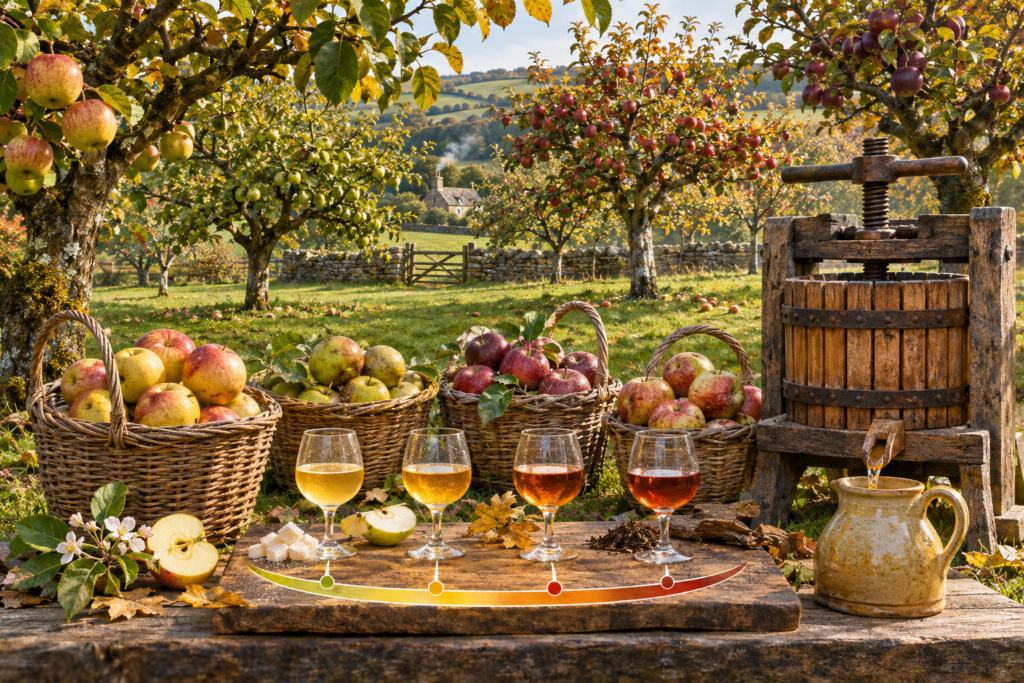
Choosing cider apple trees: sweet, sharp, bittersweet and bittersharp
Most of the great cider apples were found rather than bred. William Dabinett came across the original Dabinett growing in a hedge at Kingsbury Episcopi early in the twentieth century. A Mr Dunkerton found Dunkerton’s Late in his orchard at Baltonsborough in the 1940s. Yarlington Mill and Harry Masters Jersey both came from Yarlington, a few miles from our nursery at Castle Cary. Browns was found by Mr Hill, a nurseryman at Staverton in Devon, some time before 1920.
What these growers spotted was not a nice apple to eat. Bite into a fresh Tremletts Bitter and you will not want a second mouthful. What they were looking for was juice with the right balance of sugar, acid and tannin, and that balance is what you are choosing between when you plant a cider orchard.
A digger, a blender and a lot of luck
Not every cider starts with a carefully planned orchard. Frankie, who works with us at Ashridge, made her first cider years ago with her dad, from the four old apple trees that came with the family garden when they moved in. Nobody knew what varieties they were.
They built a press box from timber and used the digger as the press. They added crab apples to the heap, reasonably enough, and soon found that crab apples give hardly any juice. The fruit had to be pulped before it went into the box, and Frankie’s mum’s blender did not survive the job.
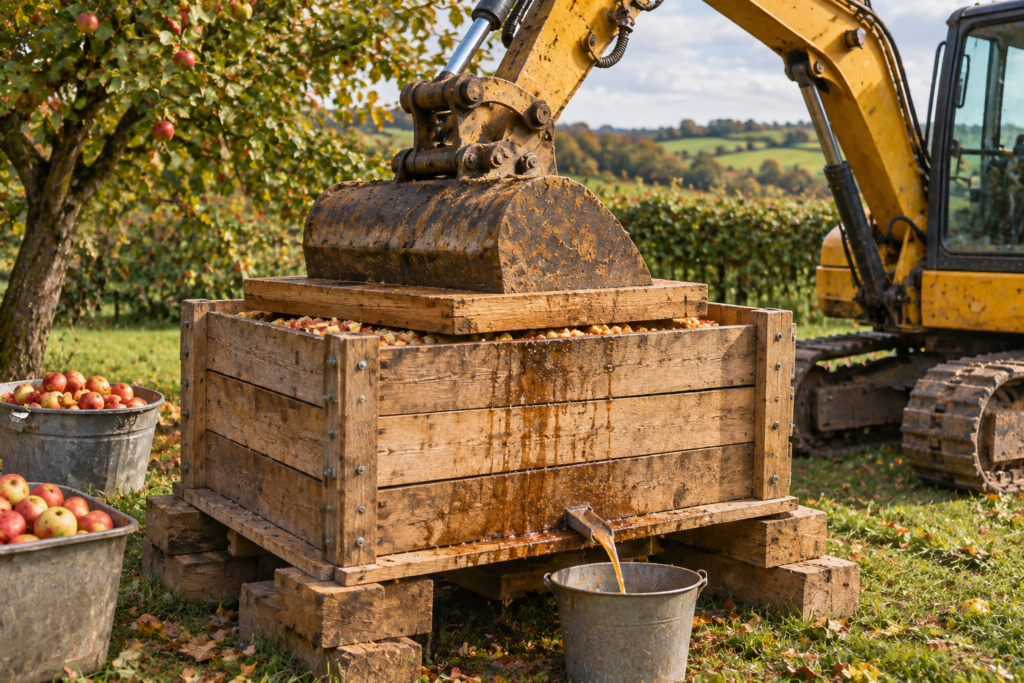
The cider was good. Frankie puts that down to luck, and she is probably right, but her story covers most of what you need to know. Apples have to be crushed to a pulp before they will give up their juice, which calls for a proper fruit crusher, or a bucket and a heavy pole, rather than anything from the kitchen. Crab apples are small and dry: a handful adds tannin and sharpness to a blend, but nothing to the volume. And old garden trees of unknown variety are usually eaters and cookers, which make a lighter, sharper cider than the West Country kind. Choosing the right cider apples takes most of the luck out of it, which is what the rest of this post is about.
Acid, tannin and sugar
Cider is fermented apple juice. The sugar becomes alcohol, so sweeter apples make stronger cider. Acid gives freshness and helps the cider keep. Tannin, the same compound that makes strong tea dry your mouth, gives body, colour and the dry finish of a West Country farmhouse cider.
The Long Ashton Research Station near Bristol sorted cider apples into four types by their acid and tannin. Juice with more than 0.45% acid is “sharp”; juice with more than 0.2% tannin is “bitter”.
- Sweet (low acid, low tannin): sugar and softness that round out a blend. Sweet Coppin, Dunkerton’s Late.
- Sharp (high acid, low tannin): freshness and bite. Browns, Frederick, Tom Putt.
- Bittersweet (low acid, high tannin): body, colour and depth, the backbone of most West Country cider. Black Dabinett, Harry Masters Jersey, Yarlington Mill, Ashton Brown Jersey, Tremletts Bitter, Michelin, Somerset Redstreak, Hereford Redstreak, Hangy Down.
- Bittersharp (high acid, high tannin): both at once. Kingston Black.
Within each type there are degrees. Tremletts Bitter is a full bittersweet with a lot of tannin; Hangy Down and the two Redstreaks are mild. Michelin tastes surprisingly sweet at first bite, then the tannin arrives.
What “vintage” means
A vintage cider apple has enough sugar, acid and tannin in balance to make a full-bodied cider on its own, with no blending. Eight of the varieties we grow are vintage:
- Bittersweet: Black Dabinett, Harry Masters Jersey, Yarlington Mill, Ashton Brown Jersey
- Bittersharp: Kingston Black
- Sharp: Browns, Frederick
- Sweet: Sweet Coppin
Dunkerton’s Late comes close, making a light, fruity cider by itself. The others are blending apples, which is not a lesser job: Michelin, Tremletts Bitter and Somerset Redstreak go into a great deal of commercial cider precisely because they blend so well, and Hangy Down, dropped by the big producers, is much loved by small ones.
Which cider apple trees should you plant?
If you have room for one
Plant Black Dabinett. It is a vintage bittersweet, high in sugar as well as tannin, so it makes a balanced, full-bodied cider on its own. The tree crops heavily and regularly, the fruit is larger than most cider apples, and it resists scab and brown rot. The apples hang into November, dark purple against nearly bare branches.
One tree still needs a pollinator. Black Dabinett is in pollination group D, so it needs an apple from group C, D or E flowering nearby. In most towns and villages a neighbour’s tree will do; in open country, plant a crab apple alongside.
If you would rather have the best cider than the most, plant Kingston Black instead. Its aromatic bittersharp juice is one of the finest single-variety ciders there is, but the tree is slow to start, crops lightly, and is prone to scab, especially in the South West. Give it an open, airy site.
Don’t make Ashton Brown Jersey your only tree. It makes outstanding cider alone, but it is slow to start and crops well only every other year.
Three trees for one pressing
The traditional West Country blend is roughly a third each of sweet, bittersweet and sharp apples. Choose three that flower at the same time, so they pollinate each other, and ripen together, so you can press them in one go.
- A late-October trio: Sweet Coppin (sweet), Black Dabinett (bittersweet) and Kingston Black (bittersharp, doing the job of the sharp). All three are in group D and ripen from late October into November.
- A mid-season trio: Michelin and Yarlington Mill (both bittersweet) with Frederick (sharp). All three are in group D and ripen in October. It makes a fuller, more tannic cider than the trio above.
- An early start: Somerset Redstreak and Tremletts Bitter (both bittersweet, ready in early October) with Tom Putt (sharp, ready in September and keeping until Christmas). No sweet cider apple in our range ripens this early, so expect a drier cider.
For wet, western gardens
Scab is the biggest problem for apple growers in the warmer, wetter West. The most resistant cider apples we grow are Tom Putt, Browns and Hangy Down. Hangy Down also shrugs off canker, which makes it a good choice for growing organically. Dunkerton’s Late and Black Dabinett have good scab resistance too.
Kingston Black and Harry Masters Jersey both suffer from scab. Grow them in the West only on an open, breezy site, and not if you garden organically.
For a small garden
Harry Masters Jersey is slow-growing and doesn’t spread much, which suits a small space, though it fruits at the branch tips so it can’t be trained against wires. Michelin grows upright and fits into a gap.
Most other cider apples are spur bearers, so you can buy a maiden and train it as a cordon or espalier along a fence. That covers Black Dabinett, Kingston Black, Yarlington Mill, Sweet Coppin, Frederick, Dunkerton’s Late, Tremletts Bitter, Hangy Down, Ashton Brown Jersey and Tom Putt. Browns is vigorous and spreading, so give it room.
If you are impatient
Somerset Redstreak starts cropping about a year before most varieties, and Hereford Redstreak and Tom Putt also crop young. Kingston Black, Yarlington Mill, Ashton Brown Jersey, Browns, Frederick and Hangy Down all take a year or two longer to get going, then crop well once they do.
Growing and harvesting cider apples
Heavy one year, light the next
Many cider apples are biennial: they crop heavily one year and lightly the next. Harry Masters Jersey, Yarlington Mill, Sweet Coppin, Somerset Redstreak, Ashton Brown Jersey, Frederick and Tremletts Bitter all lean that way, and Hereford Redstreak most strongly of all.
There are two ways to live with it. In a heavy year, thin the fruitlets hard after the natural June drop, which encourages the tree to set fruit buds for the following year as well. Or plant more than one variety, so a light year on one tree is covered by another. Black Dabinett and Tom Putt are the steadiest croppers we grow.
Pollination
None of our cider apples can be relied on to crop alone; Michelin is only partly self-fertile. Most belong to pollination group D: Black Dabinett, Harry Masters Jersey, Yarlington Mill, Sweet Coppin, Michelin, Dunkerton’s Late, Kingston Black and Frederick. Any two of those will pollinate each other.
The outliers need a little more thought:
- Tremletts Bitter is in group B and Tom Putt in group C, so they pair with each other.
- Browns and Hangy Down are in group E, which overlaps with group D.
- Ashton Brown Jersey flowers late, in group F, which helps it miss spring frosts. Pair it with Browns or Hangy Down.
In a mixed orchard, the simplest answer is a crab apple. Golden Hornet and John Downie flower long and heavily enough to pollinate almost any apple around them.
Picking, sweating and pressing
Several cider apples drop when they are ripe, including Yarlington Mill, Sweet Coppin, Tremletts Bitter, Michelin and Browns. Lay a net under the tree in October, and give the branches a shake once most of the fruit is ready. Hereford Redstreak has thin skin and rots quickly on the ground, so gather it every few days.
Most cider apples are best pressed soon after picking. Kingston Black is the exception: leave it to sweat for about ten days somewhere cool and dry, but no longer, which mellows its sharpness.
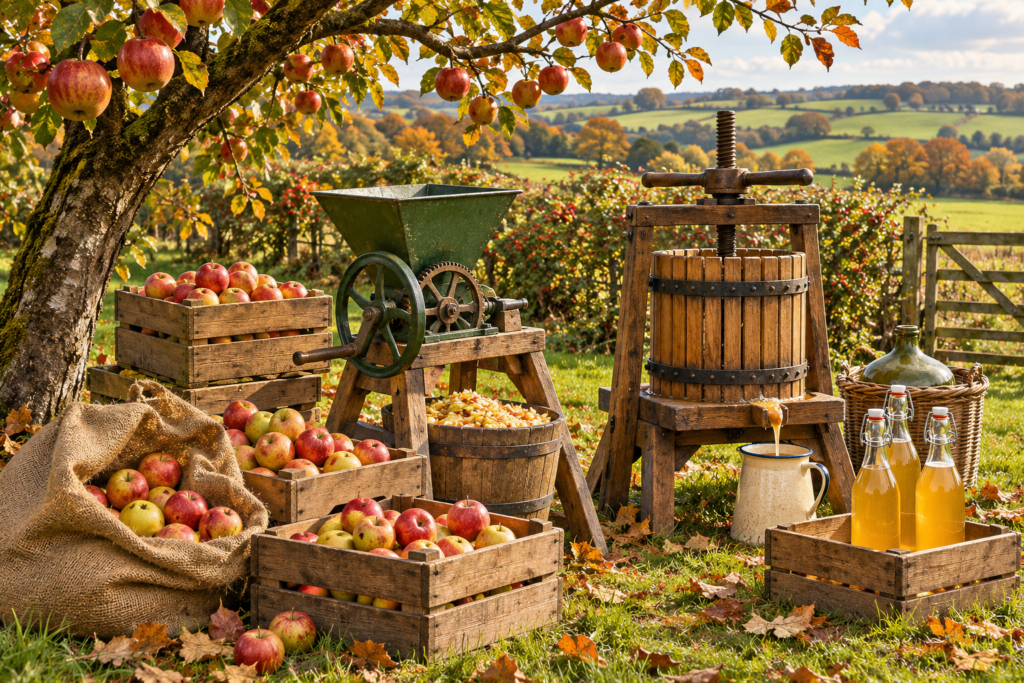
As a rough guide, 7–9kg of apples gives about 4.5 litres (1 gallon) of juice. For the rest of the process, from milling to fermenting, see our guide to making cider from home-grown apples. And in January, there is wassailing.
All 15 cider apple trees at a glance
All are grown on MM106 rootstock and sold as bareroot maidens from £24.99 (Frederick from £39.99), delivered November to March.
- Ashton Brown Jersey: vintage bittersweet. Group F, picked early November. Bred near Bristol in 1903; late flowering, slow to start, and biennial.
- Black Dabinett: vintage bittersweet. Group D, picked in November. The best single cider tree: heavy, regular crops and good disease resistance.
- Browns: vintage sharp. Group E, picked from mid-October. A vigorous Devon apple with strong scab resistance, whose juice is good to drink unfermented.
- Dunkerton’s Late: sweet, close to vintage. Group D, picked early November. Found at Baltonsborough in the 1940s; resists scab.
- Frederick: vintage sharp. Group D, picked mid-October. Also makes good juice and apple jelly; biennial.
- Hangy Down: mild bittersweet, for blending. Group E, picked mid-October. Very resistant to scab and canker; slow to get going.
- Harry Masters Jersey: vintage bittersweet. Group D, picked late October to early November. Also called Port Wine; compact but tip-bearing.
- Hereford Redstreak: mild bittersweet, for blending. Picked in October. Crops young but strongly biennial.
- Kingston Black: vintage bittersharp. Group D, picked late October to early November. The finest single-variety cider; slow, light-cropping and prone to scab.
- Michelin: medium bittersweet, for blending. Group D, partly self-fertile, picked October to November. Very juicy, on an upright tree.
- Somerset Redstreak: mild bittersweet, for blending. Picked in early October. Crops a year earlier than most; biennial.
- Sweet Coppin: vintage sweet. Group D, picked late October to early November. Heavy cropping but biennial; dislikes sulphur sprays.
- Tom Putt: full sharp, and a good cooker. Group C, picked in September. Crops young and steadily, and is very resistant to scab.
- Tremletts Bitter: full bittersweet, for blending. Group B, picked early to mid-October. High in tannin; starts cropping in its third or fourth year.
- Yarlington Mill: vintage medium bittersweet. Group D, picked October to November. Aromatic; slow to start, then heavy cropping.
Browse all our cider apple trees


Leave a Reply