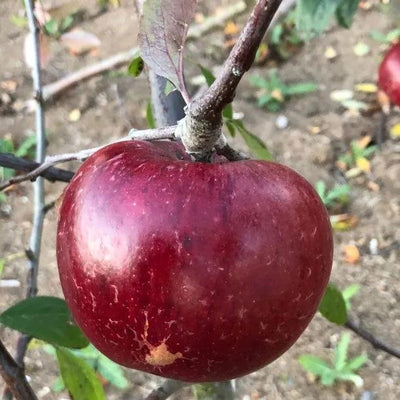
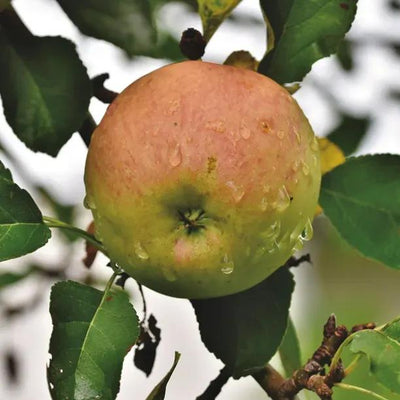
Buying cider apple trees
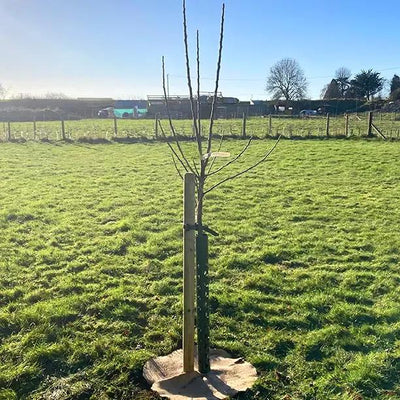
Plant bareroot cider apple trees from November to March, the traditional time to plant an orchard. Bareroot trees are lifted from the nursery field while dormant and sent with no soil on their roots, which makes them the cheapest way to buy a tree and the quickest to settle in. A few varieties also come in pots, for planting at any time of year as long as you can water them through their first summer.
Once your order is lifted and packed, it travels by next-working-day courier. All bareroot trees are covered by our 1-year guarantee.
The four kinds of cider apple
Cider apples are sorted by two things: acid, which gives freshness and helps the cider keep, and tannin, which gives body, colour and that dry, mouth-puckering finish. The Long Ashton Research Station near Bristol set the dividing lines: above 0.45% acid is "sharp", above 0.2% tannin is "bitter".
- Sweet (low acid, low tannin): sugar and softness that mellow a blend. Sweet Coppin.
- Sharp (high acid, low tannin): freshness and bite that keep the cider bright. Browns, Tom Putt.
- Bittersweet (low acid, high tannin): body and colour, the classic West Country taste. Yarlington Mill, Harry Masters Jersey, Somerset Redstreak.
- Bittersharp (high acid, high tannin): both at once, enough to make a complete cider alone. Kingston Black.
What should you plant?
For a single-variety cider, a "vintage" apple. Vintage quality means one variety makes a full-bodied cider without blending. Our pick in each category: Kingston Black (bittersharp), Browns (sharp), Sweet Coppin (sweet) and Harry Masters Jersey (bittersweet).
For a West Country blend, mostly bittersweet with a sharp. Two bittersweets, such as Yarlington Mill and Harry Masters Jersey, with a Browns to lift the acidity, is a sound starting orchard. Add Sweet Coppin if you like a softer cider.
For the famous one, Kingston Black, with your eyes open. It makes the most celebrated single-variety cider there is, but it is prone to scab and canker and crops less reliably than the others. Give it an open, airy site and a reliable partner or two.
For an early start, Somerset Redstreak. One of the first bittersweets to ripen, so you can press before the main harvest. Like many bittersweets it can slip into cropping heavily one year and lightly the next; thinning in a heavy year helps even it out.
How much fruit do you need?
As a rough guide, 7–9kg of apples gives about 4.5 litres (1 gallon) of juice, depending on the variety and your press. Pressing in one go is easier with several trees ripening together, so check the Fruiting season filter when choosing.
Cider apples are traditionally left on the tree until they fall, then gathered from the grass and left in a heap for a week or two to soften before pressing. This "sweating" raises the sugar and makes them easier to mill.
Growing cider apples
Cider apples are tougher than most dessert varieties and tolerate part shade, heavier soils and a less pampered life. Many flower late, which helps them miss spring frosts.
They still need a pollination partner flowering at the same time, so plant at least two varieties from the same or neighbouring groups unless there are other apples nearby. Each product page gives the pollination group.
Perry is the pear equivalent: for that, see Hellens Early perry pear.
Questions
Can I eat cider apples? Most are unpleasant raw. Sharps such as Browns and Tom Putt are the most palatable, and Tom Putt cooks well too.
Can I make cider from eating apples? Yes, but it will be thin and sharp, more like a white wine than a West Country cider. Adding bittersweet apples gives it the body and tannin it lacks.
Are cider apples good for juice? Bittersweet juice is astringent on its own. For drinking juice, use sharps blended with eaters; see the Juicing filter on the main apple trees page.
When should I wassail? Traditionally on Twelfth Night, with toast left in the branches for the robins. It is optional; winter pruning is not.
See also: Eating Apple Trees · Cooking Apple Trees · Mixed Orchard Bundles


 Sign In
 Saved items




 5 Star Service Rating





 Secure, One-Tap Checkout
 5 Star Feefo Rating
 Hand Picked, Delivered to Your Door!
 Platinum Trusted Service Award 2026
 Mail Order Plant Experts - Est. 1949
 1 Year Bulb Guarantee