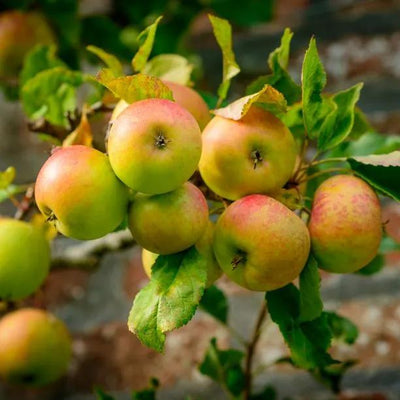
Buying cooking apple trees
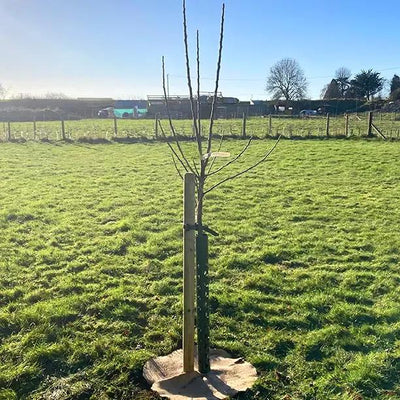
Plant bareroot apple trees from November to March. Bareroot trees are lifted from the nursery field while dormant and sent with no soil on their roots, which makes them the cheapest way to buy a tree and the quickest to settle in. Some varieties also come in pots, for planting at any time of year as long as you can water them through their first summer.
Once your order is lifted and packed, it travels by next-working-day courier. All bareroot trees are covered by our 1-year guarantee.
Fluff or firm: the choice that matters
Some cookers collapse into a smooth purée, ideal for sauce, crumble and baked apples. Others keep their slices whole, which is what you want in a tart or an open pie.
- Grenadier (pick mid August to September; keeps until late September): cooks to a purée. The first cooker of the year, compact and scab resistant.
- Tom Putt (pick in September; keeps until October): cooks to a purée. An old West Country variety that is also a sharp cider apple.
- Charles Ross (pick in September; keeps until December): holds its shape. Dual purpose, sweetening in store into a good eater.
- Lord Derby (pick late September to October; keeps until December): sharp. Hardy, and copes with the North and damp gardens.
- Bramley's Seedling (pick in October; keeps until March): cooks to a fluff. The heaviest cropper, on a big tree.
- Howgate Wonder (pick in October; keeps into the new year): huge fruit, and once held the record for the heaviest apple.
- Annie Elizabeth (pick in October; keeps until spring): holds its shape. Late flowering, so it misses most frosts.
- Norfolk Beefing (pick late October; keeps until spring): firm, for baking whole. The "Norfolk biffin" Dickens put on the shop shelves in A Christmas Carol.
Plant one early and one late cooker and you will have cooking apples from August to March.
Which cooking apple should you grow?
For the most apples, Bramley. Nothing outcrops it, and it stores until March. Be ready for its size: Bramley is vigorous and grows noticeably larger than other varieties on the same rootstock. It is also triploid, so it needs two other varieties nearby to set fruit and cannot pollinate anything itself.
For a smaller garden, Grenadier or Lord Derby. Both make a more manageable tree and pollinate normally. A Bramley carries about half as much again by weight as Lord Derby, but we think Lord Derby tastes better.
For pies and tarts, Annie Elizabeth. Raised in Leicester in 1857 and named after the raiser's daughter, it keeps its shape when cooked and stores until spring.
For the West Country, Tom Putt. It grows almost anywhere, cooks well, and goes into the cider press too.
Growing cooking apples
Cookers do not need sun to make sugar, so they tolerate part shade far better than dessert apples. They still crop best in an open, sunny spot, but a cooker is the right choice for the shadier corner of a garden.
Bramley is prone to bitter pit: small brown, bitter spots in the flesh caused by a shortage of calcium in the fruit. Watering steadily in dry spells, and mulching every spring, reduces it.
Store late cookers somewhere cool, dark and airy, each fruit wrapped in paper and not touching its neighbours. Check them every couple of weeks and remove any that start to rot.
Questions
Do I need two trees? Usually not: in most of the UK there is a neighbour's apple or a crab apple within reach of the bees. Bramley is the exception and needs two compatible partners if none grow nearby.
Can you eat cooking apples raw? Most are too sharp, but Charles Ross becomes a pleasant eater after a few weeks in store.
Which cooking apple stores longest? Bramley, Annie Elizabeth and Norfolk Beefing, all of which keep until spring in good conditions.
Will a cooking apple grow in the North? Yes. Lord Derby and Grenadier both handle cold, wet gardens well; see the Scotland & The North filter above.
See also: Eating Apple Trees · Cider Apple Trees · All Apple Trees


 Sign In
 Saved items




 5 Star Service Rating





 Secure, One-Tap Checkout
 5 Star Feefo Rating
 Hand Picked, Delivered to Your Door!
 Platinum Trusted Service Award 2026
 Mail Order Plant Experts - Est. 1949
 1 Year Bulb Guarantee