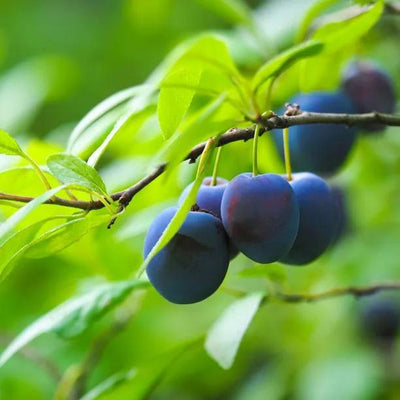
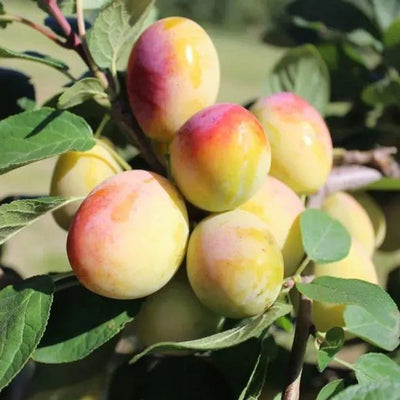
Buying Plum & Damson Trees Online:
Order Potted Trees Now For Spring Planting
Order Bareroot Trees For 2026 Spring Planting Season
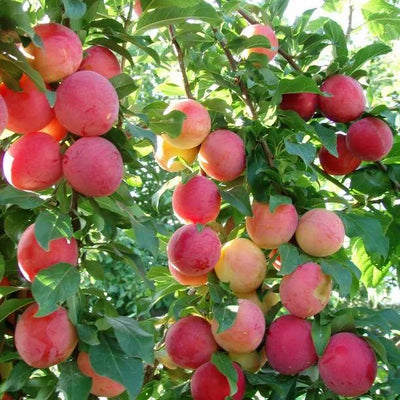
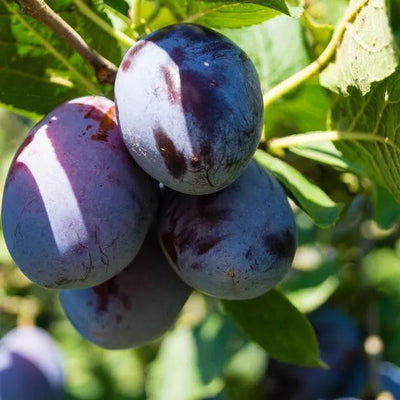
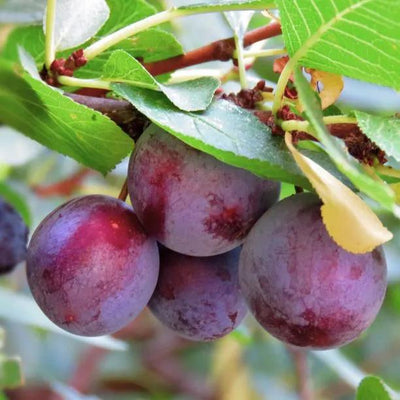
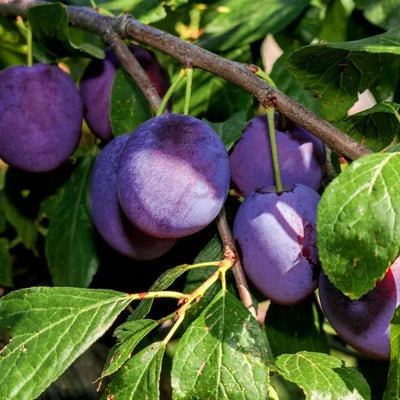
Plum trees and their close cousins in the Prunus domestica / insititia family produce the vast majority of the stone fruit that is grown in the UK.
Plums are essential in any mixed orchard of fruit trees.
- Uses: Stone fruits ranging from very sweet dessert varieties to bitter cooking varieties.
- Good Points: Heavy cropping, vigorous, generally truly self-fertile.
- Position: Good ground in a sunny & sheltered spot. Cooking varieties are more shade-tolerant
- Growth: Bushy - to 4.5 metres on St Julien rootstocks.
Buying Plum Trees
Barerooted plum trees are delivered between November and the end of March, the winter planting season.
Selected varieties are available pot grown year round.
- When your order is ready: your mail order fruit trees are delivered by next working day courier (not the next working day after ordering!)
- Friendly support: if there is anything wrong with your plants when you inspect them, Contact Us within 5 working days
All bareroot plants are covered by our Refund Guarantee, so you can give them a whirl with complete confidence.
Plum trees are vigorous and crop heavily, so they need plenty of sun and prefer a warm, sheltered spot that protects them from late spring frosts.
They thrive in well-drained, moisture-retentive soil such as clay or loam.
Which Plum Varieties Should I Choose?
The fruit of the plum family may be similar in appearance, but the flavour ranges hugely from sweet dessert varieties to cooking varieties that are practically inedible raw.
As a broad generalisation (with exceptions), Gages and Mirabelles are the sweetest, Plums are in the middle, and Damsons and Bullace are astringent-sour and need to be cooked.
The most popular Plum is Victoria: a really reliable producer, genuinely self-fertile, and delicious fresh or preserved.
Gages and Mirabelles have a sweetness that matches Turkish Delight: a tarte aux mirabelles, once eaten, is never forgotten, but if you have a lot of mouths to feed then they will probably eat them all fresh off the tree!
Gages tend to be sweeter and best eaten fresh (Cambridge Gage is a trusty British variety), and Mirabelles tend to be tangier and more multipurpose: if you had to pick one Mirabelle, de Nancy is excellent fresh or cooked.
Some Damsons and Bullaces, such as Merryweather, can be eaten fresh, and they all get sweeter as they ripen, but generally they need to be cooked.
The classic use for them is jam, and in Eastern Europe, damsons make the perfect Slivovitz.A good damson wine is on par with port.
Where Can I Grow A Plum Tree?
Wild plums are practically a weed in the UK, so it's no surprise that these vigorous trees are easy to grow in pretty much any well drained soil where they get plenty of sun.
Heavy clay is fine as long as it doesn't get waterlogged.The ideal soil pH is neutral to mildly acidic, but don't worry if you are on alkaline soil.
If your soil is poor, dry, or alkaline, you can improve it by digging in well rotted organic matter, and then mulch well every year.
Remember that because mulch is not dug into the soil, it does not need to be rotted.
Protection from Late Spring Frosts
Late Spring Frosts can ruin the crops of many fruit trees by killing the flowers, and plums are especially vulnerable because they bloom early, so it's important to choose a sheltered location in general, and especially in the North and Scotland, a warm microclimate against a South facing wall.
By growing your plum as a fan, trained on wires against a wall, it's easy to cover it up with a tarpaulin or fleece that blocks the frost while letting pollinating insects in.
When and How do I Plant my Plum Tree?
When is the best time to plant Plum trees?
The best time to plant plum trees is in winter, using bareroot stock.
Pot grown trees can be planted at any time during the rest of the year, as long as you are absolutely certain to water them well.
There are pros and cons to every season, but as long as you water well in dry weather until your tree is established, you can plant at any time.
How to Plant a Plum Tree
You have two main choices with cherries. Either grow them:
- As a normal freestanding tree in the "bush" form (with a short trunk under 1.2 metres) or half-standard form (with a trunk between 1.2 and 1.5 metres tall)
- As a fan, trained flat using support wires (usually against a wall).
Watch our Fruit Tree Planting video, (we highly recommend using Rootgrow).
Plum trees must be planted at the same depth in the ground as they were in the pot or ground before being transplanted.
Growing fruit trees requires nutritious soil, with good levels of moisture retention, so improve sandy or poor soils with well rotted organic matter before planting.
Clay soil does not need improving.
When and How do I Prune my Plum Tree?
Plum trees, like all stone fruit in the Prunus family, should only be pruned when their sap is flowing upwards, from Spring to late Summer.
This reduces the (admittedly quite low) risk of Silver Leaf Disease, because the rising sap physically pushes the spores out of the pruning cut.
However, as always, remove DDD wood at any time: Dead, Diseased, or Damaged wood.
How to Prune Plum Trees
Thinning Plums as Young Fruit for Better Crops
Why should I thin the fruit on my Plum Trees?
We thin crops on trees in the plum family for three reasons:
- Quality over quantity: if all the fruit are left on the branches, most of them will not ripen satisfactorily.
- Plum trees are very vigorous and productive. Without thinning, their branches often bend and cracking under the weight of their enormous crops!
- To prevent "biennial cropping", which means a cycle in which you get a big bumper crop one year that exhausts the tree, followed by a failed crop the following year.
When and How to Thin your Crop:
It is best to thin plums gradually, in stages.
Towards the end of May, remove some fruitlets as they begin to form, picking out ones from the centre of clusters, and any that look mishappen.
In June, there is usually a phenomenon called the June Drop, where the tree will naturally shed some fruitlets.
In July, when the plums are still hard, first remove all fruit that is damaged, bruised, or diseased.
Then, take a step back to see where the clusters are densest, and thin out some more so that each plum can develop without touching another.Ideally, aim to leave about 5-7cm (about 2-3") between plums, and you will get a great crop.
What Should I do with an Old Plum Tree?
Plums are relatively "live fast, decline young" trees that often lose their oomph by the age of about 40.
If you have inherited an old plum tree that isn't cropping too well, it's usually better to replace it.
Remember that you should not plant a new fruit tree of the same species straight into the spot where an old one was removed i.e. when you remove a Plum, replace it with something else like an Apple, Pear, or Quince.
If you know what variety it is, you can simply buy a new one, otherwise you could buy a few plum rootstocks and try your hand at grafting: it is pretty easy, especially with a willing subject like plums.


 Sign In
 Saved items


 5 Star Service Rating




 Secure, One-Tap Checkout
 5 Star Feefo Rating
 Hand Picked, Delivered to Your Door!
 1 Year Bareroot Guarantee
 Platinum Trusted Service Award 2026
 Mail Order Plant Experts - Est. 1949