




 Sign In
 Saved items

February 5th 2026•
Bedding
How to Grow Sweet Peas
The Ashridge Guide to Growing Sweet Peas
Sweet peas (Lathyrus odoratus) are the quintessential ...
Read More
 5 Star Service Rating




 Secure, One-Tap Checkout
 5 Star Feefo Rating
 Hand Picked, Delivered to Your Door!
 1 Year Bareroot Guarantee
 Platinum Trusted Service Award 2026
 Mail Order Plant Experts - Est. 1949
25/02/2026

Sweet peas are among the best climbing annuals you can grow in a container. A single large pot with a wigwam of canes, planted in late April, will give you armfuls of scented cut flowers from June until September — and all from a few square feet of patio. They do need more attention in pots than in the ground, mainly watering, but the payoff is enormous: colour, scent, and a vase on the kitchen table all summer long.

This guide covers everything specific to growing sweet peas in containers. For general sweet pea advice — soil preparation, training and even the exhibitor's cordon method — see our main how to grow sweet peas guide.
Sweet peas have deep, questing root systems. They need a tall pot more than a wide one — size matters but it is depth that really counts for good plants. Diameter is important for stability, so unless you have a way of anchoring narrower pots, we think a sensible minimum is about 30cm across and 40cm deep, which gives you room for two or three plants. A pot 45cm across and 50–60cm deep is better, and will comfortably hold four to six plants with a wigwam of canes inside it. Half barrels, large terracotta pots and deep galvanised troughs all work well.

Plastic pots are lighter and hold moisture longer. Terracotta looks beautiful but dries out faster — if you go with terracotta, you can cheat by lining the inside with a bin bag (poke a few drainage holes through) to slow water loss. Metal containers - the galvanised bucket/trough look - can overheat in full sun, cooking the roots, so stand them where they get some shade at the base. My father used to wrap the outside with hessian for July and August...
Whatever container you choose, drainage holes are non-negotiable. Sweet peas are thirsty, not amphibious so standing water will rot the roots within days.
The best planting mix for container-grown sweet peas is 50% multi-purpose compost, 40% topsoil and 10% well-rotted manure. This gives you moisture retention with the compost, weight and minerals from the topsoil, and slow-release fertility from the manure. Straight multi-purpose compost will do the job — you'll just need to feed more often, and you will probably get fewer flowers. Garden centre "patio planter" mixes tend to be too light and free-draining for sweet peas; they dry out in hours on a hot day.

Put your support structure into the pot before you plant — it's much harder to push canes into compost around established roots without damaging them (the roots that is). A wigwam of five or six bamboo canes (1.8m–2m tall) tied at the top is the classic approach and looks lovely. Wrap string or twine horizontally around the canes at 20cm intervals to give the tendrils extra grip as the plants climb. You can also use a trellis panel behind the pot if it's standing against a wall or fence. Small steel obelisks work too, and last for years.
Plant your seedlings 10–15cm apart, close to butnot touching the base of a cane. I tend to plant one plug either side of each cane which gives a fuller display. Bury them deeper than they sat in the plug — right up to the lowest side shoot. The buried stem produces extra roots, which is especially valuable in a pot where every bit of root capacity counts. Water in thoroughly. Not a light sprinkle — a proper soaking until water runs from the drainage holes. You may need to top the compost up a bit if it settles after watering.

Full sun. Sweet peas flower best with at least six hours of direct sunlight a day, and in containers they need all the light they can get. South- or west-facing patios, balconies and doorsteps are ideal. An east-facing spot works if it has some south in it so your plants get sun from morning into early afternoon. North-facing is simply a waste of time.
Shelter from strong wind helps too — not because sweet peas are fragile, but because wind dries out pot compost at an alarming rate and can shred the petals of open flowers. A wall or fence behind the pot is perfect: it gives you reflected warmth, wind protection, and something to lean a trellis against.
This is where container sweet peas differ most from those in the ground. In open soil, sweet pea roots go deep and - while water with a bit of food is always welcome - they can find their own moisture. In a pot, they depend entirely on you. Let the compost dry out and the plants, because they are stressed, will race to set seed — sometimes in a matter of a couple of days in hot weather — and once that switch flips, flowering slows dramatically. As in it stops. Prevention is everything.
From late June onwards, be ready to water daily. In a hot spell — and we do get them now, even here in Somerset — twice a day is not overdoing it. Early morning and again in the evening. Push a finger into the compost: if it's dry below the top couple of centimetres, water. A good soak each time, not a little splash. Drip trays or saucers under the pot help, but empty them after an hour so the roots aren't sitting in standing water overnight.
If you're going away for a few days, cut every flower hard, water deeply, move the pot into light shade and ask a neighbour to water. Or set up a simple drip irrigation line on a timer — cheap, widely available at garden centres, and it will save your sweet peas more reliably than the most well-intentioned but possibly forgetful friend.
Sweet peas are legumes — they fix their own nitrogen from the air through bacteria in root nodules. So they really don't want a high-nitrogen feed, which would give you lush green growth and not much flower. What they need is potassium and phosphorus, which drive flower production. A high-potash liquid feed is the answer: tomato fertiliser (Tomorite is the one most people reach for) or home-made comfrey liquid (tea - honestly), every seven to ten days once the first flower buds appear.
In a pot, start feeding a little earlier than you would in the ground — the nutrients in container compost get used up and washed through faster. If the leaves start to yellow at the base while the plant is still actively flowering, it's hungry. Feed it. (By the way - yellowing leaves low down on a plant in spring or summer usually mean "feed me" - Ed)
The rule is the same for peas in pots as in the ground: pick, pick, and pick again. Every stem you cut tells the plant to produce more buds. Every flower you leave to fade and form a seed pod tells the plant its work is done. In a container, where the root run is limited and the plant needs to work a bit harder, this is even more critical. A pot-grown sweet pea that's allowed to set seed will stop flowering faster than one in open soil.

As with so many plants, the best time to cut is in the morning when the stems are full of water and the flowers are freshest. Take the whole stem, right back to where it joins the main vine. If you've got more flowers than you can use — a good problem — deadhead the ones you don't pick. It takes thirty seconds a day and will extend your season by weeks.
The most common issue with container sweet peas. A white powdery coating on the leaves, usually starting at the bottom of the plant in late summer. It's driven by dry roots and poor airflow — both of which are more likely in a pot than in the ground. Keep watering consistently, don't crowd too many plants into one container, and pick off badly affected leaves. It's rarely fatal but it's unsightly and it weakens the plant.
Normal towards the end of the season as the plant tires, but if it happens early (July) in a pot, the plant is probably dry, or underfed, or - most likely - both. Increase watering and feeding frequency.
Usually hunger. Feed with high-potash liquid fertiliser. If the compost is also staying waterlogged, check the drainage holes aren't blocked.
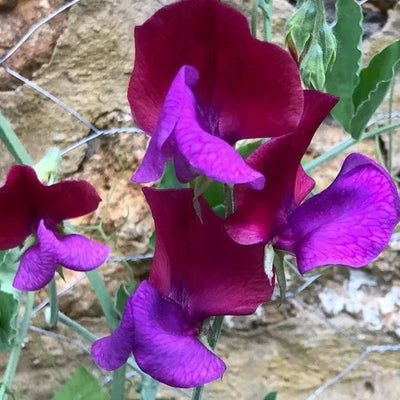
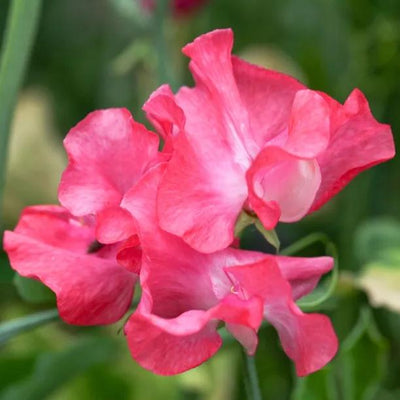
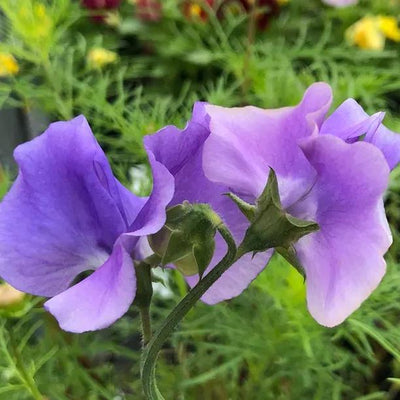
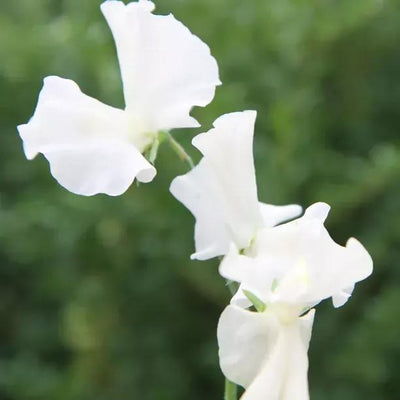
All climbing sweet peas can be grown in containers — you don't need a specific "patio" variety. The ones that tend to do best are the vigorous, prolific types that can cope with the slightly tougher conditions of a pot. Grandifloras like Matucana are hard to beat: indestructible vigour, masses of scented flowers, and they keep going even when conditions aren't perfect. Spencers like Bristol give you longer, more elegant stems for cutting. For the best of both worlds, Modern Grandifloras like Albutt Blue combine big flowers, long stems and outstanding scent.
If space is really tight — a small balcony, a windowsill — then bush or dwarf sweet peas (30–60cm, no support needed) are worth considering, though we don't currently stock them. For container growing with full-size climbers, a single large pot with a wigwam is a better use of space than several small pots.
Browse our full range of sweet pea seedling plugs, or try a cottage garden collection for a hand-picked mix of colours and fragrance.
As big as you can manage. A sensible minimum is 30cm across and 40cm deep for two or three plants. A 45–60cm pot is much better and gives you room for a proper wigwam of four to six plants. Depth matters more than width — sweet peas root deeply.
Only bush or dwarf varieties, which stay compact and don't need support. Standard climbing sweet peas will outgrow a hanging basket within weeks and the small compost volume dries out too quickly. A large floor-standing pot with a support is far more practical for climbing types.
Not special, but richer than you'd use for most bedding plants. The ideal mix is 50% multi-purpose compost, 40% topsoil and 10% well-rotted manure. Topsoil adds weight (a tall pot of sweet peas on canes can be top-heavy) and holds moisture better than lightweight peat-free compost alone. Plain multi-purpose will work — just feed more often.
From late June, daily. In hot spells, morning and evening. The single most common reason container sweet peas fail is the compost drying out — the plants set seed in self-defence and flowering drops off a cliff. Push a finger in: if it's dry below the surface, water. A thorough soak each time, please, not a dribble.
Almost certainly one of two things. Either seed pods have formed — look carefully and pick off every one you find — or the compost dried out for long enough that the plant panicked and went into seed-production mode. Remove all pods, cut back any dead growth, water deeply and feed. The plant may rally, but if it's late August, it may have run its course. Prevention as in cutting early and often is far better than the cure.







Comments (0)
Add a commentLeave a comment
Please note, comments need to be approved before they are published.