
What are the best hardy perennials for UK gardens?
Hardy perennials are plants that survive outdoors through a typical British winter, dying back in autumn and returning reliably each spring without replanting. They form the backbone of any low-maintenance border, offering seasons of colour, texture, and wildlife value from a single purchase. Chosen well, a collection of hardy perennials will reward you for a decade or more with minimal effort.
Related guides
- Best Ground Cover Perennials
- How to Grow Perennials — Complete UK Guide
- Low Maintenance Perennials for Borders
- Best Perennials for Shade
What makes a perennial truly hardy in the UK?
A plant is considered fully hardy in the UK when it tolerates prolonged frost — typically down to at least −10 °C — without dying or requiring winter protection. The Royal Horticultural Society uses an H5 or H6 rating (hardy in most or all parts of the UK) as the benchmark for reliable outdoor survival across all but the most exposed Highland locations.
Hardiness is not just about cold tolerance, though. A plant needs to handle the combination of cold, wet, and low light that characterises a British winter. Many plants marketed as “perennials” in continental Europe struggle in the UK’s heavy, wet clay soils where roots sit in standing water for weeks. When selecting hardy perennials, look for good drainage tolerance, resistance to fungal disease in damp conditions, and RHS Award of Garden Merit (AGM) status as a reliable quality indicator.
Key factors that determine UK hardiness:
- Root hardiness — some plants have hardy tops but tender roots; these need deep mulching in colder regions.
- Drainage tolerance — wet winters kill more perennials than frost alone.
- Wind resistance — coastal and upland gardens need stocky, flexible-stemmed varieties.
- Provenance — plants raised in the UK are more acclimatised than those imported from warmer nurseries.
Which hardy perennials have the longest flowering season?
Salvias, agapanthus, heucheras, and verbena consistently deliver the longest displays in UK trials, with many flowering for three to four months. Long flowering is especially important in smaller gardens where every plant needs to earn its space across multiple seasons.
| Perennial | Typical Flowering Period | Duration (weeks) | RHS AGM Available? |
|---|---|---|---|
| Salvia nemorosa types | May–October (reblooms after cutting) | 16–20 | Yes (many varieties) |
| Agapanthus (evergreen) | June–September | 12–16 | Yes (selected cultivars) |
| Verbena bonariensis | June–October | 16–18 | Yes |
| Heuchera | Foliage year-round; flowers May–July | 8–10 (flowers) | Yes (several) |
| Hosta | Foliage Apr–Oct; flowers Jul–Aug | 6–8 (flowers) | Yes (many) |
| Ornamental grasses | Foliage/plumes Jul–Feb | 28+ (structural interest) | Yes (species dependent) |
For maximum colour continuity, plant in drifts of three to five of the same variety and combine early-season perennials (such as salvia) with mid-season agapanthus and late-season verbena so something is always in flower from April through to November.
What are the best hardy perennials for shade?
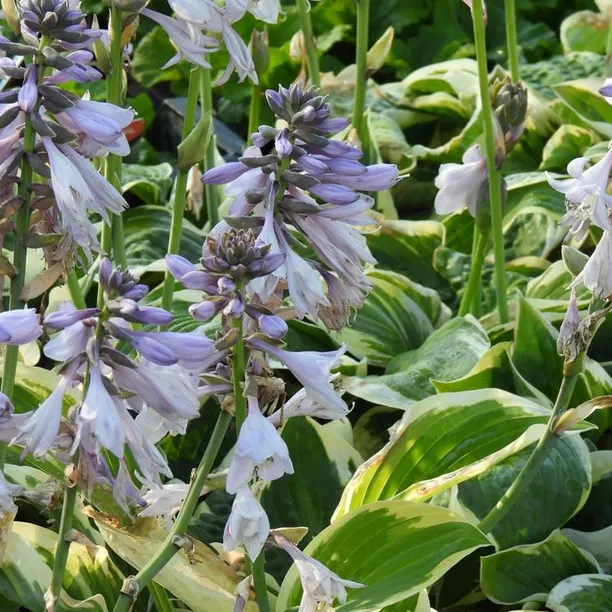
Hostas and heucheras are the two most reliable hardy perennials for shaded UK gardens, thriving in dappled to deep shade while offering bold foliage from spring to autumn. Shade perennials earn their keep through foliage drama rather than flower power, so choose varieties with contrasting leaf colour or texture.
Hostas are virtually indestructible in shade. Their large, architectural leaves range from blue-grey to chartreuse and deep green, and they tolerate everything from dry shade under trees to boggy north-facing borders. The main enemy is slug and snail damage; planting in raised beds or adding a coarse grit mulch helps significantly. Browse our full hosta range for varieties suited to your conditions.
Heucheras are semi-evergreen, retaining their richly coloured leaves through most winters. They are at their best in light to dappled shade, where intense sun cannot bleach the foliage. Standout varieties for shade include:
- Black Beauty — near-black foliage that stays dramatic all season.
- Lime Marmalade — lime-green leaves that glow in low light, perfect for brightening dark corners.
- Forever Purple — deep violet leaves with a metallic sheen, very consistent through winter.
- Crème Brûlée — warm amber-caramel tones that complement dark-leaved companions beautifully.
For a full collection, see our heuchera range.
What are the best hardy perennials for hot, sunny borders?
Agapanthus, salvia, and verbena are the outstanding choices for sunny, well-drained borders, combining drought tolerance once established with long and brilliant flowering. All three attract bees and butterflies, making them as valuable for wildlife as for colour.
Agapanthus (African lily) thrives in full sun and free-draining soil. Once established, it tolerates summer drought well and produces spectacular globe-shaped flower heads in blue, white, and purple. The key distinction for UK gardeners is between deciduous and evergreen types: deciduous agapanthus are fully hardy across the UK; evergreen types need a sheltered spot or winter mulch outside the South and West.
| Variety | Colour | Height | Hardiness | Best for |
|---|---|---|---|---|
| Brilliant Blue | Rich mid-blue | 60–70 cm | H4 (−10 °C) | Borders, large pots |
| Lapis Lazuli | Deep violet-blue | 70–80 cm | H4 | Back of border |
| Ever White | Pure white | 50–60 cm | H4 | White gardens, pots |
| Black Jack | Deep navy-blue | 60–70 cm | H4 | Modern, bold schemes |
| Poppin’ Purple | Vivid purple | 50–60 cm | H4 | Compact borders, pots |
| Fireworks | Blue & white bicolour | 60–75 cm | H4 | Statement plantings |
| Ever Sapphire | Sapphire blue | 40–50 cm | H4 | Compact pots, front of border |
Unsure which agapanthus to choose? Our Mixed Agapanthus Collection gives you three complementary varieties at excellent value. Browse the full agapanthus range for the complete selection.
Which hardy perennials are best for wildlife?
Salvia, verbena, and ornamental grasses are among the most wildlife-friendly hardy perennials available, providing nectar for bees and butterflies, seeds for birds, and overwintering habitat for beneficial insects. Choosing these plants helps you build biodiversity into a conventional ornamental border without sacrificing aesthetics.
Salvias are exceptional pollinator plants. Their tubular flowers, held on long spikes, are irresistible to bumblebees, honeybees, and many butterfly species from late spring onwards. Cutting back lightly after the first flush of flowers triggers a second and often third wave of bloom, extending nectar availability deep into autumn. Our salvia collection includes a wide range of hardy varieties suited to UK conditions.
Verbena bonariensis is a slender, airy plant with tiny purple flower clusters atop tall branching stems. It self-seeds prolifically — a virtue rather than a fault — and its open structure lets light and smaller plants through, making it ideal woven through mixed borders. It is technically short-lived but self-seeding makes it effectively permanent. Browse our verbena range for the best UK-proven varieties.
Ornamental grasses provide structure through winter when most perennials have died back, and their seed heads feed finches and sparrows well into January. They also provide nesting material and overwintering sites for insects. Grasses require virtually no maintenance: simply cut back hard in late February before new growth begins. Explore our ornamental grasses range.
Can hardy perennials be grown in pots and containers?
Yes — many hardy perennials perform excellently in containers, but they need adequate pot size, good drainage, and regular feeding to thrive long-term. Agapanthus is particularly well suited to pot culture and actually flowers better when slightly root-bound.
The key rules for perennials in pots:
- Pot size: Use containers at least 30–40 cm wide for most perennials; agapanthus prefers to be slightly congested so 25–30 cm per plant is fine initially.
- Drainage: All containers must have drainage holes. Add a layer of crocks or gravel at the base and use a loam-based compost rather than peat-free multipurpose, which tends to become waterlogged and shrink away from pot sides.
- Feeding: Container-grown perennials deplete nutrients quickly. Apply a slow-release granular fertiliser in spring and a liquid feed fortnightly from June onwards.
- Winter protection: Even fully hardy perennials can suffer root freeze in pots (roots are above ground level and more exposed than when planted in the soil). Wrap pots in bubble wrap or hessian in colder regions, or move them against a sheltered wall.
- Repotting: Divide or repot every two to three years in spring to prevent plants becoming pot-bound to the point of exhaustion.
Heucheras are also excellent container perennials, offering year-round foliage interest. Try pairing contrasting colours such as Marmalade (warm copper-orange) with Cherry Cola (deep burgundy-red) for a striking seasonal display.
How should I plan a hardy perennial border?
A successful hardy perennial border layers plants by height, sequences colour across the seasons, and groups varieties in odd-numbered drifts of three, five, or seven for a natural, cohesive appearance. The traditional rule — tall at the back, medium in the middle, low at the front — remains sound, though breaking the rule occasionally with a see-through plant like verbena creates depth and informality.
| Border Position | Suitable Perennials | Approx. Height |
|---|---|---|
| Back of border | Tall agapanthus, verbena bonariensis, large ornamental grasses | 90–150 cm |
| Middle of border | Mid-height agapanthus, salvia, medium grasses | 50–90 cm |
| Front of border | Heuchera, compact agapanthus, low verbena, small hostas | 15–50 cm |
| Ground cover | Spreading hostas, low heuchera | 10–25 cm |
For a ready-made solution, our Mixed Perennial Collections take the guesswork out of combining varieties and are designed to give a long season of interest in a coherent colour palette.
When calculating plant numbers, a useful rule of thumb is to allow one plant per 30–50 cm of border width for compact varieties, and one per 60–80 cm for larger, spreading perennials such as hostas or large agapanthus. To browse the complete range before deciding, visit our shop all perennial plants page.
When is the best time to plant hardy perennials in the UK?
The two best planting windows for hardy perennials in the UK are early autumn (September to October) and mid-spring (April to May). Autumn planting allows roots to establish during the cooler, moister months before winter dormancy; spring planting suits frost-tender or borderline-hardy varieties that benefit from settling in before the following winter.
Specific timing notes:
- Agapanthus: Plant in spring after the last frost risk has passed, or in early autumn in mild, well-drained gardens. Avoid planting into cold, wet soil in winter.
- Heuchera: Plant spring or autumn. Autumn planting is excellent as heucheras are semi-evergreen and do not need the warmth to establish that summer-flowering plants require.
- Hostas: Plant in autumn or early spring before strong growth begins. They establish readily and can handle light frost soon after planting.
- Salvia and Verbena: Plant in spring once frosts are unlikely, or in early autumn in sheltered gardens. In northern UK, spring planting is safer for borderline-hardy types.
- Ornamental grasses: Plant in spring for best establishment. Autumn planting is possible but late-planted grasses can heave in frosty ground.
How should I care for hardy perennials year-round?
Hardy perennials require relatively little maintenance once established, but a simple seasonal routine keeps them vigorous, floriferous, and disease-free. The most important tasks are dividing congested clumps every three to four years, cutting back dead growth at the appropriate time, and mulching borders in late autumn.
| Season | Key Tasks |
|---|---|
| Spring (Mar–May) | Remove winter protection; cut back dead foliage; apply slow-release fertiliser; divide congested clumps; plant new perennials |
| Summer (Jun–Aug) | Deadhead faded flowers on salvias to encourage repeat flowering; water newly planted perennials in dry spells; watch for pest activity on hostas |
| Autumn (Sep–Nov) | Plant new perennials; apply deep mulch around tender types; leave seed heads on grasses and verbena for wildlife; lightly tidy heucheras |
| Winter (Dec–Feb) | Leave dormant perennials undisturbed; structural grasses provide winter interest — do not cut until late February; protect pots from hard frosts |
Dividing perennials is the single most effective way to maintain vigour. Clumps that have become congested flower less prolifically and the centre of the plant often dies out. Lift and split hostas, heucheras, and agapanthus every three to four years in spring, replanting the healthiest outer sections. This also provides free plants to extend your borders or share with neighbours.
When in doubt about foliage, the general rule for heucheras is to remove any dead or damaged outer leaves in early spring and trim back the growing point slightly to encourage fresh, dense growth. For agapanthus, remove only fully dead leaves and spent flower stems; avoid cutting living foliage unnecessarily as the leaves feed the bulbs for the following year.
What are the most low-maintenance hardy perennials?
Ornamental grasses, heucheras, and established hostas are the lowest-maintenance hardy perennials available, requiring little more than an annual tidy and occasional division. If you want excellent results with minimal effort, these three groups are your most dependable starting point.
Low-maintenance qualities to look for:
- Pest resistance — heucheras, grasses, and agapanthus are largely trouble-free; hostas need slug management but are otherwise undemanding.
- No staking required — compact agapanthus, heucheras, and grasses do not need support even in exposed positions.
- Drought tolerance when established — agapanthus and salvias handle dry summers with minimal intervention.
- Self-sustaining — verbena self-seeds freely, maintaining its own population year after year without replanting.
- Evergreen or semi-evergreen — heucheras and some agapanthus varieties retain leaves through winter, removing the need for a full autumn cut-back.
For a complete mixed solution with minimal planning required, our Mixed Perennial Collections are curated for seasonal interest and ease of management.
Frequently Asked Questions
Are agapanthus fully hardy in the UK?
Deciduous agapanthus varieties are fully hardy across most of the UK (H4, to −10 °C). Evergreen types need a sheltered position or winter mulch outside mild southern and western areas. Our agapanthus range includes reliable hardy selections.
Do heucheras lose their leaves in winter?
Heucheras are semi-evergreen. In mild winters they retain most leaves; in harsh winters they lose some but regenerate strongly in spring. Varieties such as Forever Purple are particularly consistent through winter.
How often should I divide hardy perennials?
Every three to four years is typical. Signs it is time include declining flower numbers, a dead centre to the clump, or significantly reduced vigour. Divide in early spring just as new growth begins for best recovery.
Can I grow agapanthus from seed?
Yes, but it takes three to five years to flower from seed. Buying pot-grown plants such as those in our agapanthus collection gives you flowering plants in their first or second season, which is far more rewarding.
Which heuchera colours are best for a shady border?
Lime-green and amber-toned heucheras such as Lime Marmalade and Crème Brûlée illuminate dark corners effectively. Dark varieties like Black Beauty create excellent contrast when lit by dappled light.
Do hostas grow well in full shade?
Hostas tolerate deep shade better than almost any other hardy perennial, though they grow most vigorously in dappled rather than total darkness. Blue-leaved varieties hold their colour best in full shade; yellow-leaved types need a little more light. Browse our hosta range.
How do I protect agapanthus over winter in a pot?
Move pots to a sheltered position against a south or west-facing wall. Wrap the pot in bubble wrap or hessian to prevent root freeze, and ensure drainage holes are clear so the compost does not become waterlogged, which is more damaging than cold alone.
Is verbena bonariensis a true perennial?
It is a short-lived perennial that rarely persists beyond two to three years in UK gardens. However, it self-seeds prolifically and effectively maintains itself as a permanent border feature. Collect a few seeds in autumn as insurance. See our verbena range.
Which hardy perennials work best in clay soil?
Hostas, heucheras, salvias, and ornamental grasses all tolerate clay better than most perennials. Improve heavy clay by incorporating grit and organic matter at planting. Agapanthus needs sharper drainage and performs better if the soil is amended or planted in raised beds on clay sites.
How many perennials do I need for a 2 m border?
As a guide, allow three to five compact plants (heuchera, small agapanthus) or two to three larger plants (hostas, tall agapanthus) per metre run. Our Mixed Perennial Collections are sized to fill typical border sections with good coverage and seasonal interest.
Do ornamental grasses need cutting back?
Yes — cut most deciduous ornamental grasses back hard to about 10 cm in late February before new growth emerges. Leave the cut-back as late as possible to provide winter structure and wildlife habitat. Evergreen grasses only need dead leaves combed out, not a full cut.
Which cherry or red heuchera is best for year-round colour?
Cherry Truffles offers deep red-cherry foliage that remains consistent across all four seasons. Cherry Cola provides a slightly darker, richer burgundy-red tone that intensifies in cool autumn weather — both are excellent choices.
Related Products
- Shop All Perennial Plants
- Agapanthus (African Lily) Plants
- Heuchera (Coral Bells) Plants
- Hosta Plants
- Salvia Plants
- Verbena Plants
- Ornamental Grass Plants
- Mixed Perennial Collections
- Mixed Agapanthus Collection
- Brilliant Blue Agapanthus
- Fireworks Agapanthus
- Black Beauty Heuchera
- Lime Marmalade Heuchera
- Cherry Truffles Heuchera
- Forever Purple Heuchera
Leave a Reply