from £5.25
Sold as:

from £8.99

Sold as:
from £24.99
 5 Star Service Rating




 Secure, One-Tap Checkout
 5 Star Feefo Rating
 Hand Picked, Delivered to Your Door!
 1 Year Bareroot Guarantee
 Platinum Trusted Service Award 2026
 Mail Order Plant Experts - Est. 1949

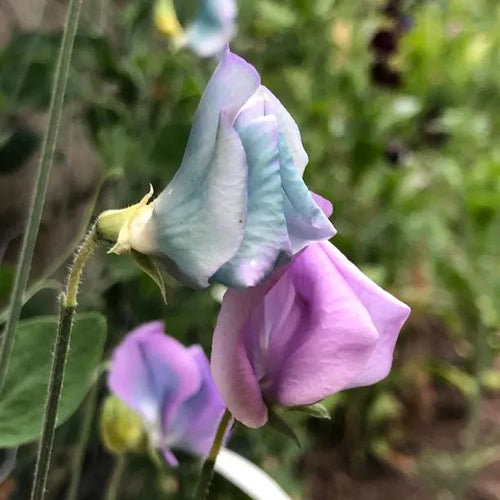

True blue is the colour that sweet pea breeders have chased for over a century. Lavender, violet, mid-blue, powder-blue – all exist. Actual blue does not. Turquoise Lagoon comes closer than anything else in cultivation. The young flowers open a startling turquoise-teal – a colour so unexpected in a sweet pea that people seeing it for the first time assume they are looking at a different plant altogether. They are not. The colour is real, and it is a sweet pea!
But Turquoise Lagoon is no ordinary sweet pea. It is a Lathyrus × hammettii hybrid – a cross between the familiar annual L. odoratus and a wild Bolivian species, L. belinensis, made by Dr Keith Hammett in New Zealand, who is probably the greatest living sweet pea breeder. The result is a shorter plant (1.2–1.5m rather than the 2m of a typical Spencer), with smaller, open-faced flowers that look more like butterflies than the frilly balls of the Spencer class. What it lacks in size it makes up for in colour. Nothing else in the garden looks quite like this.
The turquoise is strongest in the first day or two after opening. As each bloom ages, the teal shifts through blue into violet-blue, and eventually into a muted lavender before the petals drop. A plant in full flower carries all of these stages at once – turquoise at the top, blue in the middle, violet at the base – giving the whole plant a shifting, iridescent quality. In strong sunlight the turquoise is vivid. In shade or on a cloudy day, the blue deepens. Either way, it stops people in their tracks.
Scent is one area where the experts disagree. Roger Parsons rates it 3 out of 5. English Sweet Peas rates it 5 out of 5. The truth is probably somewhere in between, and likely depends on the individual plant and the growing conditions. What we can say from experience is that the scent is present, sweet, and pleasant – stronger on warm days and in sheltered spots, fainter in cooler weather. Grow it against a south-facing wall and you will get the best of both colour and fragrance.
Turquoise Lagoon is a hybrid, and hybrids do not come true from seed. If you save seed and sow it, the offspring will revert toward the parent species – you will get something, but not Turquoise Lagoon. For this colour, you need fresh plants each year. That is the trade-off for something this unusual.
Turquoise alongside dark maroon is one of the great colour combinations – Windsor (deep maroon) or Henry Thomas (blue-purple) are both stunning partners. The contrast is bold but harmonious. For something softer, pair with Jilly (ivory-cream) – the cream cools the turquoise and lets it sing.
Because Turquoise Lagoon is shorter than a standard Spencer, it suits a sheltered spot near a wall or fence. A warm south-facing wall with a star jasmine (Trachelospermum) growing above makes a beautiful partner – the glossy evergreen foliage sets off the turquoise flowers and the jasmine adds its own fragrance in the evening. Full growing instructions in our sweet pea growing guide.
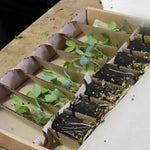
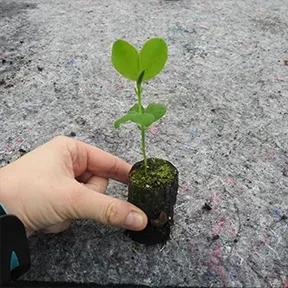
We have been growing sweet peas in Somerset since the early 2000s. The seed, which we collect ourselves, is hand-sown at two seeds per plug. After germination, the weaker seedling is removed. Every plant is then pinched out to encourage bushy growth and hardened off before dispatch. What you are buying are sturdy, garden-ready jumbo plug plants that have had the best possible start.
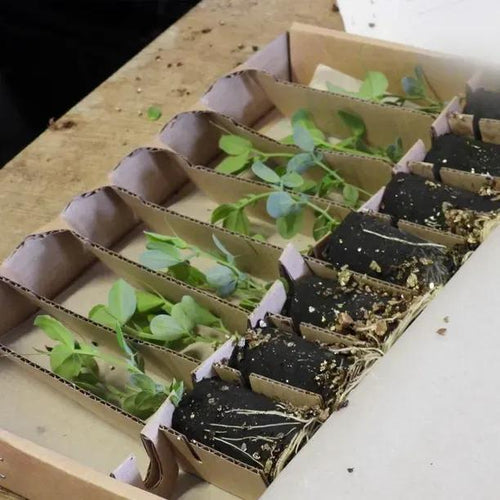
We send your sweet peas out by next-day courier between March and May, packed in purpose-designed recycled cardboard packaging. The moment they arrive, they are ready to go into the ground or a container. If anything is not right, we have real people on the phone in Somerset who will sort it out. We hold a Feefo Platinum Service Award and have been named a Which? Best Buy plant supplier — endorsements that came from our customers, not our marketing team.
A hybrid between the ordinary garden sweet pea (L. odoratus) and a wild Bolivian species (L. belinensis). The cross was made by Dr Keith Hammett in New Zealand to introduce new colours – blues and turquoises above all – that are not possible within L. odoratus alone. The trade-off: shorter plants and seed that will not come true.
The experts disagree on this one – ratings range from 3 to 5 out of 5 depending on the source. In practice, the scent is sweet and noticeable, especially on warm days in a sheltered spot. Some plants seem more strongly scented than others. Grow it against a warm wall for the best results.
You can collect seed, but it will not produce Turquoise Lagoon. As a hybrid, the offspring revert toward the parent species. You might get something interesting, but the turquoise colour will be lost. For this variety, fresh plants each year is the only reliable approach.
Yes – and the shorter height (1.2–1.5m) makes it better suited to containers than taller Spencers. Use a deep pot with at least 4 litres of compost per plant. A sheltered, sunny spot – a south-facing patio or balcony – brings out the best colour and scent. Keep well watered.
No – annual. One season of flowers, then done. Turquoise Lagoon is even more firmly annual than standard sweet peas because it cannot be reproduced from saved seed. See our sweet pea collection for the full range, including other unusual varieties like Erewhon, its hammettii sibling.


 Sign In
 Saved items