
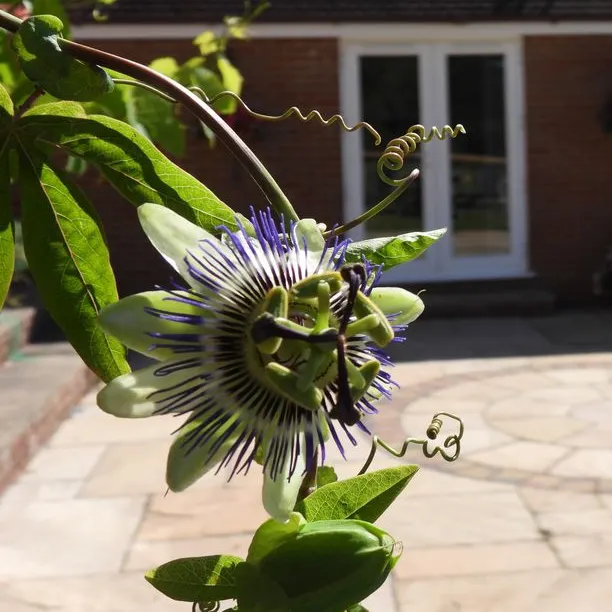
How do you grow passion flower in the UK?
Passion flower (Passiflora) is one of the most exotic-looking climbers you can grow in a British garden, yet it is far tougher than it appears. Given a sunny, sheltered spot and reasonable drainage, most garden-worthy varieties will establish quickly, flower freely from midsummer, and survive most UK winters with little more than a light mulch for protection.
Related guides
- Best climbing plants — which climber for walls, fences, scent, shade and screening
- Clematis pruning groups explained — Groups 1, 2 and 3 with variety lists
- Clematis wilt — what it is, how to prevent it, and which varieties resist it
- Do climbing plants damage walls and fences?
- Evergreen climbing plants — year-round cover for walls, fences and screens
Which passion flower varieties are hardy enough for the UK?
Hardiness varies significantly between species, and choosing the right variety is the single most important decision you will make. The good news is that several are reliably hardy across most of England and Wales, and even in Scotland with some shelter.
The species most commonly grown outdoors in Britain belong to two main groups: Passiflora caerulea and its cultivars (hardy to around −10 °C to −15 °C in a sheltered spot), and the more tender Passiflora incarnata types (hardy to roughly −15 °C but dying back to the root each winter). Tropical species sold as houseplants — such as P. quadrangularis or P. edulis — will not survive outdoors in the UK except in the very mildest corners of Cornwall or the Scilly Isles.
| Variety | Flower colour | Approximate hardiness | Fruit in UK? | Evergreen? |
|---|---|---|---|---|
| P. caerulea (Blue Passion Flower) | White petals, blue-purple corona | −10 °C to −15 °C (sheltered) | Yes — orange, edible but bland | Semi-evergreen in mild areas |
| P. caerulea ‘Constance Elliott’ | Pure white throughout | −10 °C to −12 °C | Yes — orange fruits | Semi-evergreen in mild areas |
| P. caerulea ‘Clear Sky’ | Pale blue-white, compact | −10 °C | Occasionally | Semi-evergreen |
| P. incarnata (Maypop) | Lavender-pink, fragrant | −15 °C (dies back to root) | Yes — yellow-green, edible | Deciduous |
| P. edulis (Passion Fruit) | White and purple | Frost-tender (2 °C minimum) | Glasshouse only in UK | Evergreen (under glass) |
For most UK gardens, Passiflora caerulea is the default choice, and it is the species you will find in our passion flower range. It has been grown in British gardens since the 17th century and is genuinely reliable across most of England and Wales.
Where should you plant passion flower?
Passion flower thrives in a sunny, sheltered position — a south- or west-facing wall or fence is ideal. The reflected warmth from masonry encourages flowering, ripens stems to help them withstand frost, and protects the crown from icy winds.
While passion flower will tolerate partial shade, flowering becomes noticeably sparser when sunlight drops below about four to five hours a day. North-facing aspects are unsuitable for outdoor planting. East-facing walls can work in milder counties but may suffer from late spring frosts on emerging shoots.
Soil drainage matters more than soil richness. Passion flower is surprisingly tolerant of poor, lean soils and actually flowers better when it is not over-fed with nitrogen. Heavy, waterlogged clay is the main enemy: the roots will rot in wet winters, which is often the true cause of plants that appear to have been killed by cold.
If your soil is heavy, either improve it before planting by incorporating grit and organic matter, or choose a raised bed or large container. In a pot, passion flower is extremely effective on a sheltered patio and can be moved under glass for winter in colder regions.
How do you plant passion flower?
Plant in late spring once the risk of hard frost has passed, or in early autumn to allow roots to settle before winter. Container-grown plants from the nursery can technically be planted at any point in the growing season, but these two windows give the best establishment.
- Prepare the site. Dig a hole at least twice the width of the root ball and about 40 cm deep. Loosen the base and sides.
- Improve drainage if needed. Mix in a layer of horticultural grit at the base and incorporate some into the surrounding soil.
- Plant at the same depth as in the pot. Unlike clematis, passion flower does not benefit from being planted deeply.
- Position away from the wall base. Plant at least 30–40 cm out from the wall, where rain can reach the roots. Lean the plant towards its support with a cane.
- Water in thoroughly and apply a 5–7 cm mulch of garden compost or bark chips around the root zone, keeping it clear of the stems.
- Fix your support. Passion flower climbs by tendrils and needs horizontal wires, trellis, or a wire mesh framework. Space wires about 30 cm apart.
| Planting factor | Recommendation |
|---|---|
| Aspect | South- or west-facing, sheltered |
| Soil type | Well-drained; fertile to moderately poor; slightly alkaline to neutral (pH 6–7.5) |
| Planting depth | Same as nursery pot — do not plant deep |
| Distance from wall | 30–40 cm minimum |
| Support type | Trellis, wire mesh, or horizontal wires at 30 cm intervals |
| Best planting time | Late spring (May–June) or early autumn (September) |
How do you care for passion flower through the growing season?
Once established, passion flower is a relatively low-maintenance plant. The key tasks are watering in the first year, appropriate feeding, and guiding new stems onto their support.
Watering: Water newly planted specimens thoroughly and regularly throughout their first summer, particularly during dry spells. Once established (from year two onwards), passion flower is reasonably drought-tolerant against a wall, but will flower better and more reliably if it does not go short of water during the long dry periods that parts of the UK now regularly experience in summer.
Feeding: This is where many gardeners go wrong. Passion flower fed heavily with a high-nitrogen fertiliser produces abundant leafy growth at the expense of flowers. Instead, apply a low-nitrogen, high-potassium feed (such as a tomato fertiliser) from late spring through to late August, following the pack instructions. This encourages flower bud formation and hardens stems for winter.
Training: Guide new stems horizontally along wires where possible. Horizontally trained stems produce more lateral flowering shoots than those left to grow straight upwards. Use soft garden twine or plant clips to tie in stems loosely — the tendrils will then grip the support on their own.
Mulching: Apply a fresh mulch in late autumn each year. This insulates the root zone through winter and is especially valuable in colder parts of the country.
How and when do you prune passion flower?
Prune passion flower in spring, once you can see which stems have survived the winter — typically late March to April. Cutting back too early risks removing stems that may yet break into growth.
Passion flower flowers on the current season’s growth, so pruning in spring does not sacrifice this year’s display. The approach depends on the situation:
- Established plants in a good position: Simply remove any stems killed by winter, cut back any shoots that are congested or growing in the wrong direction, and shorten sideshoots to two or three buds from their base. This keeps the framework open and productive.
- Overgrown or neglected plants: Passion flower responds well to hard renovation. Cut the whole plant back to about 30 cm from ground level in spring. It will regrow vigorously and flower in the same season, though perhaps a little later than usual.
- Plants that have been cut to the ground by frost: Do not panic and do not dig it up. Cut away all the dead top growth and wait. New shoots will frequently emerge from the roots, sometimes not until May or even June. Mark the position so you do not accidentally disturb it.
Light tidying during summer — removing shoots that have wandered where they are not wanted — is perfectly fine at any time.
Does passion flower fruit in the UK?
Yes, Passiflora caerulea does produce fruit in the UK, though reliably only in warmer summers and in southern and central England. The fruit are oval, orange-yellow when ripe, about the size of a hen’s egg, and develop through late summer into autumn.
They are edible, but do not expect the intense flavour of a shop-bought passion fruit. The flesh is small in quantity and the flavour is mild, slightly sweet but largely unremarkable. The seeds are edible too. The real ornamental value is the colour — orange ripe fruits against dark green foliage are genuinely striking.
Fruiting depends on pollination by insects, warm summer temperatures to encourage fruit set, and a long enough growing season for the fruit to ripen. In cooler or wetter summers, flowers may not set fruit at all, or unripe fruit will be frosted before they colour up. There is no reliable way to improve fruiting outdoors other than choosing the warmest, sunniest spot you have available.
Passiflora incarnata (Maypop) produces better-flavoured fruit — genuinely edible and pleasant — but needs a very warm summer to ripen it in the UK. It is an interesting experiment in a favoured spot, but not a reliable cropping plant in most of Britain.
Passiflora edulis, the species sold as passion fruit for consumption, must be grown under glass in the UK. It is frost-tender and will not survive outdoors, but it can be very productive in a heated greenhouse or conservatory given good light and warmth.
How do you protect passion flower over winter?
Winter care is the question we are asked most frequently about passion flower, and for good reason: this is the one area where getting things right makes the difference between a plant that thrives for decades and one that has to be replaced each spring.
The honest answer is that established, well-drained Passiflora caerulea growing against a sheltered wall needs very little protection in most of England and Wales. The main risks are waterlogged soil and cold, wet roots — not cold air alone.
Here is what to do by region:
| Region | Typical winter risk | Recommended action |
|---|---|---|
| South-west England, South Wales, coastal areas | Low — rarely below −5 °C | Mulch root zone in November; no other protection usually needed |
| Southern and central England, lowland Wales | Moderate — occasional −8 °C to −10 °C possible | Thick mulch (10 cm) over root zone; fleece in prolonged cold snaps |
| Northern England, Midlands, upland areas | Higher — can fall to −12 °C or below | Thick mulch; wrap stems in fleece or hessian; consider container growing to bring under glass |
| Scotland, exposed upland sites | High — sustained hard frosts likely | Container growing and overwintering under glass recommended; or try P. incarnata which dies back but re-shoots from hardy roots |
Key winter care tips:
- Never cut back dead-looking stems in autumn — leave them until spring; they provide some insulation and the plant may still be alive inside them.
- Apply a 10 cm mulch of garden compost, well-rotted manure, or bark chippings over the root zone in November, but keep it away from the main stem.
- If wrapping with fleece, use a breathable horticultural fleece rather than plastic, and remove it on mild days to prevent moisture build-up.
- Container-grown plants should be moved into a cool but frost-free greenhouse, porch, or garage — they do not need warmth, just frost protection.
- If the plant does die back to ground level, mark the position clearly and wait until early June before giving up — new growth can emerge remarkably late.
What are the main pests and problems with passion flower?
Passion flower is generally robust and pest-resistant outdoors. The most common problems are cultural rather than pest-related.
Poor or no flowering is the most common complaint. Causes include: insufficient sun, over-feeding with nitrogen, planting in the first year (young plants rarely flower well), or cold wet soil. Check all these before concluding the plant is the wrong variety.
Frost damage causes blackened, wilted stems in spring. Wait until late April before cutting back — as noted above, stems that look dead may still break into growth.
Woolly aphids and scale insects occasionally colonise stems and undersides of leaves. A jet of water, followed by a horticultural soap spray if needed, usually controls light infestations. Good air circulation around the plant reduces the risk.
Vine weevil can be a serious problem in container-grown plants, where the grubs eat the roots. Use a biological control (nematodes) in late summer or spring, or a container compost that incorporates vine weevil protection.
Verticillium wilt occasionally affects passion flower, causing sudden wilting and die-back of individual stems. Cut back affected growth to healthy tissue, disinfect your tools, and avoid replanting in the same spot. There is no chemical control available to gardeners.
Passion flower does not suffer from the same wilt problems as clematis — if you have had difficulties with clematis wilt, switching to passion flower for a sunny wall is a perfectly sensible strategy. For more on this, see our guide to clematis wilt.
Can you grow passion flower in a container?
Yes, and this is an excellent solution for gardeners in colder regions, those with heavy clay soil, or anyone who wants to bring the plant under cover for winter. Container culture also allows you to position the plant precisely on a patio or balcony where it will receive maximum sun.
Use a pot of at least 40 cm diameter — larger is better, as passion flower has an extensive root system and will become pot-bound quickly in a small container. A soil-based compost (such as John Innes No. 3) mixed with approximately 20% grit or perlite gives the drainage passion flower needs while retaining enough moisture through the growing season.
Water container plants more frequently than those in the ground, and feed with a high-potassium liquid feed every two weeks from May to August. Repot every two to three years into a slightly larger container, or root-prune and refresh the compost if you want to keep the plant in the same pot.
Provide a trellis or obelisk within the pot, or position the pot against a wall or fence with support. A large container with passion flower trained up a sunny fence is one of the most effective and flexible ways to grow this plant in the UK.
How effective is passion flower for covering a fence?
Very effective. Passiflora caerulea is a vigorous grower — typically reaching 3–5 metres in a good position within three to four years, and potentially 8–10 metres on a warm wall over many years. It covers horizontal wires quickly, produces dense foliage through the growing season, and is semi-evergreen in mild winters, giving partial cover year-round.
It is particularly well suited to covering panel fencing and trellis on sheltered south- or west-facing boundaries. For fence cover in shadier conditions, passion flower is not the right choice — see our guide to climbing plants for shade and north-facing walls for better alternatives.
For a comparison of all the best climbers for fences, our fence covering plants collection brings together all the options we stock, with notes on speed of coverage, soil requirements, and aspect.
| Climber | Best aspect | Speed of cover | Evergreen? | Flower interest |
|---|---|---|---|---|
| Passion flower | South, West | Fast | Semi (mild areas) | July–October, exotic |
| Clematis | All aspects (variety-dependent) | Moderate–Fast | Some varieties | Spring–autumn depending on variety |
| Honeysuckle | All aspects | Moderate–Fast | Some varieties | Summer, fragrant |
| Wisteria | South, West | Slow to establish then fast | No | Spring, spectacular |
| Star jasmine | South, West, sheltered East | Moderate | Yes | Summer, fragrant |
Frequently Asked Questions
Is passion flower hardy in the UK?
Passiflora caerulea is reliably hardy in most of England and Wales, tolerating temperatures down to around −10 °C to −15 °C in a sheltered spot with good drainage. Browse our passion flower range for UK-suitable varieties.
How fast does passion flower grow?
In a warm, sunny position Passiflora caerulea is a fast grower, typically adding 1–2 metres of new growth per season once established. Expect reasonable fence coverage within two to three years.
Will passion flower survive winter in pots?
Container-grown plants should be moved into a frost-free but cool space — an unheated greenhouse, garage, or porch — for winter. They do not need warmth, only protection from hard frosts below around −5 °C.
Why is my passion flower not flowering?
The most common causes are insufficient sun, over-feeding with nitrogen, or the plant being too young. Ensure it receives at least five hours of direct sun daily and feed with a high-potassium, low-nitrogen fertiliser from May onwards.
Can I grow passion fruit for eating in the UK?
Passiflora edulis (the edible passion fruit) requires a heated greenhouse to fruit in the UK. Outdoors, only P. caerulea and P. incarnata produce fruit, which is edible but mild-flavoured rather than the intense tropical taste of shop-bought fruit.
What support does passion flower need?
Passion flower climbs by tendrils and needs something to grip — horizontal wires spaced 30 cm apart, trellis, or wire mesh all work well. The tendrils will attach naturally once guided into position with a cane or twine.
When should I prune passion flower?
Prune in late March or April, once you can see which stems survived winter. Remove dead growth, shorten sideshoots to two or three buds, and thin congested stems. Passion flower flowers on new growth, so spring pruning will not reduce this year’s display.
My passion flower looks completely dead after winter — should I remove it?
Wait until at least late May, ideally early June, before giving up. New shoots frequently emerge from the rootstock long after the tops appear dead. Cut back the dead stems but leave the roots undisturbed and wait patiently.
Does passion flower attract wildlife?
Yes — passion flower flowers are excellent for bees and other pollinators. The fruit attracts birds in autumn. The foliage is the sole food plant of the caterpillars of the rare large blue butterfly where it occurs, though this is mainly a consideration in continental Europe.
Can passion flower damage walls or fences?
Passion flower clings by tendrils rather than adhesive pads or aerial roots, so it does not damage masonry in the way that self-clinging climbers can. It will not penetrate pointing or force apart brickwork. See our full guide to climbing plants and wall damage for more detail.
How much space does passion flower need?
Allow at least 1.5–2 metres of horizontal spread for a mature plant, and up to 3–5 metres of height against a wall. In containers, root growth can be controlled, but the top growth will still be vigorous and will need regular tying in and pruning.
What other climbers grow well alongside passion flower?
Clematis makes an excellent companion — their seasons and habits complement each other well on a sunny wall. See our clematis range or our advice on choosing the best climbing plants for more ideas.
Related Products
- Passion Flower — shop all varieties
- Shop All Climbing Plants
- Best Plants for Covering Fences
- Clematis
- Honeysuckle
- Jasmine
- Star Jasmine
- Wisteria
Related Articles
- Best climbing plants — which climber for walls, fences, scent, shade and screening
- Fast growing climbing plants — the quickest climbers for cover and screening
- Evergreen climbing plants — year-round cover for walls, fences and screens
- Best climbing plants for shade and north-facing walls
- Do climbing plants damage walls and fences?
- How to grow wisteria — species, pruning, training and getting it to flower
- How to grow honeysuckle — planting, training, pruning and scent
- How to grow jasmine — common jasmine, star jasmine and winter jasmine compared
- How to grow clematis — planting, feeding, watering and first-year care
- Clematis wilt — what it is, how to prevent it, and which varieties resist it

Leave a Reply