


Out of Stock
Sold as:

from £6.99

Sold as:
from £19.99
 5 Star Service Rating




 Secure, One-Tap Checkout
 5 Star Feefo Rating
 Hand Picked, Delivered to Your Door!
 1 Year Bareroot Guarantee
 Platinum Trusted Service Award 2026
 Mail Order Plant Experts - Est. 1949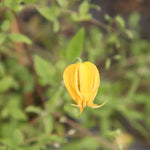
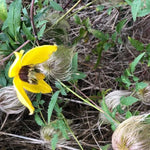
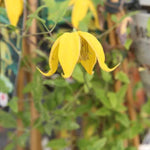
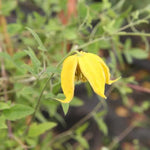
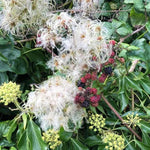





Bill MacKenzie produces hundreds of small, bright yellow, nodding bell flowers from July to October. The petals are thick and waxy, often compared to orange peel, and they glow against the finely cut foliage. But the flowers are only half the story. As the first blooms fade, the seedheads begin to form: silver-silk spheres that catch the light and last right through winter. By late autumn the plant carries flowers and seedheads simultaneously, yellow bells among silver globes, and the effect in low winter sun is something you do not forget. We used to have one growing into a large Thuja plicata, and when it was in flower the whole tree looked as if someone had decorated it with hundreds of little orange Christmas tree decorations. Striking. But nothing compared to the sight when the seedheads appeared.
This is a big, vigorous plant. Given something to climb it will reach 8m and spread to 4m or more. A house wall, a large fence, a dead tree, or a substantial pergola are all suitable. It is fully hardy, tolerant of poor soil, wind, and cold, and it flowers on new wood, so you can keep it under control by cutting it back hard February and letting it rebuild. The RHS gave it an Award of Garden Merit in 1993. The only clematis in our range with yellow flowers.
This clematis was bred by the plantswoman Valerie Finnis at Waterperry in 1968 and named after her friend and mentor William MacKenzie, who was curator of the Chelsea Physic Garden for nearly thirty years. Popularity created a problem: demand so outstripped supply in the early years that some growers sold seedlings under the name, and not all of them were the real article. We can be fairly confident that the Bill MacKenzie we sell is genuine. My father bought one from Waterperry itself in the 1970s. Our stock plant was taken as a cutting from his.
Bill MacKenzie flowers from July and the seedheads last until February, so the gap is spring. A Clematis armandii Apple Blossom on the same wall provides scented pink flowers in March and April while the tangutica is still just emerging from its February prune. For a summer companion at ground level, lavender (Grosso or Vera) picks up the yellow theme with silver foliage and purple flowers. A rambling rose (Albertine or Rambling Rector) growing alongside gives you pink or white flowers in June before the clematis takes over for the rest of the year. If you want another clematis on an adjacent wall, Polish Spirit provides deep violet-purple from July, a sharp colour contrast to the yellow bells.
Our Bill MacKenzie stockplants descend from a plant bought at Waterperry, where the variety was bred. Not many nurseries can trace theirs that far back. We propagate from cuttings in peat-free compost using biological controls throughout. Tangutica clematis root readily and grow strongly, so we lose very few in production. Every plant is guaranteed. Feefo Platinum Partner, Which? Gardening Best Buy. See the full clematis range.
In February, as hard as you like. Bill MacKenzie flowers on the current year's growth, so last year's stems serve little purpose. If you want to keep the seedheads for as long as possible, delay the prune until late February, but do not leave it later than early March or the new growth starts late and you lose flowering time.
Plant 8–10cm below pot level. Deep planting encourages basal shoots and protects the plant if the top growth is ever damaged. For the full planting method see our clematis planting depth guide.
The two names are often used interchangeably, but they are different plants. Bill MacKenzie is a named cultivar, bred by Valerie Finnis in 1968 from a cross of C. orientalis and C. tangutica. Orange Peel is a general term applied to several tangutica-type clematis with thick, yellow, peel-like petals. Some plants sold as "Orange Peel" are open-pollinated seedlings and are not the true Bill MacKenzie.
Up to 8m in height with a 4m spread. It is one of the most vigorous clematis you can grow and it achieves about half of that height in a single season from the February cut. It needs a strong support: a solid wall, a large pergola, or an established tree.
It will grow, but flowering is reduced in deep shade and the seedheads are less impressive. A south- or west-facing wall with warmth and light produces the best display. For a clematis that thrives in shade, consider The President or Polish Spirit. See our shade-tolerant climbers guide.
The seedheads last well in a vase and dry beautifully for winter arrangements. Cut them on a dry day when the silk has fully expanded. They hold their shape for months without any treatment. The flowers are less useful as cut stems; they drop quickly once picked.


 Sign In
 Saved items