
What Are the Best Ground Cover Perennials for UK Gardens?
Ground cover perennials are low-growing, spreading plants that return year after year, suppressing weeds, stabilising soil, and filling gaps between shrubs or under trees. Unlike annual bedding, they establish once and require minimal intervention, making them one of the most cost-effective and low-maintenance choices a gardener can make. The best varieties combine attractive foliage or flowers with genuine spreading vigour — smothering bare soil before weeds can colonise it.
Related guides
- Best Hardy Perennials for UK Gardens
- How to Grow Perennials — Complete UK Guide
- Low Maintenance Perennials for Borders
- Best Perennials for Shade
Why Should You Use Ground Cover Perennials Instead of Mulch or Bedding?
Ground cover perennials do everything a mulch does — retain moisture, moderate soil temperature, and suppress weeds — but they also look beautiful and feed pollinators into the bargain. Mulch needs replacing every one to three years and contributes nothing visually; annual bedding plants must be replanted each season at considerable cost. A well-chosen perennial ground cover, by contrast, typically pays for itself within two or three seasons and improves with age as the plant spreads and fills in.
There are additional practical advantages: the root systems of perennial ground covers actively bind soil on slopes, preventing erosion that bare mulch cannot address. Dense foliage creates a humid microclimate at ground level, which benefits earthworms and soil biology. For wildlife gardens, low-growing perennials provide overwintering habitat for beetles, spiders, and other beneficial invertebrates.
The key is matching the plant to the conditions. A perennial that thrives in dry shade will fail in boggy sun, and vice versa. The sections below address the main situations you are likely to encounter in a UK garden.
Which Ground Cover Perennials Work Best in Shade?
Shade is the condition most gardeners struggle with, yet it is also where some of the finest ground cover perennials shine. The three most reliable genera for shaded UK gardens are hostas, heucheras, and geraniums (the hardy cranesbill type, not pelargoniums).
Hostas
Hostas are unmatched for foliage impact in shade. Their large, architectural leaves — ranging from tiny mounds of five centimetres to bold clumps exceeding a metre across — create a seamless carpet that little will push through. They tolerate deep shade under trees and cope with root competition better than most competitors. Slugs are the primary challenge; choose thick-leaved, blue-glaucous varieties for the best resistance, and apply organic slug controls in spring when shoots first emerge. Browse our full hosta plant collection to find the right size and colour for your space.
Heucheras
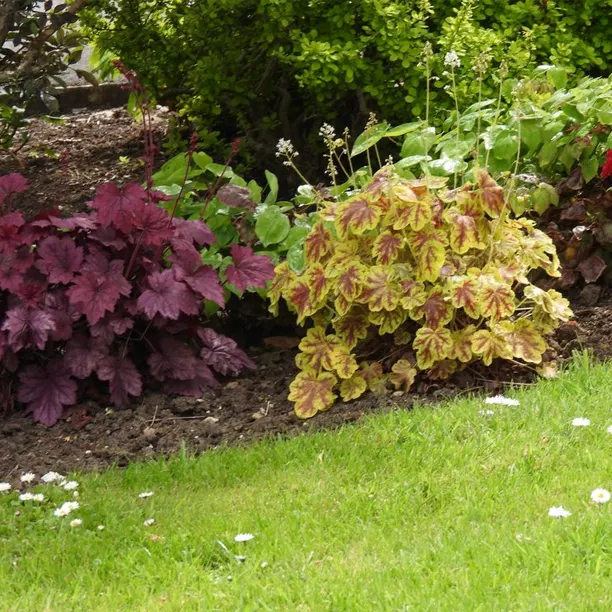
Heucheras (coral bells) offer year-round evergreen foliage in colours ranging from near-black through burgundy, caramel, and lime green. They are tolerant of partial shade and perform well on the north side of a building or under a light tree canopy. Unlike hostas, heucheras are largely slug-resistant and hold their colour throughout winter, giving the border structure when everything else has died back. They produce airy wands of tiny flowers in summer — a bonus for early pollinators. Our full heuchera range includes both warm-toned and cool-toned varieties to suit different planting schemes.
| Variety | Foliage Colour | Light | Spread | Link |
|---|---|---|---|---|
| Black Beauty | Deep purple-black | Partial shade to sun | 40 cm | View |
| Cherry Cola | Bronze-red with silver overlay | Partial shade to sun | 45 cm | View |
| Cherry Truffles | Deep cherry-red | Partial shade | 40 cm | View |
| Crème Brûlée | Warm caramel-amber | Sun to partial shade | 40 cm | View |
| Forever Purple | Rich violet-purple | Sun to partial shade | 45 cm | View |
| Lime Marmalade | Bright chartreuse-lime | Partial shade (bleaches in full sun) | 40 cm | View |
| Marmalade | Amber-orange with ruffled edges | Sun to partial shade | 40 cm | View |
Which Ground Cover Perennials Thrive in Full Sun?
Full sun suits a wide range of ground cover perennials, and these are often the showiest flowerers of the group. Agapanthus, salvia, and verbena are among the best choices for sunny, well-drained spots, while ornamental grasses add texture and movement.
Agapanthus
Agapanthus (African lily) forms dense clumps of strap-like evergreen or deciduous foliage that suppresses weeds effectively once established. In summer, it throws up tall stems — typically 60–100 cm — topped with globe-shaped clusters of deep blue, pale blue, or white flowers. It performs best in full sun and sharply drained soil, making it ideal for gravel gardens, raised beds, or south-facing borders. Agapanthus is moderately frost-hardy; evergreen varieties benefit from a dry mulch over winter in colder parts of the UK. Browse our full agapanthus collection for the complete range.
| Variety | Flower Colour | Height | Evergreen? | Link |
|---|---|---|---|---|
| Lapis Lazuli | Mid-blue | 60 cm | Deciduous | View |
| Black Jack | Deep violet-blue | 70 cm | Deciduous | View |
| Brilliant Blue | Vivid blue | 75 cm | Deciduous | View |
| Ever Sapphire | Rich blue | 60 cm | Evergreen | View |
| Ever White | Pure white | 55 cm | Evergreen | View |
| Fireworks | Bicolour blue and white | 80 cm | Deciduous | View |
| Poppin’ Purple | Violet-purple | 65 cm | Deciduous | View |
| Mixed Agapanthus | Blue, white, violet mixed | 60–80 cm | Mixed | View |
Salvia and Verbena
Ornamental salvias are exceptional low-maintenance ground covers for sunny borders. Many varieties are herbaceous perennials in UK conditions — they die back in winter and regrow reliably from the base each spring, providing dense weed-suppressing foliage from late spring onwards. Their long flowering season, often from June through to October, makes them invaluable for pollinators. Explore our salvia range for varieties suited to different heights and colours.
Verbenas are similarly sun-loving and long-flowering, with a naturally spreading habit that knits together nicely as ground cover in gravel or cottage-style plantings. Unlike the annual types sold as summer bedding, perennial verbena is a tough, self-seeding plant that naturalises readily. See our verbena collection for current availability.
Can Ornamental Grasses Be Used as Ground Cover?
Yes — ornamental grasses make excellent ground cover, particularly in dry or exposed sites where many perennials struggle. Their fibrous root systems bind soil and their dense tufted foliage is impenetrable to most annual weeds once established. Unlike broadleaved perennials, grasses also retain winter interest, their seed heads and bleached foliage catching frost and low winter light beautifully.
The best ground-covering grasses for UK gardens include low-growing varieties of festuca, carex, and liriope (not a true grass, but a grass-like perennial). These spread slowly but steadily, filling gaps without becoming invasive. For large areas, taller miscanthus and pennisetum varieties can be planted at wider spacings to create a naturalistic meadow effect. Browse our full ornamental grasses range to find the right scale and form for your garden.
How Many Ground Cover Plants Do I Need Per Square Metre?
Planting density depends on how quickly you want full coverage and how large each plant grows at maturity. As a general rule, faster coverage requires more plants but increases upfront cost; planting more sparsely saves money but requires more vigilance against weeds for the first two seasons.
| Plant Type | Mature Spread | Plants per m² (fast cover) | Plants per m² (economy) | Years to full cover |
|---|---|---|---|---|
| Heuchera | 40–50 cm | 5–6 | 3–4 | 1–2 |
| Hosta (medium) | 50–75 cm | 3–4 | 2 | 2–3 |
| Agapanthus | 40–60 cm | 4–5 | 2–3 | 2–3 |
| Salvia (perennial) | 45–60 cm | 4 | 2–3 | 1–2 |
| Ornamental grass (low) | 30–40 cm | 6–9 | 4 | 2 |
Whichever density you choose, it pays to mulch between plants in year one with a 5–7 cm layer of bark chips or well-rotted compost. This suppresses weeds while the plants establish, and breaks down to enrich the soil over time. Remove any perennial weeds — bindweed, couch grass, ground elder — thoroughly before planting, as no ground cover will reliably outcompete these once they are established in the root zone.
Which Ground Cover Perennials Are Best for Slopes and Banks?
Slopes present two challenges: erosion during heavy rain, and the difficulty of maintaining traditional planting. Ground cover perennials with strong, fibrous root systems are the ideal solution — they bind the soil, slow water runoff, and once established need virtually no intervention. Ornamental grasses are particularly effective here, as are vigorous spreading perennials.
For sunny banks, agapanthus planted in bold drifts are both practical and spectacular. Their fleshy rhizomatous roots grip sloping soil effectively, and their dense leaf rosettes prevent rain splash erosion. On lightly shaded banks, hostas perform admirably, though they will need protection from slugs in their first season. Ornamental grasses — particularly taller varieties — are useful on exposed, windy banks where more tender perennials would struggle.
Avoid plants that spread exclusively by stolons (above-ground runners) on steep banks, as these are less effective at binding soil than clump-forming or rhizomatous species. Root depth matters more than surface spread on a slope.
What Are the Best Ground Cover Perennials for Dry Soil?
Dry soil, particularly under trees or in free-draining sandy or chalky ground, suits a narrower range of plants but there are reliable performers for every situation. The key is choosing species that evolved in naturally dry or drought-prone habitats.
Agapanthus thrives in dry, well-drained soil and actually flowers more freely when slightly stressed by dry conditions in late spring — this encourages the plant to invest in reproduction. Perennial salvias are equally drought-tolerant once established; their aromatic foliage is a sign of Mediterranean adaptation to dry summers. Ornamental grasses, especially festuca, are classics for dry, sunny spots — their silvery-blue or golden foliage looks at its best against gravel or pale stone paving.
For dry shade (one of the hardiest conditions), heucheras are among the most dependable choices. Their waxy leaves reduce water loss, and they survive on surprisingly little moisture once past the establishment phase of their first growing season.
How Should You Plant Ground Cover Perennials for Best Results?
Successful establishment depends almost entirely on thorough ground preparation and timing. Getting these two things right dramatically reduces the time before your ground cover closes and weed problems disappear.
Soil preparation: Dig the area over to at least a spade’s depth, removing all perennial weed roots. Incorporate organic matter — garden compost or well-rotted manure — to improve moisture retention and biological activity. On very sandy or chalky soils, a generous addition of compost is particularly important.
Timing: Autumn and spring are the ideal planting windows for most ground cover perennials in the UK. Autumn planting allows roots to establish during the cooler, wetter months before the plant faces its first summer. Spring planting works well if you can water adequately through the first summer. Avoid planting in frozen ground or during prolonged summer drought. For detailed timing guidance, see our article on when to plant herbaceous perennials.
Spacing: Use the density guide in the table above. Plant at the depth the plant was growing in its container — heucheras in particular are prone to rot if buried too deep, and hostas will establish more quickly if the crown sits just at soil level.
Aftercare: Water in well at planting and consistently for the first six weeks. Apply a mulch around (not over) the crowns. A balanced general-purpose fertiliser applied in spring of years two and three will encourage rapid spread and establishment.
How Do You Maintain and Divide Ground Cover Perennials?
One of the great advantages of perennial ground cover is that division gives you free plants — so your initial investment can be multiplied across the garden at no extra cost. Most clump-forming ground cover perennials benefit from division every three to five years, which both rejuvenates the plant and generates new divisions for extending coverage.
Signs that division is needed include a dead or woody centre to the clump, reduced flowering, or noticeably smaller new leaves than in previous years. Division is best carried out in early spring as new growth is just beginning, or in early autumn after flowering has finished. For a full step-by-step guide to the process, see our article on how to divide herbaceous perennial plants.
Beyond division, maintenance is minimal. Remove dead foliage in late winter before new growth begins — this is particularly important for ornamental grasses, which should be cut back hard in February or March. Heucheras benefit from having their woody crowns gently lifted and replanted slightly deeper every few years, as they tend to surface over time. Agapanthus needs deadheading after flowering if you want to prevent self-seeding, though in most UK conditions self-seeding is minimal anyway.
How Do You Mix Ground Cover Perennials for Year-Round Interest?
The most effective planting schemes layer perennials with different seasonal peaks, so that as one plant fades another comes into its prime. Ground cover perennials are no different — the goal is to have something interesting at every point from February through to November.
| Season | Key Plants | What to Enjoy |
|---|---|---|
| Winter / Early Spring | Heuchera, ornamental grasses | Evergreen foliage colour; frosted grass seed heads |
| Late Spring | Hosta, heuchera (flowers) | Emerging hosta leaves; first heuchera flower spikes |
| Summer | Agapanthus, salvia, verbena | Bold flower globes; long-season colour for pollinators |
| Autumn | Ornamental grasses, late salvia | Warm tones; continued late flowering |
For a ready-made combination planting, our mixed perennial collections are designed with seasonal succession in mind. They take the guesswork out of combining species and ensure a cohesive colour palette through the season.
In shade borders, a classic trio is a large-leaved blue hosta for summer structure, a dark-foliaged heuchera for year-round colour, and a low ornamental grass such as carex for textural contrast. In sunny, well-drained borders, combine agapanthus with salvias at the front and ornamental grasses as a backdrop — the blues and purples of all three genera complement each other naturally.
For further help understanding how perennials fit into your garden, see our guide on what perennial plants are and how they differ from bedding plants.
Frequently Asked Questions
What is the fastest-spreading ground cover perennial?
Perennial salvias and verbenas establish quickly, often achieving good coverage within their first full growing season. For shade, hardy geraniums are among the most vigorous spreaders in UK conditions. See our salvia range.
Are ground cover perennials invasive?
Most well-chosen garden perennials spread steadily but remain manageable. Avoid species listed as invasive in the UK — always check before planting near watercourses or natural habitats. The varieties on this page are all well-behaved garden plants.
Do ground cover perennials completely stop weeds?
Once established and dense, they suppress the vast majority of annual weeds by blocking light from reaching the soil. However, they will not reliably control established perennial weeds such as bindweed or ground elder — remove those before planting.
Can I use heucheras as ground cover under trees?
Yes. Heucheras are among the best choices for dry shade under tree canopies. Their waxy foliage handles drought and low light well. See our heuchera collection for suitable varieties.
Will agapanthus spread to form a ground cover?
Agapanthus forms slowly expanding clumps rather than running spreaders. Plant at 30–40 cm centres for ground-covering effect; they will close within two to three seasons. See the agapanthus range.
Which ground cover perennial is best for heavy clay soil?
Hostas and hardy geraniums tolerate heavy clay better than most. Improve drainage by incorporating grit and organic matter before planting, and avoid agapanthus, which dislikes waterlogged conditions. Browse our hosta collection.
How do I stop slugs eating ground cover perennials?
Hostas are the most vulnerable. Choose thicker-leaved, blue-glaucous varieties for best resistance. Apply organic slug pellets or wool pellets around emerging shoots in spring. Heucheras are largely slug-resistant and a safer choice in badly affected gardens.
Do I need to feed ground cover perennials?
A top-dressing of general-purpose slow-release fertiliser in spring for the first two or three years encourages strong establishment and spread. Once mature, most ground cover perennials need little or no additional feeding if grown in reasonable soil.
Can ground cover perennials be grown in containers?
Agapanthus and heucheras both perform well in pots and can be used to cover the surface of large containers, suppressing compost from drying too quickly. Use a loam-based compost with added grit for drainage. See our Ever Sapphire agapanthus — a compact, evergreen variety ideal for pots.
When is the best time to plant ground cover perennials?
Autumn (September to November) and spring (March to May) are both excellent. Autumn is preferred because cool, moist conditions promote root establishment before summer. For detailed advice, see our guide on when to plant herbaceous perennials.
Which ground cover perennials are best for pollinators?
Salvias, agapanthus, verbenas, and heucheras all attract bees and other pollinators. Perennial salvia in particular provides one of the longest nectar seasons of any garden plant — often from June through to October. See our salvia range.
How do I get more plants from my ground cover perennials?
Most clump-forming perennials can be lifted and divided in early spring or autumn. Each division can be replanted to extend coverage for free. See our full guide on how to divide herbaceous perennial plants.
Related Products
- Shop All Perennial Plants
- Heucheras (Coral Bells)
- Hostas
- Agapanthus (African Lily)
- Ornamental Grasses
- Salvia (Ornamental Sage)
- Verbena
- Mixed Perennial Collections
- Heuchera ‘Lime Marmalade’
- Heuchera ‘Black Beauty’
- Heuchera ‘Forever Purple’
- Agapanthus ‘Ever Sapphire’
- Agapanthus ‘Brilliant Blue’
- Agapanthus ‘Fireworks’
- Mixed Agapanthus (Three Varieties)
Leave a Reply