Order Potted Dogwood Plants Now For October Delivery
Pre-Order Bareroot Dogwood Plants For 2025/26 Winter Planting Season
What is Dogwood Hedging?
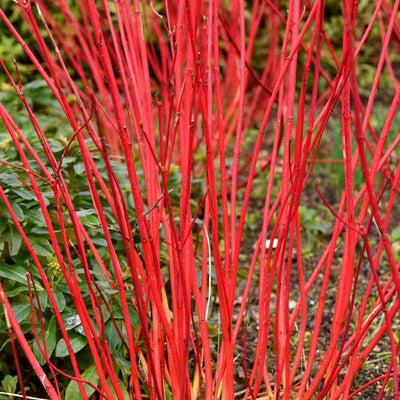
The dogwoods, Cornus species, are all suitable for hedging, especially the wild species, but the ornamental varieties are typically grown for their brightly coloured new bark that gleams like coral all winter.
They are vigorous, versatile shrubs that naturally thrive in wet soils, but are also drought tolerant and will grow on a dry embankment.
- Red and Common dogwood are the cheapest and best for practical, solid, mixed country hedging when grown with hawthorn, hazel, wild roses, and so on.
- The colourful ones below are intended for use as ornamental shrubs. They should be hard pruned every year when they are settled in:
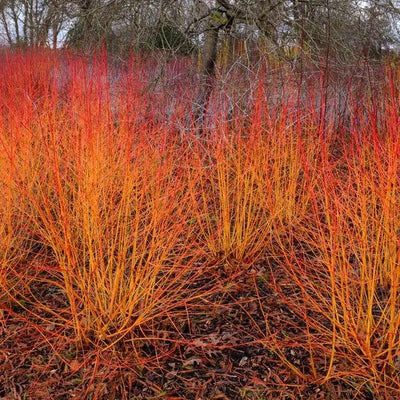
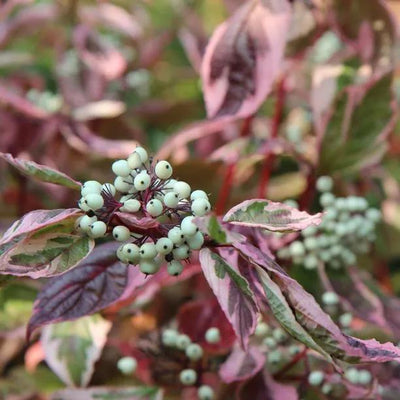
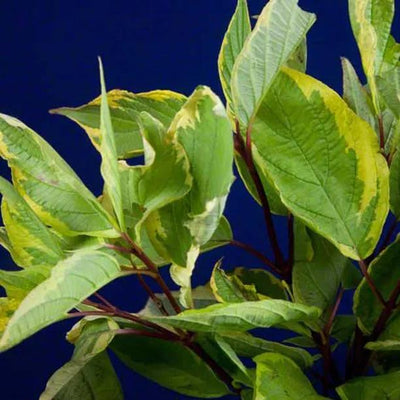
- Elegantissima, Gouchaultii, Midwinter Fire, Sibirica and Spaethii have bright red and/or orange bark.
- Kesselringii (dark purple) and Flaviramea (gold) provide extra variety/contrast.
Cornus Mas, Cornelian Cherry, doesn't have colourful bark, but is attractive as a small, bushy tree with red, edible fruit that can be pickled to improve the flavour. It can be grown as a hedge plant or shrub.
Browse our range of hedging plants, or our more ornamental garden shrubs.
Spacing: Dogwoods in a mixed country hedge go at 3 plants per metre single row or 5 in a double row.
The ornamentals can be spaced looser at 50-60cm apart for neon avenues in winter. They should settle in for about two years, only trim off whippy growth in winter, and then be coppiced close to the ground every year in Spring for the best brightly coloured new bark the following winter.
The planting and delivery season for bareroot Dogwood hedge plants is between November and April.
Your mail order Dogwood plants are delivered by next working day courier.
If there is anything wrong with your plants when they arrive, Contact Us within 5 working days, and our friendly support team will sort it out.
All bareroot plants are covered by our Refund Guarantee, so you can give them a whirl with complete confidence.
Dogwoods, members of the Cornus family, are often the unsung heroes of the winter garden.
Only Cornus sanguinea is native, and it's a great country hedge plant.
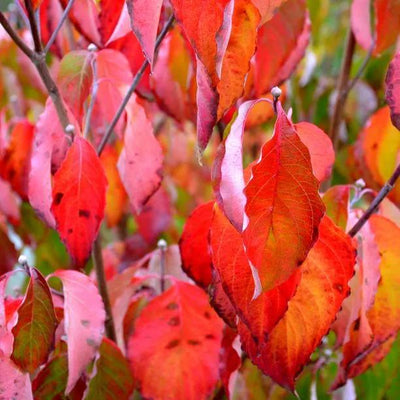
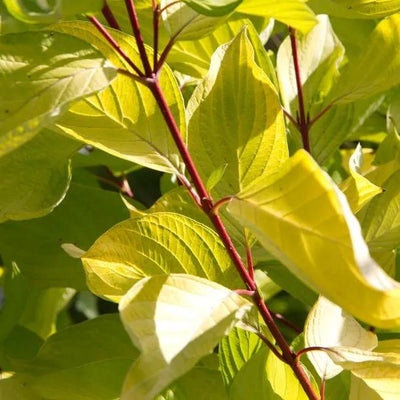
Although there are exceptions, like the variegated Elegantissima, in Summer dogwood foliage tends to be unremarkable.
Their glory is their bark, which is on show from Autumn, after the leaves have fallen.
In Winter, shrubby dogwoods dress themselves in shades of gold, bright green, dark purple, scarlet and orange. In a large garden, a border can be devoted to a mixed dogwood planting.
They look good when underplanted with early Spring flowering bulbs, and evergreen perennials such as Hostas.
Ornamental Cornus Varieties in Your Garden Design
These dogwoods are a joy to grow, planted for their brightly coloured young stems that look great in winter. You can plant them in a loose, natural looking clump, or as a decorative hedge.
- Their only demand is that they get most of the day in full sunshine during spring & summer.
- They will grow in any soil type, acid or alkaline.
- Their favourite soil is wet and waterlogged, but they will be fine in dry soil on a hill: you can't go wrong!
If you are planning on planting them in poorly fertile soil, we recommend improving it first with plenty of well rotted manure and/or compost. It is not essential that you do this, but it will ensure that you get a thick shower of bright young shoots each year.
The wild dogwoods, Cornus sanguinea & Cornus alba, are also fine for ornamental planting, but their reddish stems are less vivid, so if you do use them they should probably go at the back.
Spacing: For a decorative dogwood hedge, plant them 2ft / 60cm apart. For a nice wild looking clump, plant them 3ft / 90cm apart.
Where does Dogwood grow?
All shrubby dogwoods are best planted in soil with plenty of organic matter, as they prefer a little moisture at their feet.
Having said that, dogwoods will grow on poor dry soil with help in their first couple of years to establish.
Allow your plant room to grow, a healthy specimen will be just over a metre tall and will spread to as much across.
Position it, if you can, where it catches some afternoon sun and where you can see it from a window on a rainy afternoon.
Mixing Different Dogwood Colours
You can plant a single variety and it will look great. For an even more exciting and wild looking dogwood feature, mix up a few different cultivars to get a nice mix of reds, oranges, yellows, and darker colours for contrast
How to Hard Prune Dogwood
Hard pruning is necessary for a steady supply of brightly coloured young stems
All you have to do to keep your plants producing lots of new stems is to hard prune, or coppice, - them every year from the end of their second or third year, maybe their fourth if you think they struggled to establish.
- After planting, let them establish for at least two growing seasons.
- After that, hard prune them every year in late February or early March.
- Cut all the stems down to about 6 inches above ground level, just after where the plant begins to branch out at the base.
Unless your soil is very wet, mulch around your plants after pruning: this will trap moisture and keep down the weeds that will try to take advantage of the extra sunlight.
Dogwood only flowers on wood that is a year old, which is removed in a hard pruning regime.
To increase the wildlife value of the bushes by allowing them to flower, you could try:
- Cut your dogwoods back every other year.
- Cut half your dogwoods back each year
- Cut most of the stems on each bush each year, leaving some to flower and set seed.
Ornamental dogwoods are right at home added into a mixed country hedge, where they will give you a tickle of extra winter colour.
Hard Pruning Dogwoods for Displays of Winter Bark
Only the young bark on shrubby dogwoods colours well in winter, so a yearly hard pruning is necessary.
It is best to let newly planted Dogwood grow without interruption in its first year, just water them well.
You will get a good show of coloured bark in the first winter. The winter after that, you should cut them down to a stool about 30cm high, unless you need more height to see them over whatever is in front of them.
This means that ornamental dogwoods are great at the back of a herbaceous border. When the border dies down in late autumn, the dogwood takes over.



 Sign In
 Saved items



 5 Star Service Rating




 Secure, One-Tap Checkout
 5 Star Feefo Rating
 Hand Picked, Delivered to Your Door!
 Platinum Trusted Service Award 2026
 Mail Order Plant Experts - Est. 1949
 1 Year Bulb Guarantee